
Download Official Form AU11I (PDF)
Opens the official government PDF in a new tab
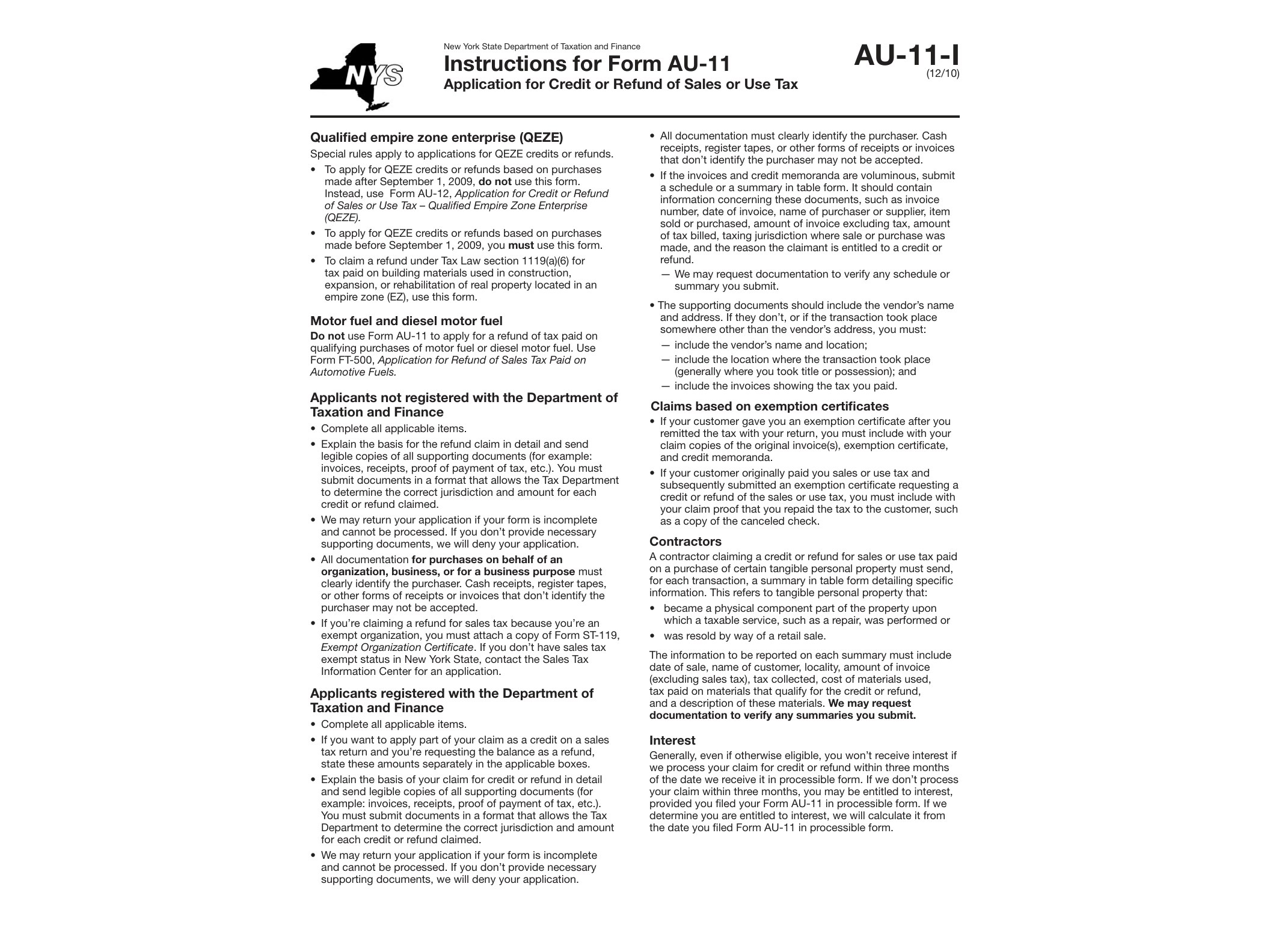
Form AU-11-I is the instructional companion to Form AU-11, Application for Credit or Refund of Sales or Use Tax, issued by the New York State Department of Taxation and Finance. If you’ve overpaid sales or use tax, paid tax on a transaction that later turned out to be exempt, or need to correct an error on a prior return, Form AU-11 is the document that starts that process — and AU-11-I is what tells you exactly how to fill it out correctly.
This isn’t a form you submit on its own. It’s a reference guide meant to sit next to Form AU-11 while you complete it, explaining each line item, what documentation you’ll need, and which situations qualify for a credit versus a refund. Since the underlying AU-11 form has no digital fill-in fields, you’ll need to print both documents, use the instructions to work through the application, and fill it out by hand before mailing it to the Department of Taxation and Finance.
Who Needs Form AU-11-I
Businesses and individuals who’ve paid excess sales or use tax in New York are the primary users of this instruction set. Common scenarios include vendors who charged tax on an exempt sale, businesses that paid use tax on property later resold or used in an exempt manner, and taxpayers who simply made a calculation error on a previous sales tax return. If you’re a registered sales tax vendor trying to recover tax paid to a supplier that should have been exempt, or a purchaser who paid tax directly to the state and believes a refund is due, this instructional form walks you through the eligibility rules before you attempt the application itself.
Accountants and tax preparers working with New York clients also rely on AU-11-I regularly, since the underlying rules around what qualifies for credit versus refund treatment, and what supporting documentation is required, aren’t always intuitive. The instructions clarify distinctions that the AU-11 form itself doesn’t have room to explain.
When You’d Use This Form
You’ll turn to Form AU-11-I any time you’re preparing to file Form AU-11 for the first time, or when you’re unsure whether your situation qualifies for a credit against future tax liability rather than a cash refund. The instructions also cover time limits for filing — generally three years from the date the tax was payable, or two years from the date the tax was paid, whichever is later — so reviewing them early can prevent you from missing a filing window entirely.
Other common triggers include amending a previously filed sales tax return, disputing an assessment where you believe you’re owed money back, or reconciling use tax paid on equipment or inventory that was later exempted through a valid exemption certificate. In each of these cases, the instructions help determine which sections of AU-11 apply to your specific facts.
How to Get and Use Form AU-11-I
The instructions are available as a free PDF directly from the New York State Department of Taxation and Finance website. Because there’s no digital fillable version, the practical approach is to download and print both AU-11-I and the AU-11 application together, read through the relevant sections of the instructions first, then complete the application by hand using black ink and legible printing.
Pay close attention to the documentation requirements outlined in the instructions — incomplete applications, particularly those missing invoices, exemption certificates, or proof of tax paid, are a leading cause of processing delays or denials. Once completed, the application and supporting documents get mailed to the address specified in the instructions, not submitted electronically.
If your business also deals with motor fuel tax matters, it’s worth comparing this process with related filings like Form AU-619 for fuel tax refunds, since fuel-related tax recovery follows a separate track from general sales and use tax claims. Businesses involved in fuel distribution who are also managing bonding requirements may find it useful to review Form AU-432 for motor fuel distributor bonds as part of their broader compliance picture. And if your filings involve computer-generated tax documents rather than handwritten submissions, the formatting standards described in Form TR-2658 are worth reviewing for context on how New York handles alternative form formats.
Keep a copy of both the completed AU-11 application and the AU-11-I instructions for your records after mailing, since processing times can extend several months and you may need to reference your original submission if the Department requests additional information.
Download Official Form AU11I (PDF)
Opens the official government PDF in a new tab