
Download Official Form AU196 (PDF)
Opens the official government PDF in a new tab
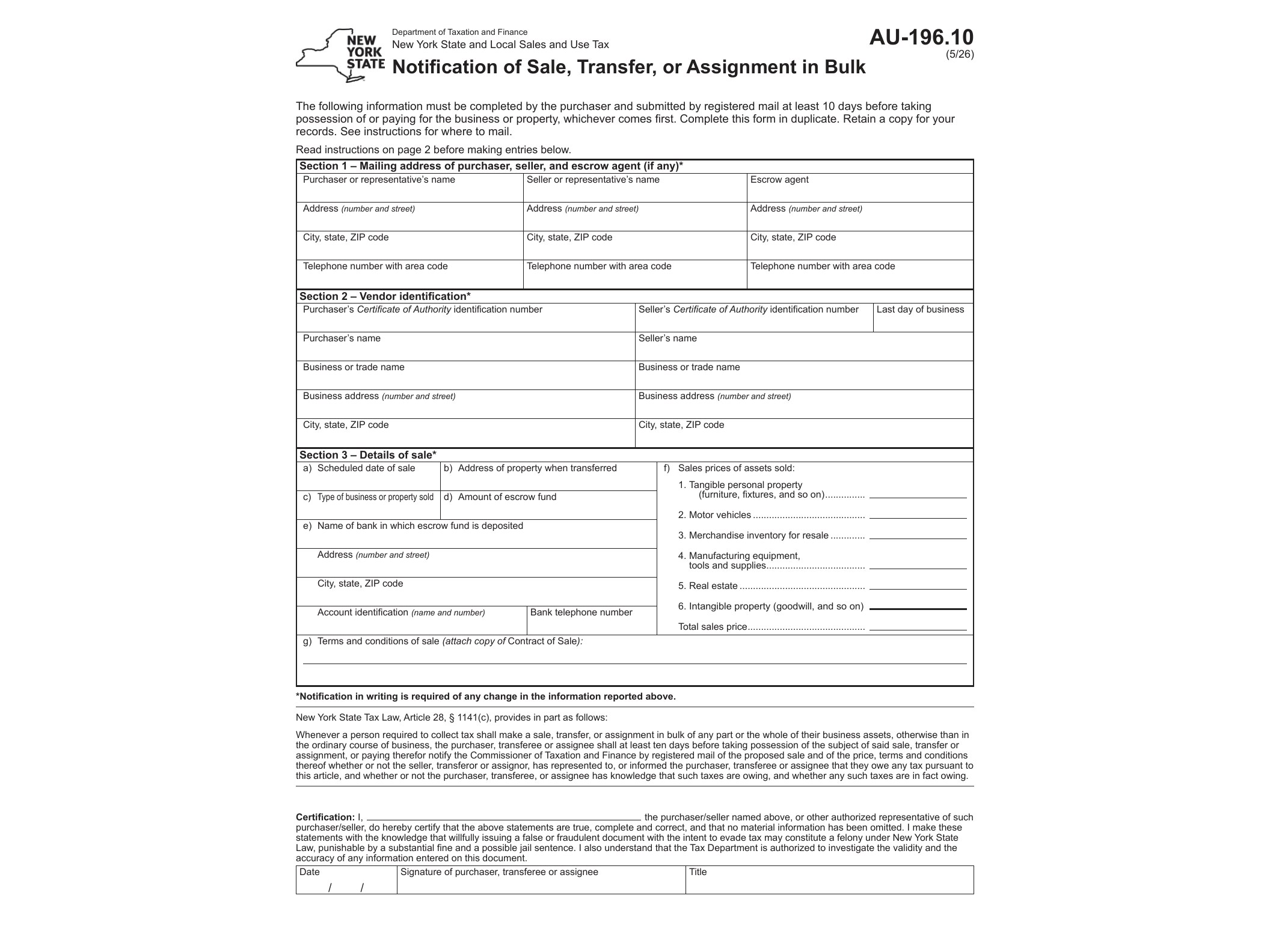
If you’re buying or selling a business in New York State — or transferring a significant chunk of business assets outside the ordinary course of operations — the state’s tax department wants to know about it before the deal closes. That’s exactly what Form AU-196.10, Notification of Sale, Transfer, or Assignment in Bulk, is for. It’s issued by the New York State Department of Taxation and Finance, and it functions as an early-warning notice so the state can check whether the seller owes any outstanding taxes before the sale goes through.
This isn’t a form you file after the fact. It has to be submitted before the transaction closes, which is why it catches so many first-time business buyers off guard. New York’s bulk sale law exists to protect the state’s ability to collect sales tax, and it also protects the buyer. If a purchaser doesn’t give proper notice, they can end up personally liable for the seller’s unpaid sales tax debts, even if they had no idea those debts existed.
What Counts as a Bulk Sale
A bulk sale generally means the sale, transfer, or assignment of business assets outside the normal course of business — think selling an entire restaurant, retail store, or other operation, including its inventory, fixtures, equipment, or goodwill. It applies whether the transfer happens through an asset sale, a stock sale in some cases, or even a lease arrangement that effectively transfers control of the business. If you’re unsure whether your transaction qualifies, it’s worth checking with a tax professional, since the penalties for skipping notification fall hardest on the buyer.
Businesses that regularly deal with exemption certificates or resale documentation, such as contractors handling Form ST-120.1 for exempt purchases, should keep in mind that bulk sale rules are separate from routine sales tax exemption paperwork. AU-196.10 deals specifically with the transfer of the business itself, not day-to-day exempt purchases.
Who Needs to File It
The purchaser, transferee, or assignee is responsible for filing Form AU-196.10. In practice, this is usually handled by the buyer’s attorney or accountant as part of due diligence before closing. The seller doesn’t file this form, but sellers should expect to cooperate, since the state may follow up with them directly to verify tax status.
When It’s Due
Form AU-196.10 must be filed with the Tax Department at least 10 days before the sale, transfer, or assignment takes place. Filing early gives the state time to review the seller’s tax account and issue a notice back to the purchaser indicating whether there are outstanding liabilities. If the department responds with a claim for unpaid taxes, part of the purchase price may need to be withheld or escrowed until those taxes are settled.
How to Complete and Submit the Form
The form asks for basic transaction details: identifying information for both the seller and purchaser, the date of the sale, a description of the assets being transferred, and the sale price. Because it’s an AcroForm, you can fill it out directly on a computer using PDF software before printing or submitting it, which cuts down on handwriting errors and makes it easier to keep a clean copy for your records.
Once completed, the form is typically submitted according to the instructions printed on the current version of the PDF, which may include mailing or faxing it to the Tax Department’s Bulk Sales Unit. Because procedures and mailing addresses can change between revisions, always confirm you’re using the most recent version dated 5/26 and follow the submission instructions listed on that specific form.
If a dispute arises later over how the state handled your bulk sale notification or any resulting tax claim, taxpayers have the option of reaching out through channels like Form DTF-911, which addresses taxpayer rights and advocacy concerns separately from the bulk sale process itself.
Given how much liability is riding on proper notice, it’s worth building the 10-day filing window into your closing timeline from the start rather than treating it as a last-minute formality.
Download Official Form AU196 (PDF)
Opens the official government PDF in a new tab