
Download Official Form DTF911 (PDF)
Opens the official government PDF in a new tab
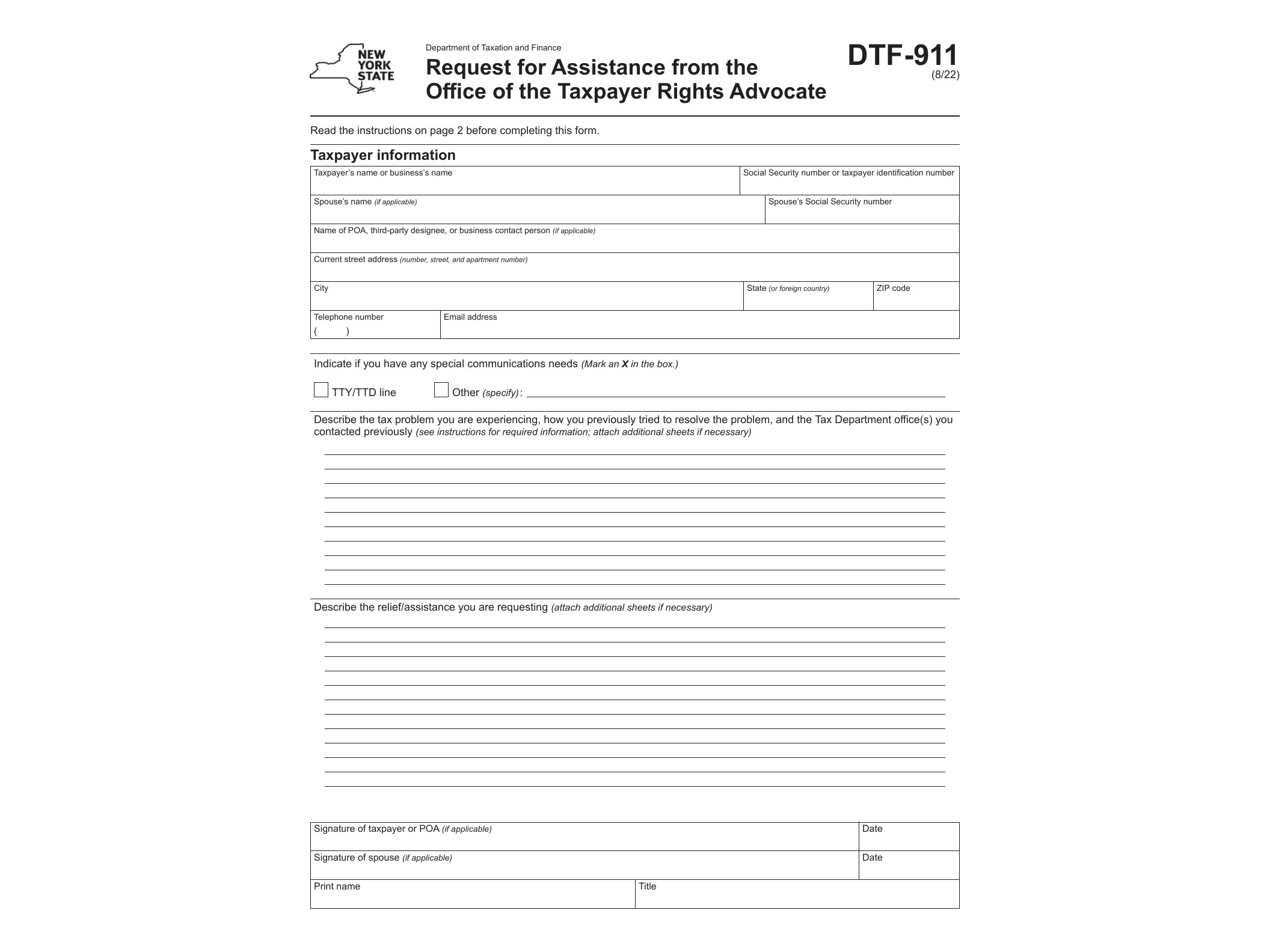
Form DTF-911 is the official request form used to bring a case to the Office of the Taxpayer Rights Advocate (OTRA) within the New York State Department of Taxation and Finance. This office exists specifically to step in when a taxpayer’s issue with the department has stalled, gone unanswered through normal channels, or is causing significant financial harm. Filing this form is essentially a formal way of saying, “I’ve tried the usual process and I still need help.”
The revised 8/22 version is a fillable PDF (AcroForm), so you can type your information directly into the document on a computer before printing or submitting it, rather than filling it out by hand.
What the Taxpayer Rights Advocate Office Actually Does
The OTRA operates somewhat independently from the rest of the tax department’s day-to-day operations. Its job is to review cases where standard procedures haven’t worked — think unresolved audits, delayed refunds, collection actions that seem disproportionate, or repeated attempts to reach the right department without success. It’s not a substitute for regular customer service; it’s meant for situations where regular channels have already failed you.
Who Should File Form DTF-911
This form is appropriate for individuals, business owners, and tax preparers acting on behalf of a client who are experiencing one of the following:
- A tax problem that hasn’t been resolved after multiple contacts with the department
- An IRS-style hardship, such as a bank levy or wage garnishment causing serious financial difficulty
- A significant delay in receiving a response or resolution to an open case
- A situation where the taxpayer believes the department’s action is causing (or about to cause) irreparable harm
- Systemic issues in how a case has been handled internally
Tax professionals and third-party representatives can also submit this form on a client’s behalf, provided they have the proper authorization on file, typically through a completed power of attorney form.
When to Use This Form
DTF-911 isn’t the first step for a routine tax question or a simple filing correction — those should go through normal department channels first. It becomes relevant once you’ve already attempted to resolve the matter and hit a wall: no response, no progress, or an outcome that’s creating real hardship. If your case involves an active collection action with an approaching deadline, it’s worth noting that on the form, since urgency can affect how quickly OTRA responds.
How to Fill Out and Submit Form DTF-911
The form asks for standard identifying information: your name, Social Security number or Employer Identification Number, mailing address, and a description of the tax issue you’re facing. You’ll need to explain what steps you’ve already taken to resolve the problem and why those efforts haven’t worked. Being specific here matters — include case numbers, dates of prior contact, and copies of any relevant notices you’ve received from the department.
If you’re a representative filing on someone else’s behalf, make sure your authorization documentation is current and attached, since incomplete authorization is one of the most common reasons requests get delayed.
Once completed, the form can be submitted by mail or fax according to the instructions printed on the document itself. Because the PDF is fillable, most people complete it electronically and then print it for signature, since a physical signature is still required before submission.
Keep a copy of everything you send, along with proof of submission if you fax it. If your situation escalates or you need to follow up, having that documentation on hand makes the process considerably smoother.
Taxpayers dealing with other state-specific filings, such as the AA-56 Americans with Disabilities Act Complaint Form for accessibility concerns with the department, or real estate matters requiring Form TP-584, may find that unresolved issues with those filings are also within the scope of what the Taxpayer Rights Advocate can help untangle. Businesses working through exemption paperwork like Form FT-123 can likewise turn to DTF-911 if a related dispute with the department isn’t moving forward through standard channels.
Download Official Form DTF911 (PDF)
Opens the official government PDF in a new tab