
Download Official Form ST120 (PDF)
Opens the official government PDF in a new tab
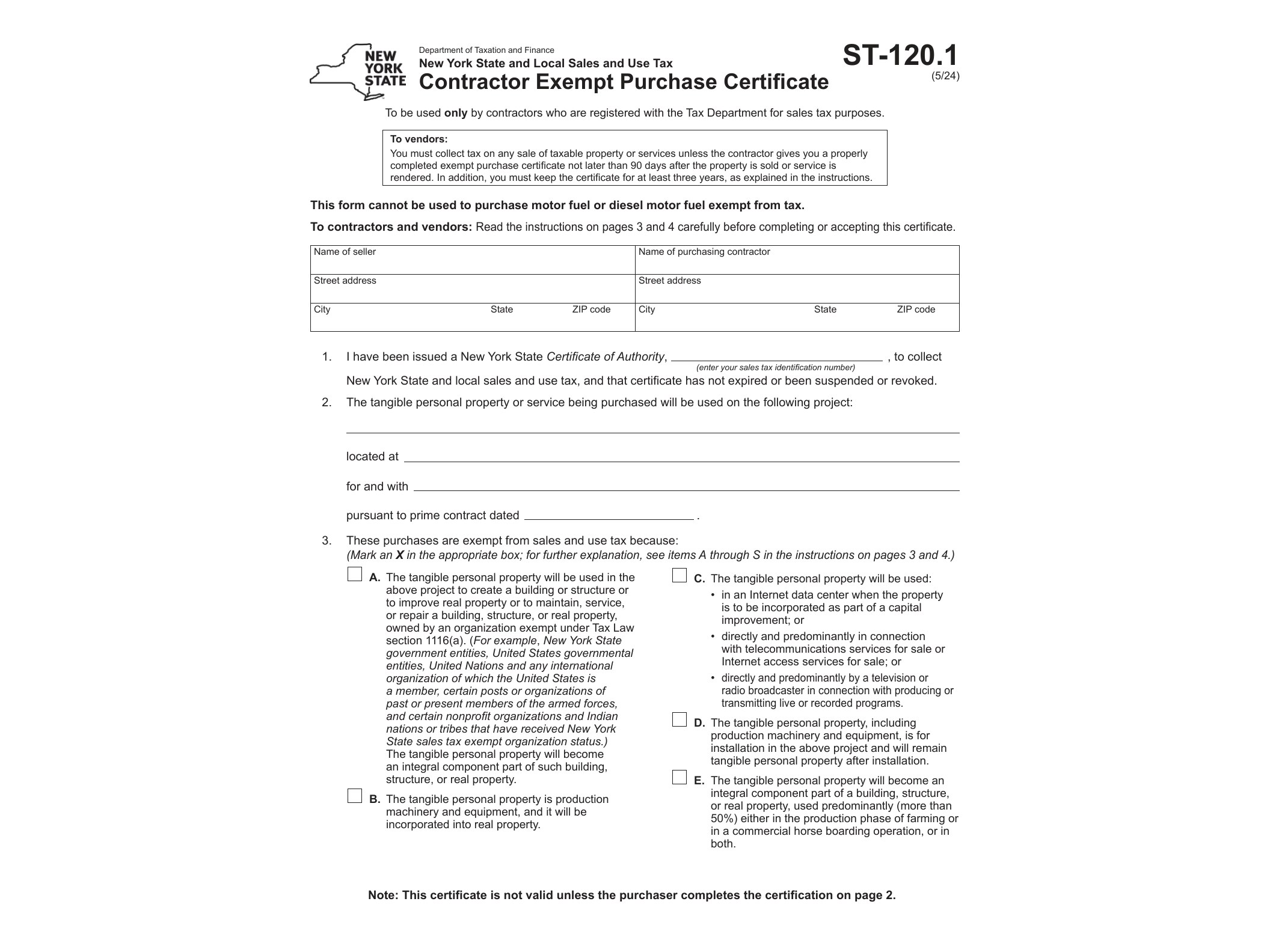
Form ST-120.1, the Contractor Exempt Purchase Certificate, is issued by the New York State Department of Taxation and Finance and used by contractors who need to buy building materials or services without paying sales tax at the time of purchase. It’s a narrower version of the general resale certificate, built specifically for the construction trade, where the line between taxable repairs and tax-exempt capital improvements matters a lot.
The certificate exists because sales tax rules in New York treat construction work differently depending on what’s being done. Repairs, maintenance, and installation of tangible personal property are usually taxable services. Capital improvements, on the other hand, are generally exempt when the customer gives the contractor a properly completed Certificate of Capital Improvement (Form ST-124). Form ST-120.1 fits into this system by letting a contractor purchase materials tax-free when those materials will be resold as part of a taxable service, incorporated into real property in a way that qualifies for exemption, or used in a manner the law otherwise permits without tax being charged upfront.
Who needs to use ST-120.1
This form is meant for contractors, subcontractors, and businesses in the construction or improvement trades who buy materials from suppliers and need to avoid paying sales tax on those purchases because the tax will ultimately be collected from the end customer, or because the work qualifies as an exempt capital improvement. It is not for the general public and not for occasional buyers picking up hardware for personal projects. A supplier who receives this certificate from a contractor is relieved of the responsibility to collect sales tax on that sale, provided the certificate is filled out correctly and accepted in good faith.
Subcontractors working under a general contractor also use this form when purchasing materials that will be passed along or incorporated into a larger project. Since New York’s sales tax treatment of construction work depends heavily on documentation, having the right exemption certificate on file protects both the buyer and the seller if the transaction is ever reviewed by the Department of Taxation and Finance.
When the form applies
Form ST-120.1 comes into play at the point of purchase, not at the point of billing the customer. A contractor buying lumber, fixtures, or other materials for a job presents this certificate to the supplier instead of paying sales tax on the spot. The contractor is then responsible for handling the tax correctly on the back end, either by charging it to the customer if the work is taxable, or by treating it as exempt if the job qualifies as a capital improvement supported by a separate certificate from the property owner.
It’s worth noting that this certificate does not exempt a contractor from all sales tax obligations. It shifts where and how the tax gets accounted for. Misusing the form, for example applying it to purchases unrelated to a qualifying job, can create liability down the line, so contractors should keep clear records tying each certificate to a specific project or purchase.
Filling it out and getting a copy
The current version of Form ST-120.1, revised in May 2024, is a fillable PDF, so it can be completed on a computer before printing or saving. The form asks for standard identifying information: the contractor’s name, address, and sales tax Certificate of Authority number, along with a description of the property being purchased and the reason it qualifies for exemption. The supplier keeps the completed certificate on file rather than sending it to the Tax Department, so accuracy at the time of signing matters since it’s the record that will be checked in an audit.
Contractors who deal with real estate transactions more broadly may also run into related paperwork, such as the Combined Real Estate Transfer Tax Return, which comes up when property changes hands rather than when materials are purchased. And if a dispute arises over how a sales tax exemption was handled, taxpayers have the option to request help through the Office of the Taxpayer Rights Advocate using Form DTF-911.
Because the form is short and specific, most contractors fill it out per supplier relationship or per job, keeping copies alongside other project documentation like contracts and material invoices. Since it’s an AcroForm PDF, it can be typed into directly, saved digitally, and reprinted as needed for multiple purchases tied to the same qualifying project.
Download Official Form ST120 (PDF)
Opens the official government PDF in a new tab