
Download Official Form RP462 (PDF)
Opens the official government PDF in a new tab
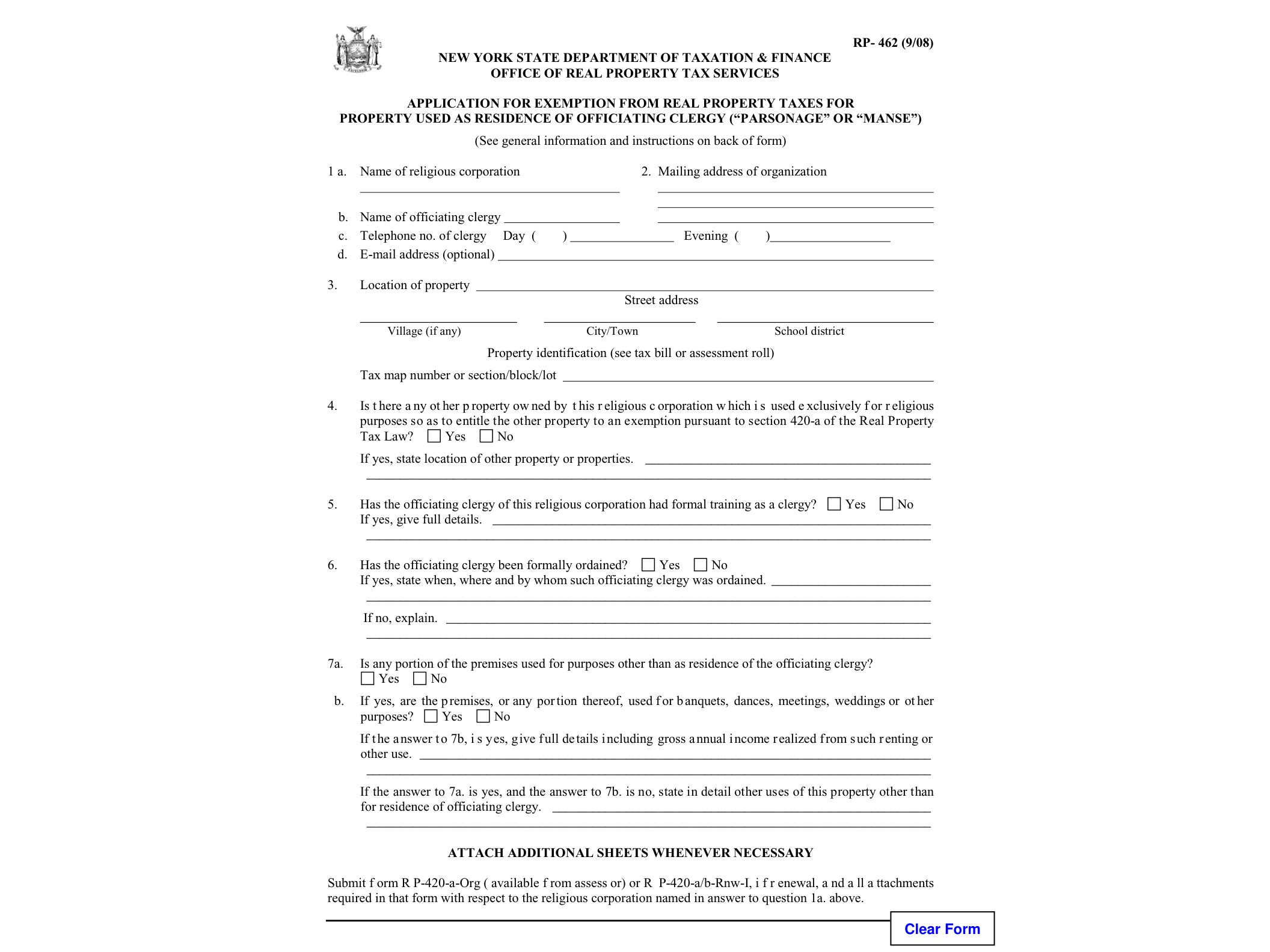
Form RP-462, issued by the New York State Department of Taxation and Finance, is the application religious corporations use to request a real property tax exemption for a residence used by their officiating clergy member. This type of property is commonly known as a parsonage or a manse. New York law recognizes that a home provided to a minister, priest, rabbi, or other officiating clergy as part of their religious duties serves a religious purpose similar to the house of worship itself, and it allows a corresponding exemption from local property taxes.
The form is officially titled “Application for Exemption from Real Property Taxes for Property Used as Residence of Officiating Clergy (Parsonage or Manse)” and is filed with the local assessor’s office in the municipality where the property is located, not directly with the state tax department.
Who Needs to File Form RP-462
This application is meant for religious corporations that own a residence occupied by an officiating clergy member who serves that congregation. If your church, synagogue, mosque, or other religious organization owns a house or apartment where the acting minister or spiritual leader lives, and that residence is tied to their duties within the congregation, this exemption may apply. The exemption is not available for residences used by retired clergy, administrative staff without officiating duties, or properties rented out to third parties unrelated to religious service.
It’s worth noting that the clergy member does not need to own the property. The exemption applies to property owned by the religious corporation and made available for the clergy’s use as a residence connected to their role.
When to Use This Form
Form RP-462 should be submitted when a religious organization first acquires or designates a property as a parsonage or manse and wants to establish the tax exemption. It’s also used when there’s a change in circumstances that affects an existing exemption, such as a new clergy member moving into the residence or a change in how the property is used. Filing deadlines are set locally, so religious corporations should check with their county or town assessor to confirm the exact date by which the application must be submitted for the exemption to take effect in that assessment year.
Because property tax exemptions in New York generally need to be renewed or verified periodically, some assessors may request updated documentation even after the exemption has been granted, particularly if there’s a change in clergy or property use.
How to Fill Out and Submit Form RP-462
The form is available as a fillable PDF (AcroForm), which means you can complete it directly on your computer before printing it for signature and submission. It asks for basic identifying information about the religious corporation, details about the property including its location and assessment roll information, and a description of how the property is used in relation to the officiating clergy’s duties.
You’ll need to provide the name and title of the clergy member residing at the property, confirm that the corporation holds title to the property, and describe the religious function tied to the residence. Supporting documentation, such as proof of the corporation’s religious status and evidence of the clergy member’s role, may be requested by the local assessor to support the application.
Once completed, the form is filed with the assessor of the city, town, or village where the property sits. Assessors review these applications and determine eligibility based on state law and any local requirements. If approved, the exemption will be reflected on the property’s future tax assessment rolls.
Religious organizations that also deal with other property valuation or exemption matters may find it useful to look at related assessment paperwork, such as the Assessor’s Worksheet for RP-305-R, which assessors use when reviewing certain property valuations. Organizations managing multiple properties, including commercial ones, might also want to reference Form RP-3106 for economic information related to commercial property valuation, or review how industrial development agencies handle exemptions through Form RP-412a for a comparison of how different exemption categories work under New York property tax law.
Because assessment practices and deadlines can vary between municipalities, religious corporations preparing to file Form RP-462 should reach out to their local assessor’s office ahead of time to confirm submission requirements and avoid missing the exemption window for the current tax year.
Download Official Form RP462 (PDF)
Opens the official government PDF in a new tab