
Download Official Form RP459C (PDF)
Opens the official government PDF in a new tab
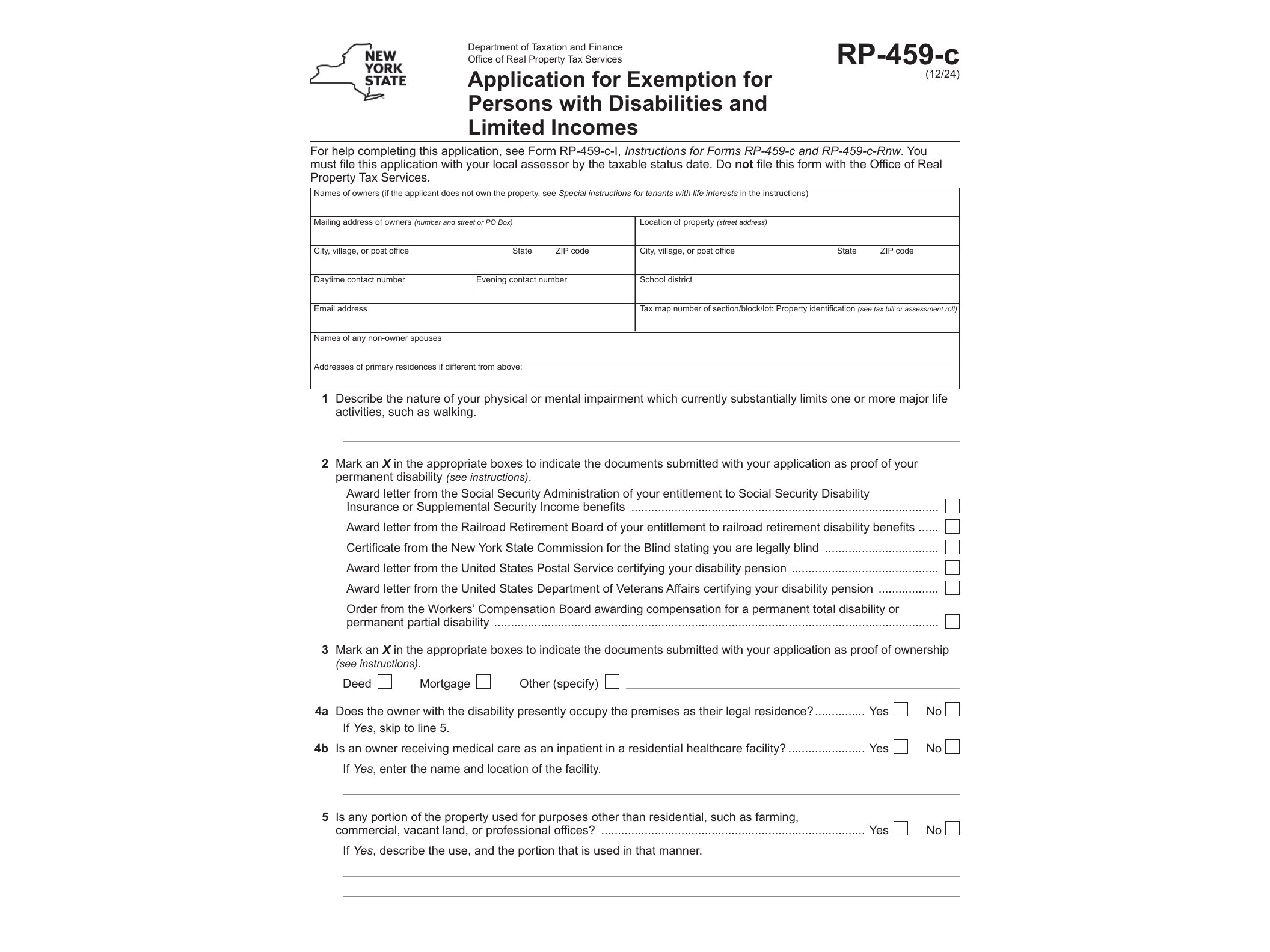
Form RP-459-c is the application New York homeowners use to request a partial exemption from real property taxes when they have a disability and their household income falls under a limit set by their local taxing jurisdiction. It’s issued by the New York State Department of Taxation and Finance, but the actual exemption amount and income thresholds are decided locally by the county, city, town, village, or school district where the property sits, since each jurisdiction can adopt its own sliding scale.
This exemption exists because New York recognizes that disabled homeowners living on fixed or limited incomes often struggle to keep up with rising property tax bills. Rather than a flat discount, the law allows local governments to reduce the assessed value used to calculate taxes, with bigger reductions going to lower-income applicants. Some jurisdictions offer exemptions ranging from 5% up to 50% of assessed value depending on where the applicant’s income falls within the approved range.
Who Should File This Form
You may need Form RP-459-c if you own residential property in New York State, have a documented disability, and your gross income (including that of your spouse and any co-owner) stays below the limit your locality has set. The property generally must be your primary residence, and there are specific rules about how income is calculated, including allowable deductions for medical and prescription drug expenses that many applicants overlook.
Proof of disability is required and can come from several sources: an award letter from the Social Security Administration, a certificate from the State Commission for the Blind, or documentation from the Railroad Retirement Board or the U.S. Postal Service, among other accepted sources listed in the form’s instructions. Applicants should gather this paperwork before starting the application, since incomplete filings are one of the most common reasons assessors send applications back.
It’s worth noting that a homeowner cannot combine this exemption with the senior citizens’ exemption under section 467 of the Real Property Tax Law for the same property in the same tax year. Applicants who might qualify for either program should compare which one offers a better reduction based on their specific income and local exemption schedule before filing.
When and How to Submit RP-459-c
Timing matters a lot with this form. Local taxable status dates vary, but in most of New York State that date falls on March 1, meaning the application typically needs to reach the local assessor’s office by that deadline for the exemption to apply to the upcoming tax year. Some municipalities, particularly in New York City and a few counties, have different filing dates, so checking with the local assessor is a necessary step rather than an optional one.
The form itself is a fillable PDF, so applicants can complete it directly on a computer before printing and signing it. It asks for the property’s identification information, ownership details, income figures for all owners and their spouses, and details about the disability documentation being submitted. Once completed, the form goes to the assessor in the city, town, or village where the property is located rather than to the state tax department, since assessors administer the exemption locally even though the form is a state document.
Homeowners who already receive this exemption typically need to reapply and verify their income each year, since eligibility is reassessed annually based on updated income figures. Missing a renewal deadline can mean losing the exemption for that tax cycle, even if the homeowner still technically qualifies.
Property owners dealing with other exemption or valuation paperwork in New York might also find it useful to look at Form RP-462 for parsonage and manse exemptions, or review how assessors evaluate property value adjustments through the RP-305-R-WS assessor’s worksheet. Those managing commercial holdings alongside a personal residence may also want to check Form RP-3106 on commercial property valuation for a broader picture of how New York’s assessment system works across different property types.
Because local rules vary so much on income limits and exemption percentages, applicants should call their assessor’s office directly to confirm the exact figures that apply to their address before submitting Form RP-459-c.
Download Official Form RP459C (PDF)
Opens the official government PDF in a new tab