
Download Official Form RP466H (PDF)
Opens the official government PDF in a new tab
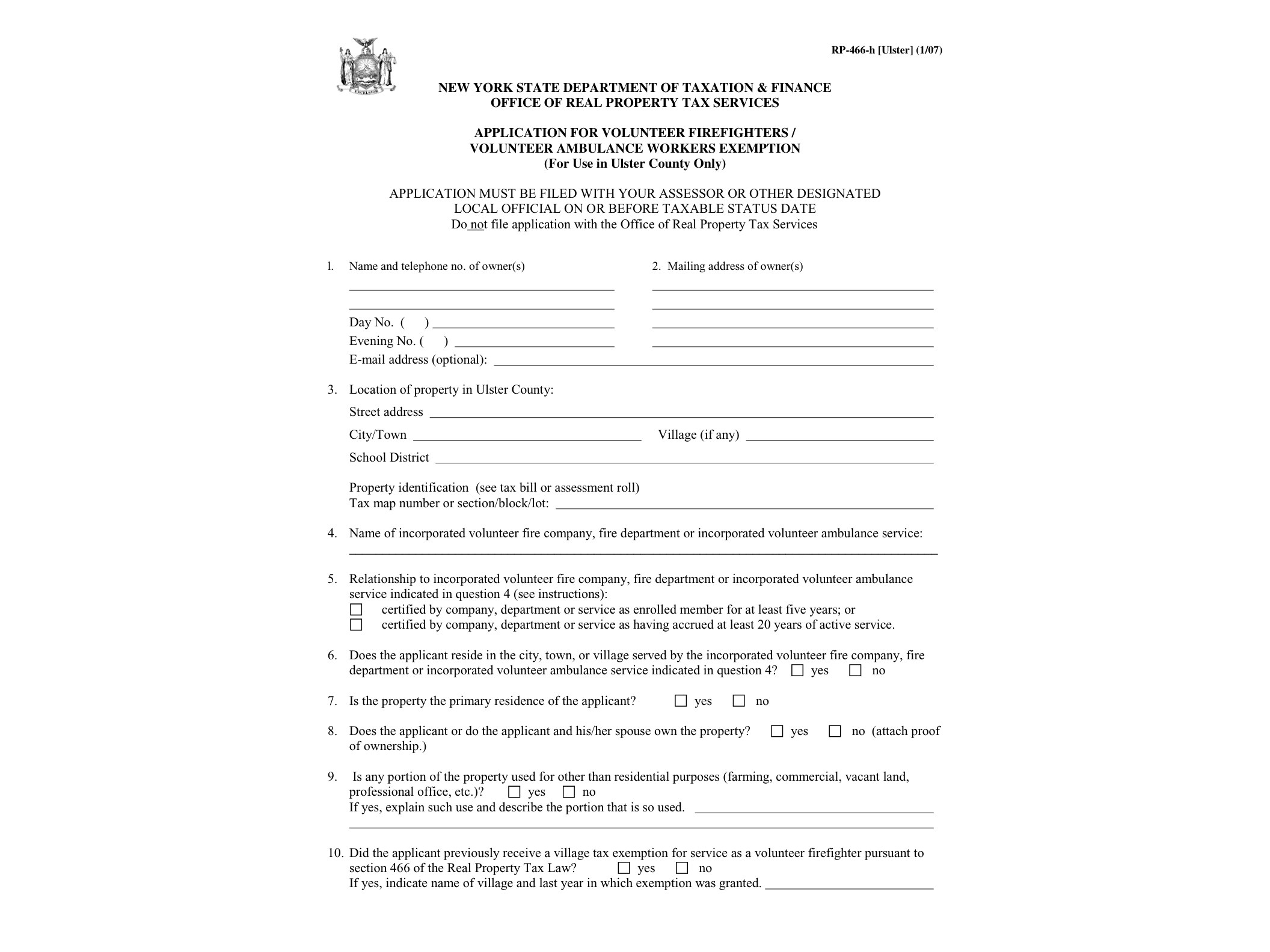
Form RP-466-H is the application New York State uses to grant a property tax exemption to volunteer firefighters and volunteer ambulance workers who own property in certain municipalities within Ulster County. It’s issued by the New York State Department of Taxation and Finance, but like most RP-466 series forms, it only applies where the local county, city, town, or village has voted to adopt the exemption under Real Property Tax Law section 466-a. Ulster County residents should confirm with their local assessor that their specific municipality has opted in before applying, since not every town automatically offers this benefit.
The purpose of this exemption is straightforward: it rewards residents who serve their communities as unpaid firefighters or ambulance workers by reducing the assessed value of their primary residence for tax purposes. If your municipality has adopted the exemption, qualifying volunteers can see a meaningful reduction in their annual property tax bill, which is one of the few tangible financial incentives available to people who commit years of unpaid emergency service.
To be eligible, an applicant generally needs to show they’ve been an enrolled member of an incorporated volunteer fire company, fire department, or ambulance service for a minimum number of years — often five years, though some localities allow accumulated service credit or extend the benefit to spouses of deceased volunteers who met the requirements. The property must also be the applicant’s primary residence located within the municipality that has adopted the local law. Because eligibility rules can vary slightly by jurisdiction, it’s worth double-checking length-of-service requirements and any residency stipulations directly with the Ulster County assessor’s office or fire district before submitting paperwork.
Form RP-466-H is a fillable PDF, meaning you can complete it digitally on your computer before printing it out for signature and submission. The form asks for basic identifying information — the property owner’s name, address, and section/block/lot number — along with details confirming years of active service and the name of the fire company or ambulance service. A certifying official from that company or department typically needs to sign off verifying the applicant’s service record, so it’s a good idea to coordinate with your fire company secretary or chief ahead of the filing deadline.
Timing matters here. Like other property tax exemption applications in New York, RP-466-H generally needs to be filed with the local assessor by the taxable status date, which in most municipalities falls on March 1st, though some counties observe different dates. Missing this window usually means waiting until the following assessment year to apply, so it pays to get the paperwork together early rather than scrambling at the last minute.
Once granted, the exemption isn’t necessarily permanent — many localities require an annual renewal or periodic recertification to confirm the volunteer is still active and still residing at the property. Assessors’ offices can tell you whether your specific town requires yearly refiling or whether the exemption continues automatically as long as your status hasn’t changed.
If you’re a volunteer firefighter or ambulance worker outside Ulster County, similar forms exist for other counties that have adopted this same exemption. For example, residents of Lewis County would use Form RP-466-E, while those in Albany County file Form RP-466-I. There’s also a general version, Form RP-466-B, which covers additional counties that have enacted the same local option. Each version is functionally identical in purpose but tied to the specific county named in its title, so make sure you’re using the one that matches where your property is located.
Before submitting, review the completed form carefully for accuracy, gather any supporting documentation your fire company requires, and confirm the current taxable status date with your local assessor’s office. A small filing error or missed signature is often the reason otherwise-eligible applications get delayed.
Download Official Form RP466H (PDF)
Opens the official government PDF in a new tab