
Download Official Form RP466I (PDF)
Opens the official government PDF in a new tab
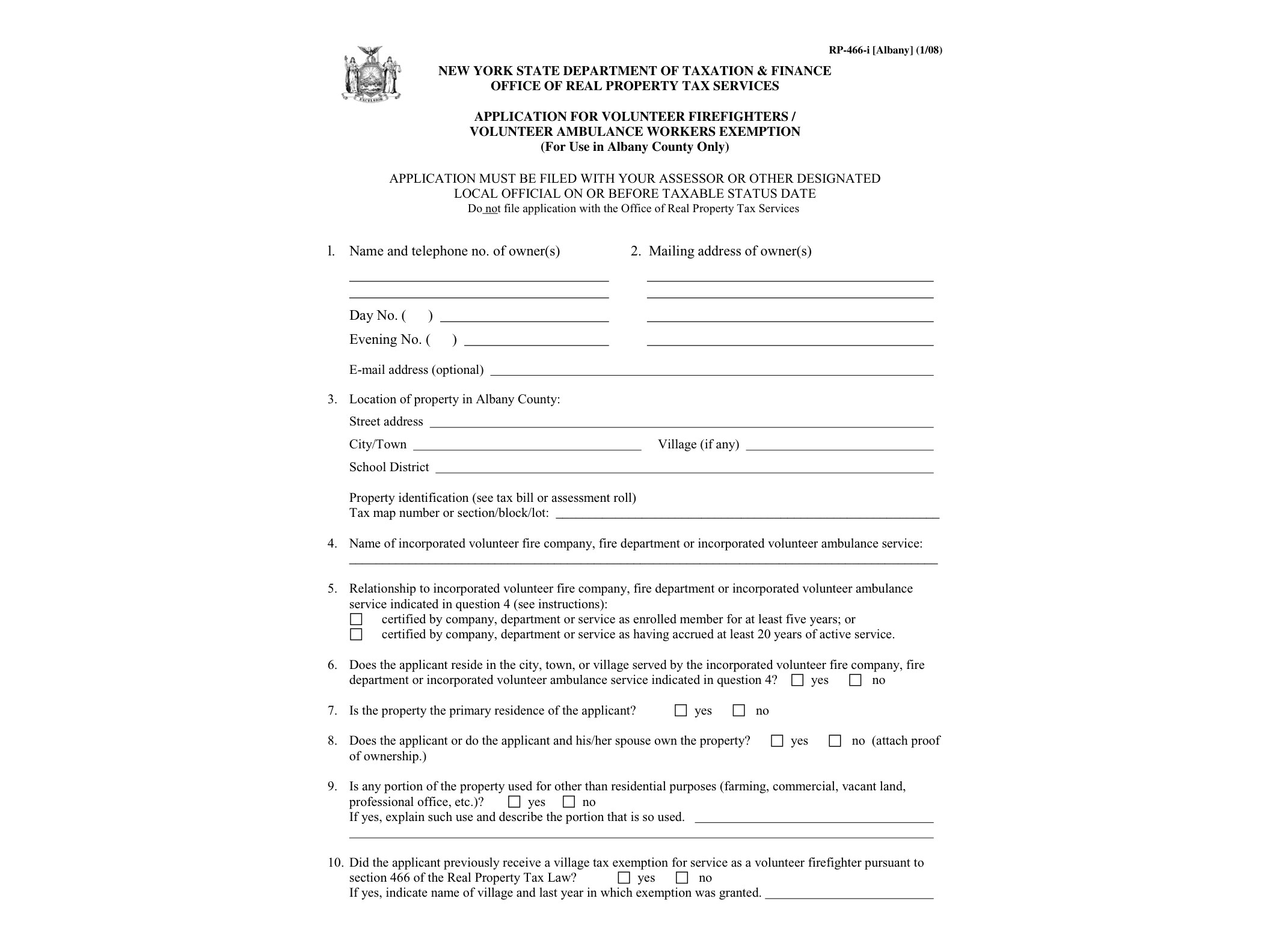
Form RP-466-I is the application New York State uses to grant a property tax exemption to volunteer firefighters and volunteer ambulance workers whose primary residence is located in Albany County. It’s issued by the New York State Department of Taxation and Finance, but like most RP-466 series forms, it applies to a specific county authorized under Real Property Tax Law section 466 to offer this benefit. If you volunteer for a fire company or ambulance squad in Albany County and meet the service requirements set by your local taxing jurisdiction, this is the form you file to claim the exemption on your assessed property value.
The exemption reduces the taxable assessed value of a qualifying volunteer’s primary residence, which in turn lowers the property tax bill. It doesn’t eliminate taxes entirely, but the savings can be meaningful depending on your local assessment rate and the percentage your municipality has adopted. Not every town, village, or county automatically offers this exemption—each local government has to opt in through its own resolution, so the specific percentage and eligibility rules can vary even within the same county.
Who Needs to File RP-466-I
This form is meant for active volunteer firefighters and volunteer ambulance workers who own and occupy property as their primary residence within a jurisdiction in Albany County that has adopted the exemption. Typically, applicants need to show a minimum number of years of active service, and in many cases the exemption can become permanent after a longer period of continuous volunteer service (often around 20 years), even if the person later becomes inactive due to age or retirement from the volunteer role. Surviving spouses of volunteers who died in the line of duty may also qualify under certain conditions, so it’s worth checking the specific criteria with your local assessor.
If your property is located outside Albany County, this exact version of the form won’t apply to you. New York publishes separate localized versions of RP-466 for different counties, since each county’s participating municipalities and exemption terms differ. For example, volunteers in Jefferson or St. Lawrence counties would use Form RP-466-F, while those in Clinton County rely on Form RP-466-J. There’s also a broader version, Form RP-466-B, which covers additional counties that have adopted similar exemptions. Using the wrong county-specific form can delay or invalidate your application, so it’s important to confirm you’re filing the version that matches where your property sits.
When to File
Applications need to be submitted to the local assessor’s office by the taxable status date, which in most New York municipalities falls on March 1, though some cities and towns set different dates. Missing this deadline generally means waiting until the following assessment year to apply, so it helps to confirm the exact date with your town or city assessor well in advance rather than assuming a statewide default.
How to Complete and Submit the Form
Form RP-466-I is a fillable PDF, so you can type your information directly into the form before printing it for signature and submission—assessors typically require an original signature rather than a digital one. You’ll need to provide details about your property, your length of service as a volunteer firefighter or ambulance worker, and certification from your fire department or ambulance service confirming your active or exempt status. Some jurisdictions also request supporting documentation, such as a letter from your company or squad chief verifying years of service.
Once completed, the form goes to the assessor’s office for the city, town, or village where your property is located—not to the state tax department directly. Because approval and renewal requirements can differ by municipality, it’s a good idea to contact your local assessor before submitting to confirm whether annual renewal is required or whether your exemption, once granted, remains in effect automatically for future years.
Download Official Form RP466I (PDF)
Opens the official government PDF in a new tab