
Download Official Form RP466B (PDF)
Opens the official government PDF in a new tab
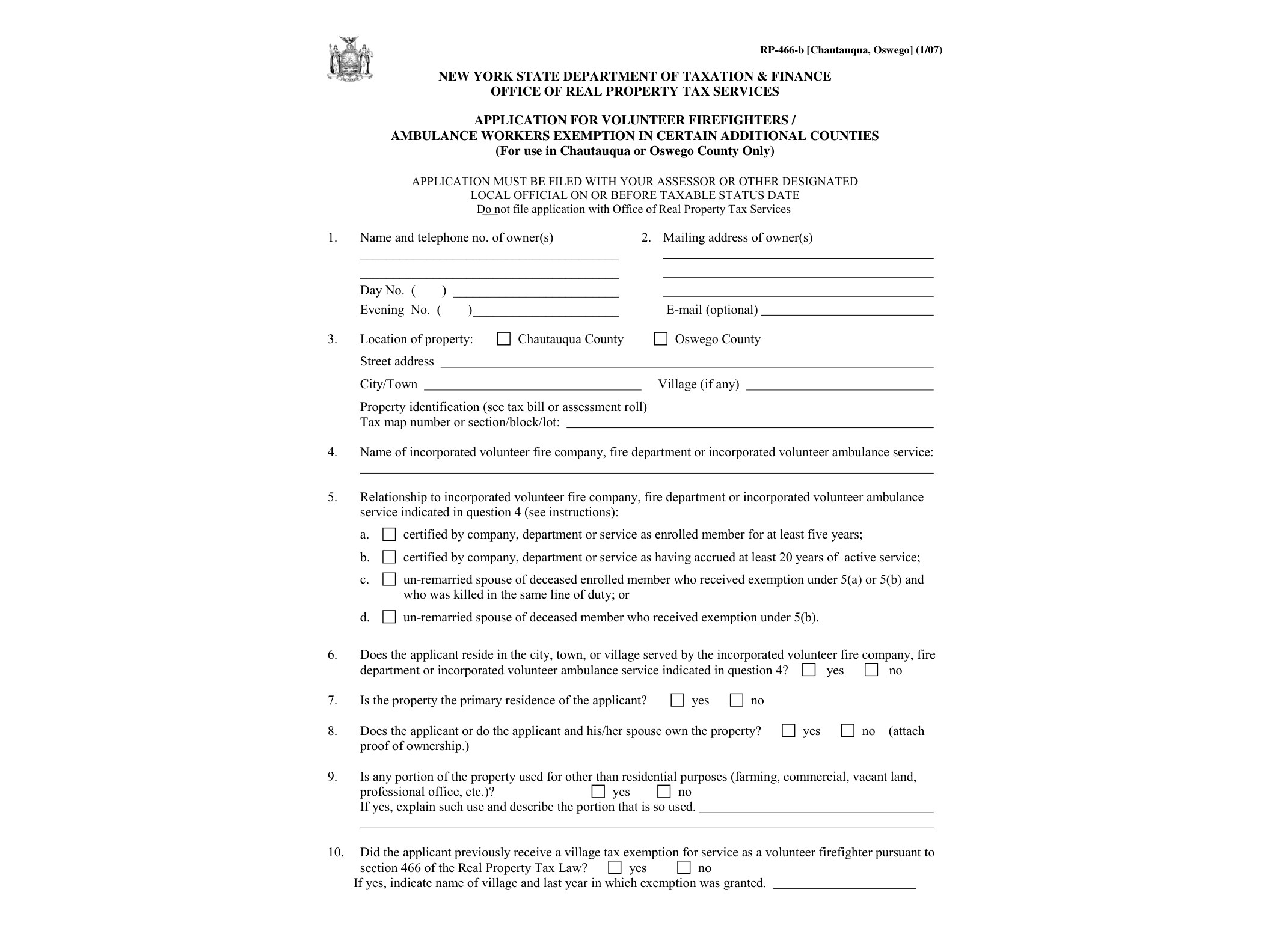
Form RP-466-B is a New York State property tax exemption application specifically designed for volunteer firefighters and volunteer ambulance workers who live in certain additional counties that have opted into this exemption program under Real Property Tax Law section 466-a. It’s issued by the New York State Department of Taxation and Finance, but like most exemption forms of this type, it’s filed with your local assessor rather than sent to the state directly.
The purpose of the form is straightforward: it lets eligible volunteers apply for a reduction in the assessed value of their primary residence, recognizing the unpaid service they provide to their community. Because volunteer fire departments and ambulance squads are often the backbone of emergency response in smaller towns and rural areas, New York allows counties, cities, towns, and villages to adopt local laws granting this exemption as an incentive to recruit and retain volunteers.
What makes RP-466-B distinct from similar forms is that it applies to counties that adopted the exemption under a specific set of statutory provisions different from the original 466 counties. New York has issued several county-specific versions of this application over the years — for example, Form RP-466-F covers Jefferson and St. Lawrence Counties, while Form RP-466-J is used in Clinton County. RP-466-B was created for a separate group of additional counties that later opted into the exemption, so it’s important to confirm with your assessor’s office that this is the correct version for your specific county before filing, since submitting the wrong county-specific form can delay processing.
Who Needs This Form
You should use RP-466-B if you are an enrolled member of an incorporated volunteer fire company, fire department, or volunteer ambulance service located in one of the additional counties that adopted this exemption, and your municipality has passed a local law or resolution authorizing it. Typically, applicants must meet a minimum number of years of active service (often five years, though some localities allow enrollment after two years with a reduced or partial exemption), and the property must be your primary residence within that municipality.
Surviving spouses of volunteer firefighters or ambulance workers who were killed in the line of duty, or who had accrued a certain number of years of service, may also qualify to continue receiving the exemption under specific conditions outlined in the statute.
When to File
Timing matters with this exemption. Local assessors set a taxable status date each year, and applications generally must be submitted before that date to be considered for the current assessment roll. Since this varies by municipality, it’s worth checking with your local assessor’s office early rather than waiting until the deadline. If you’re a first-time applicant, you’ll need to provide proof of active volunteer status, usually a certification from the chief of your fire department or ambulance service confirming your years of service.
How to Complete and Submit It
The form is available as a fillable PDF, meaning you can type your information directly into the document before printing it for signature — no need to write everything by hand. You’ll need to fill in identifying information about the property, your years of service, and certification details from your volunteer organization. Once completed and signed, the form goes to your local town, city, or village assessor’s office, not to the state tax department.
If you’re unsure whether your county falls under RP-466-B or one of the other county-specific versions, such as the one used in Cattaraugus County, your assessor can confirm which form applies to your municipality. Many assessors also require renewal applications or periodic recertification, so keep a copy of your submitted form and any correspondence for your records in case you need to reapply or verify your exemption status in future years.
Download Official Form RP466B (PDF)
Opens the official government PDF in a new tab