
Download Official Form RP485B (PDF)
Opens the official government PDF in a new tab
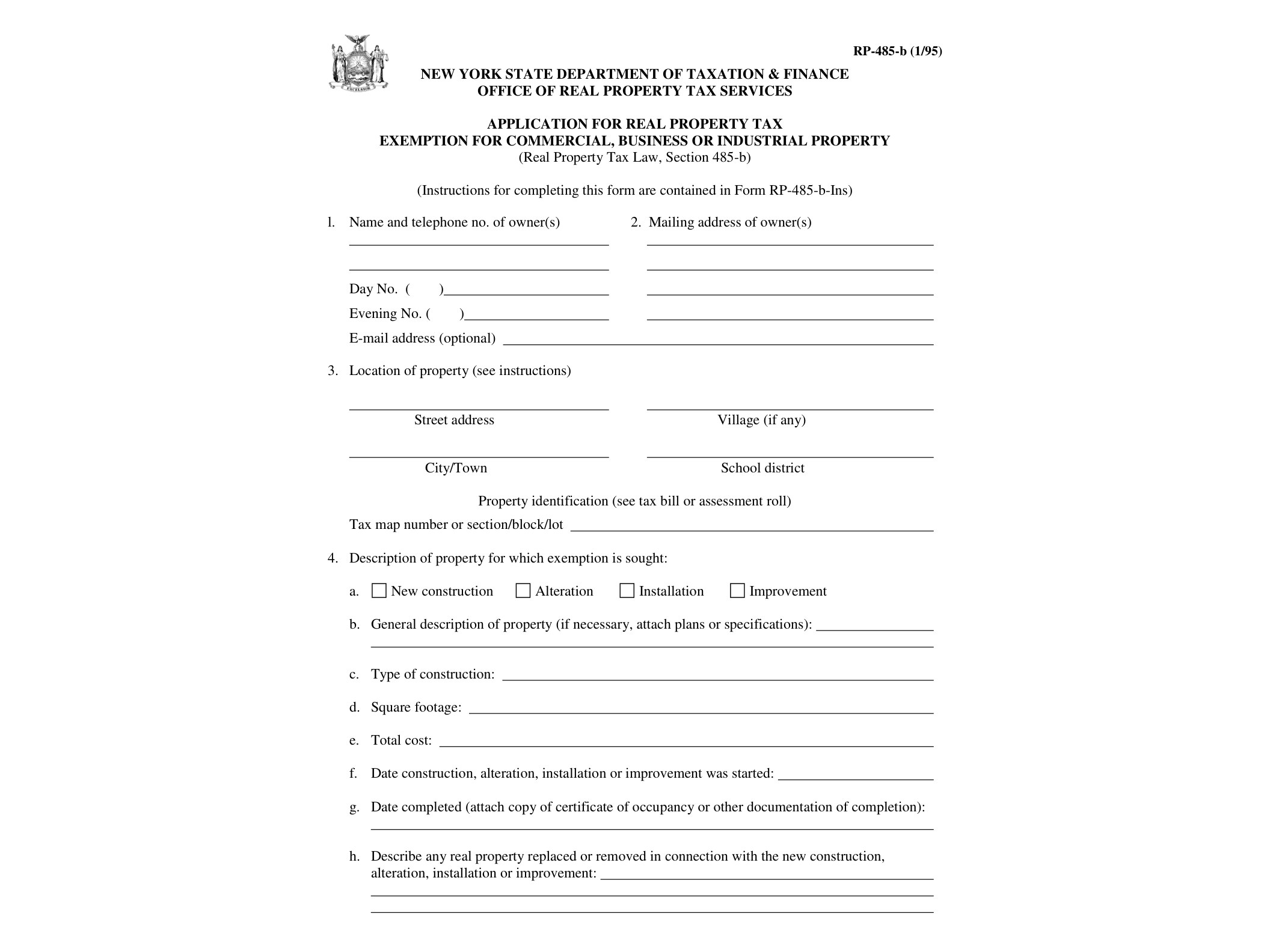
Form RP-485-B is the application New York property owners use to request a real property tax exemption tied to new construction, alteration, or rehabilitation of commercial, business, or industrial property. It’s issued by the New York State Department of Taxation and Finance, but like most property tax exemption applications in the state, it gets filed locally with the assessor’s office in the municipality where the property sits, not with the state agency directly.
The exemption under RPTL Section 485-b exists to encourage business investment. When a property owner constructs a new commercial building, expands an existing one, or converts a structure to commercial, business, or industrial use, the assessed value typically jumps once the work is complete. This exemption softens that hit by phasing in the added assessed value over a period of years rather than taxing it all at once. Instead of paying full tax on the increased value from day one, the owner gets a declining percentage exemption that steps down annually, giving the business time to absorb the new tax burden as it grows into the improved property.
Who Needs to File This Form
This application is meant for owners of commercial, business, or industrial property who have completed, or are planning, construction or improvements that increase the assessed value of their property. That covers a wide range of situations: a warehouse owner adding a new loading dock, a retail building undergoing a major renovation, a manufacturer expanding floor space, or a business converting a vacant structure into usable commercial space.
It’s worth noting that not every municipality in New York has opted into offering this exemption. Local governments and school districts have to adopt a local law, ordinance, or resolution allowing the 485-b exemption before property owners in that jurisdiction can benefit from it. Before spending time filling out the form, check with your local assessor to confirm the exemption is actually available where your property is located, and ask about any local variations in the percentage schedule or eligibility rules.
When to File
Timing matters with this exemption. The application generally needs to be submitted to the local assessor within one year from the completion of the construction or improvement work. Missing that window typically means losing eligibility for that project, so property owners should mark the completion date and file promptly rather than waiting until the next assessment cycle.
How to Fill Out and Submit Form RP-485-B
The PDF version of Form RP-485-B is a fillable AcroForm, meaning you can type your information directly into the document using standard PDF software before printing it for signature and submission. The form asks for basic identifying information about the property owner, a description of the property and its use, details about the construction or improvement project including costs and completion dates, and a certification section where the applicant attests to the accuracy of the information provided.
Supporting documentation is usually expected alongside the application, such as building permits, certificates of occupancy, contractor invoices, or other proof of the work completed and its cost. Assessors rely on this documentation to verify the exemption amount and confirm the project qualifies under the statute.
Once completed, the form and any attachments go to the assessor’s office for the city, town, or village where the property is located, not to the state tax department. Assessors review the application, determine the exemption schedule, and apply it to future assessment rolls if approved.
Business owners dealing with New York property and tax filings often run into other specialized forms depending on their industry and location. For example, hospitality businesses in certain regions may want to review the Form RP-4736 Southampton hospitality exemption application, while businesses involved in transportation or transmission corporations should look at filings like Form CT-183-M for the MTA surcharge return or Form CT-184 for the franchise tax return on capital stock, since many commercial property owners also carry franchise tax obligations alongside their property tax filings.
Keeping a copy of the filed RP-485-B application and all supporting documents is a good practice, since the exemption phases out over several years and assessors may request verification during that period. Property owners planning any commercial expansion should factor this filing deadline into their project timeline from the start rather than treating it as an afterthought once construction wraps up.
Download Official Form RP485B (PDF)
Opens the official government PDF in a new tab