
Download Official Form RP485N (PDF)
Opens the official government PDF in a new tab
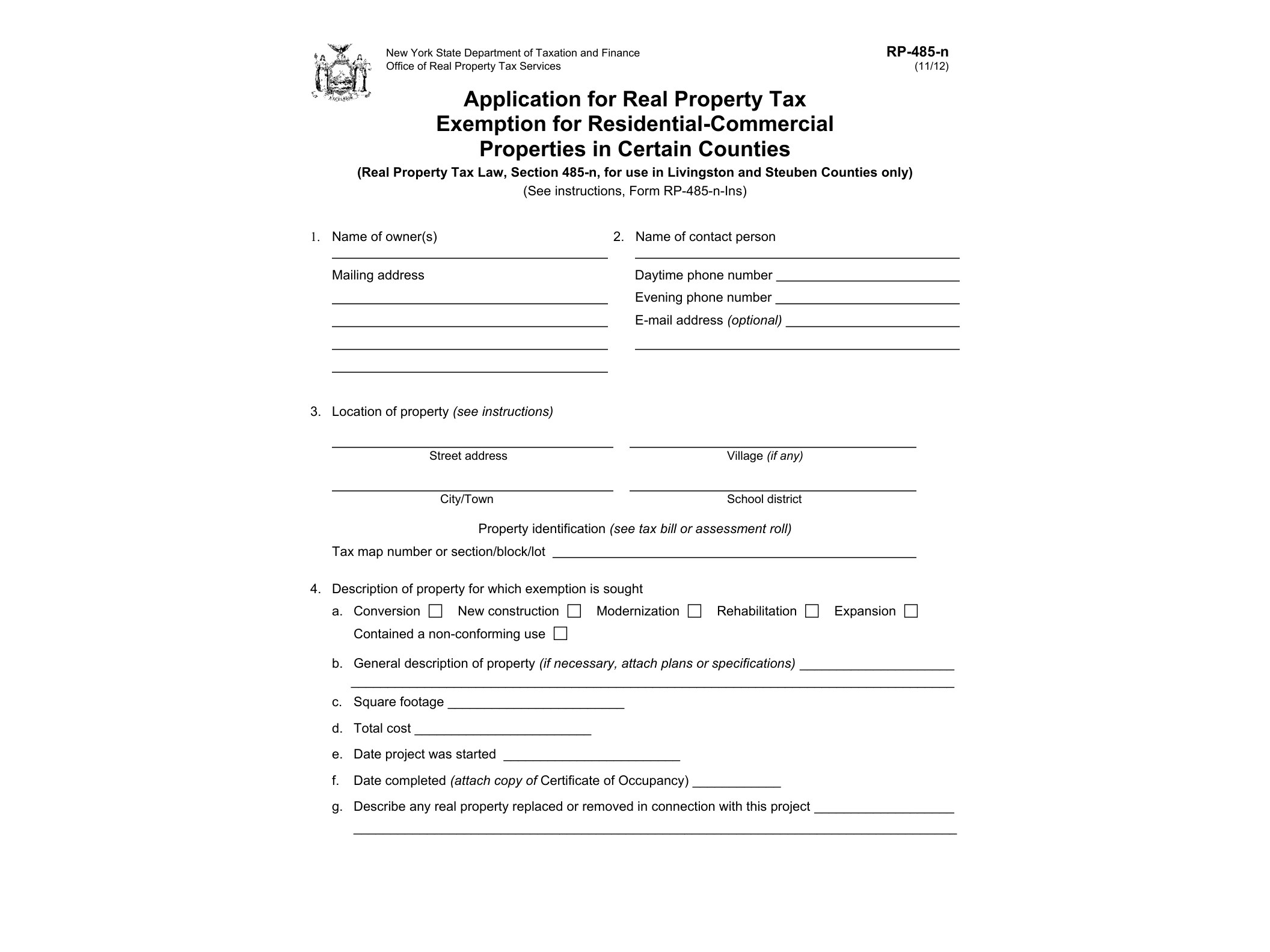
Form RP-485-N is an application used in New York State to request a partial property tax exemption for buildings that combine residential and commercial uses. It’s issued by the New York State Department of Taxation and Finance, but the exemption itself is authorized under Real Property Tax Law section 485-n, which allows certain counties, cities, towns, villages, and school districts to offer tax incentives for the construction or conversion of mixed-use buildings. If you’re renovating or building a property that will house both apartments and commercial space, this form may apply to you.
What This Exemption Covers
The 485-n exemption targets properties where owners are investing in construction, reconstruction, or conversion work that results in a building with both residential units and commercial space. The idea behind the law is to encourage revitalization of downtown areas and underused commercial corridors by making it more financially feasible to add housing above or alongside retail and office space. Not every county has adopted this exemption, so before filling out the paperwork, it’s worth confirming with your local assessor’s office whether your county, city, or school district has opted into the 485-n program. Since adoption is local, exemption percentages, schedules, and eligibility details can vary from one jurisdiction to another.
This form is similar in spirit to other partial exemption applications New York offers for residential improvements, such as Form RP-485-T, which applies to residential construction work in certain cities, or Form RP-485-V2, used for residential revaluation exemptions. The key difference with RP-485-N is that it’s specifically designed for mixed residential-commercial buildings rather than purely residential projects.
Who Needs to File This Form
Property owners who have completed or are undertaking construction, reconstruction, alteration, or conversion of a building for combined residential and commercial use in a participating county are the ones who should file RP-485-N. This typically includes developers converting vacant upper floors of commercial buildings into apartments, owners adding retail space to a residential structure, or anyone rehabilitating a mixed-use property in an area where local officials have adopted the exemption. Landlords and small business owners investing in downtown redevelopment projects are common applicants, since these buildings often qualify if the construction meets the value and use thresholds set by local law.
If your project is purely residential and located in a city that has adopted a different local exemption program, you may want to look into forms like Form RP-485-J, which applies specifically to residential investment properties in Amsterdam, New York. Each of these forms serves a narrower purpose, so matching your project type to the correct application matters for approval.
When to Submit the Application
Timing matters with property tax exemption applications. Generally, RP-485-N should be filed with the local assessor after construction is complete, or according to the specific deadline set by the taxing jurisdiction, which is often tied to the taxable status date in your municipality. Missing that window can mean waiting another full assessment cycle before the exemption can take effect, so it’s smart to talk to your assessor’s office early in the project rather than after the fact.
How to Complete and Submit the Form
The PDF version of RP-485-N includes fillable fields, so you can type your information directly into the document using Adobe Acrobat or a similar PDF reader before printing it for signature and submission. The form asks for details about the property, the nature and cost of the construction or conversion work, the breakdown between residential and commercial use, and supporting documentation such as building permits or certificates of occupancy. Because exemption schedules and percentages are set locally, your assessor may also request additional paperwork specific to your municipality’s adopted local law.
Once completed, the application is submitted to the assessor’s office in the city, town, or county where the property is located, not to the state tax department directly. Keep copies of everything you submit, along with proof of construction costs, in case the assessor requests clarification or the exemption needs to be renewed or adjusted in future years.
Download Official Form RP485N (PDF)
Opens the official government PDF in a new tab