
Download Official Form RP485T (PDF)
Opens the official government PDF in a new tab
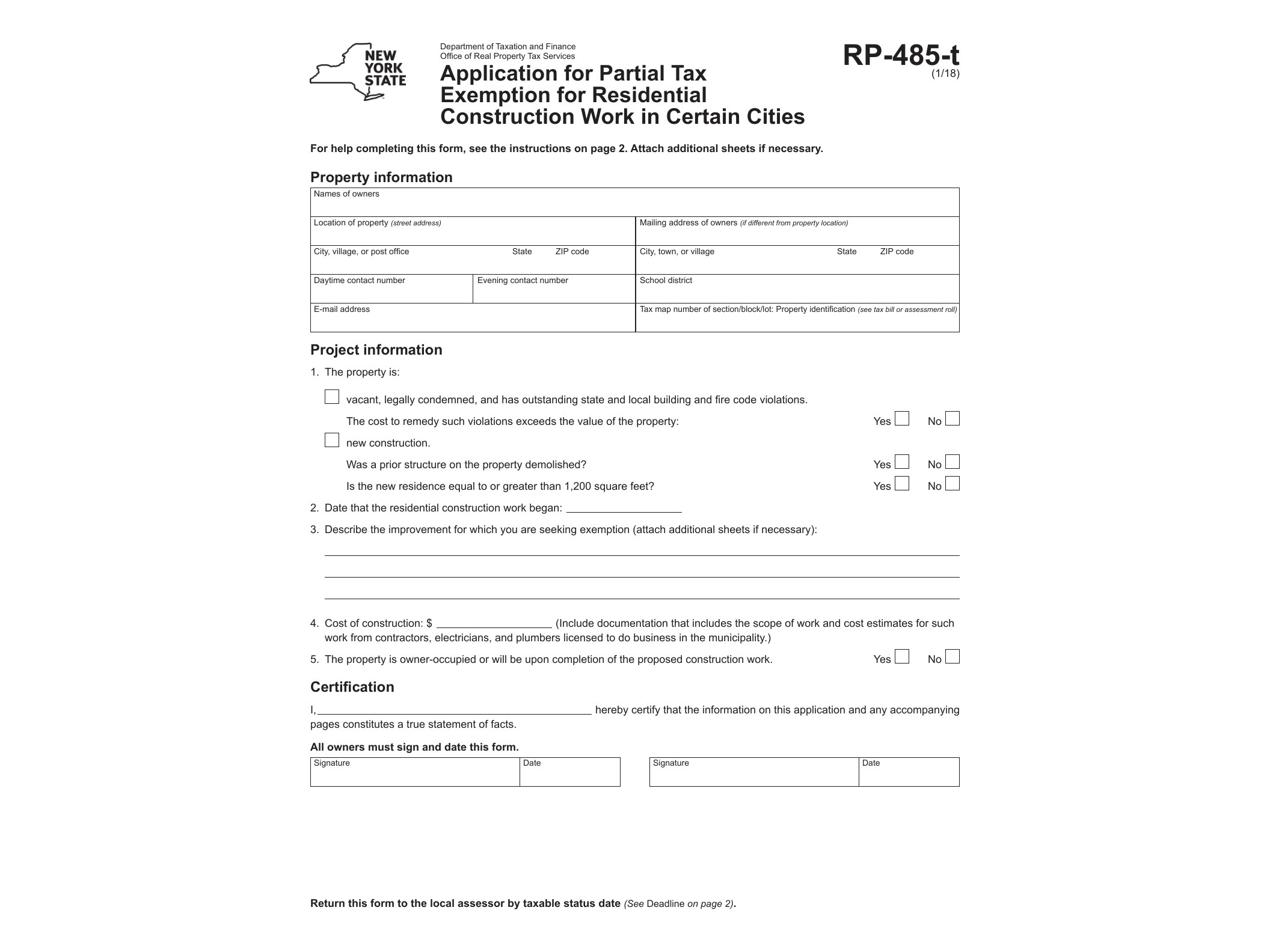
Form RP-485-T, issued by the New York State Department of Taxation and Finance, is the application property owners use to request a partial tax exemption for residential construction work done in certain qualifying cities. This exemption applies to alterations, improvements, or new residential construction that increases a property’s assessed value, allowing owners to phase in the added tax burden rather than absorbing it all at once.
The program exists because local governments in specific cities have adopted resolutions allowing this exemption under New York’s Real Property Tax Law. Not every municipality participates, so before filling out RP-485-T, homeowners should confirm with their local assessor’s office that their city has opted into the program. The form itself is an AcroForm PDF, meaning you can fill it out digitally on your computer before printing and submitting it, which saves time compared to handwriting every field.
Who Needs This Form
RP-485-T is meant for owners of residential property who have completed, or are planning, construction work that qualifies under their city’s exemption resolution. This typically includes reconstruction, alterations, or improvements to existing one- to three-family homes. It’s not intended for brand-new commercial developments or for revaluation-driven assessment changes unrelated to construction—those situations are covered by different forms.
If your project involves residential investment property rather than a standard owner-occupied home, you may want to compare this form with Form RP-485-J, which covers residential investment real property tax exemptions specifically for the city of Amsterdam. Each municipality’s program has its own eligibility rules, so matching the correct form to your city and project type matters.
When to File
Timing is critical with this exemption. Property owners generally need to file RP-485-T with their local assessor before construction begins, or shortly after, depending on the specific city’s adopted local law. Waiting until after the improvements are assessed can result in losing eligibility for the exemption period. Since each participating city sets its own deadlines and exemption percentages, it’s worth calling the assessor’s office directly to confirm the filing window and required documentation, such as building permits or contractor estimates.
The exemption itself is usually phased over several years, reducing the taxable increase gradually rather than applying the full new assessment immediately. This gives homeowners time to adjust their budgets while still encouraging property improvements and reinvestment in older housing stock within these cities.
How to Fill Out and Submit RP-485-T
The form asks for basic identifying information: the property owner’s name, address, parcel identification number, and a description of the construction work performed or planned. You’ll also need to include estimated costs and dates of construction, since the assessor uses this information to calculate the exemption amount and schedule.
Because the PDF supports digital fill-in fields, you can complete it on-screen, save a copy for your records, and print the final version for signature. Most assessors still require a physical signature and paper submission, though some offices now accept scanned copies by email. Check with your local assessor’s office for their preferred submission method before mailing anything.
If your situation instead involves a revaluation rather than new construction, you’ll want to look at Form RP-485-V2, which addresses partial exemptions tied to reassessment rather than physical improvements. And for larger-scale infrastructure-related projects, Form RP-485-G covers exemptions tied to infrastructure improvements rather than residential construction specifically.
Keep in mind that approval isn’t automatic. The local assessor reviews each application, verifies the construction details, and determines the exemption schedule based on the city’s specific resolution. If you’re unsure whether your project qualifies, it’s worth reaching out to the assessor’s office before starting work, since exemption eligibility can sometimes hinge on permit dates or the scope of the renovation.
Download Official Form RP485T (PDF)
Opens the official government PDF in a new tab