
Download Official Form RP485S (PDF)
Opens the official government PDF in a new tab
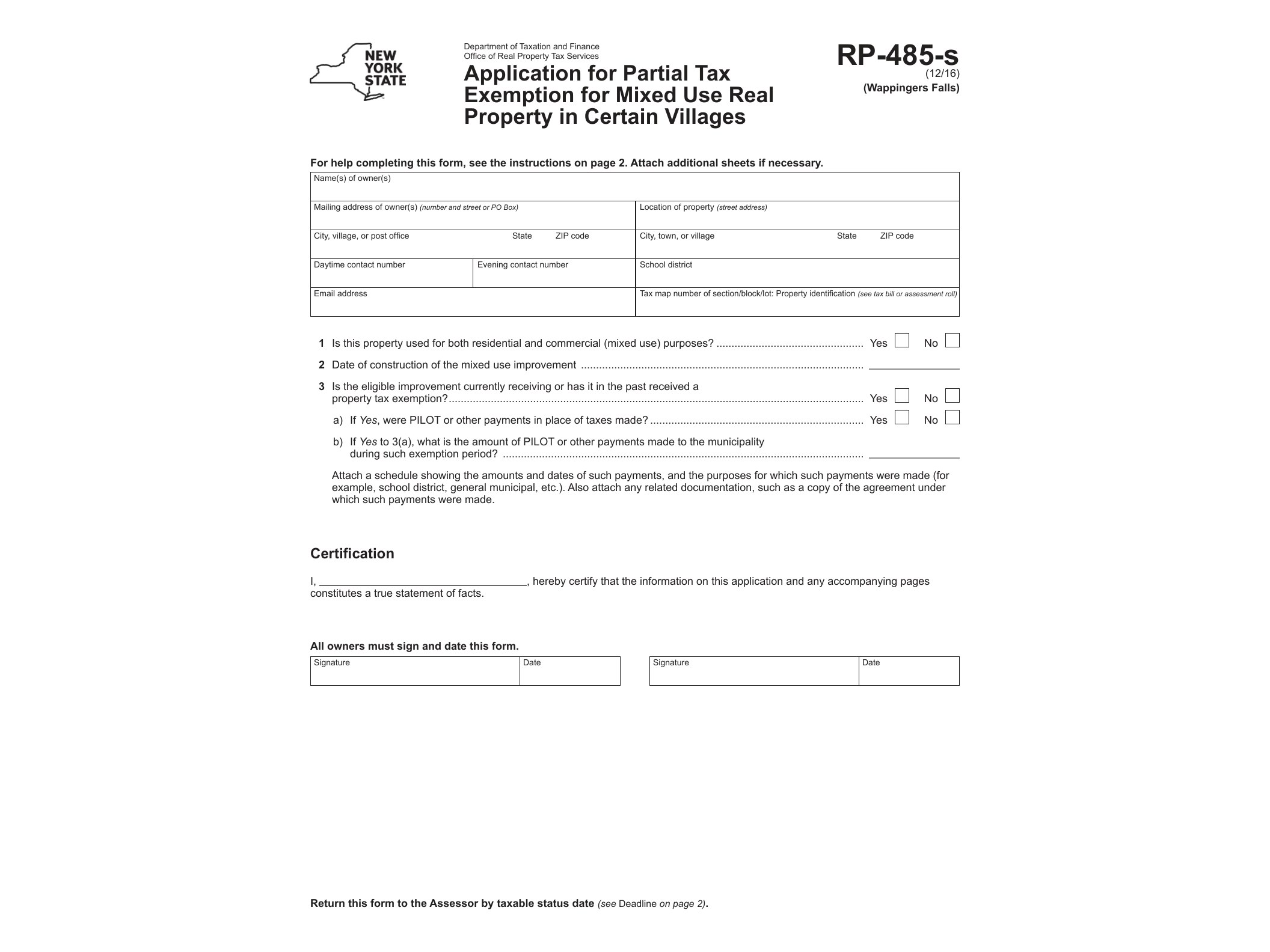
Form RP-485-S is issued by the New York State Department of Taxation and Finance for property owners who want a partial property tax exemption on mixed use real property located in certain villages. “Mixed use” here generally means a building or parcel that combines residential space with commercial or business space under one roof, like a storefront with an apartment above it or a small office attached to a home. Not every village offers this exemption, so the first thing to check before filling anything out is whether your local village has actually adopted the local law authorizing it under Real Property Tax Law section 485-s.
This form matters because mixed use properties often get taxed as if they were fully commercial, even when a good portion of the building is residential. The exemption exists to encourage this kind of development or renovation in village centers, where a mix of housing and small businesses is common but the tax burden can discourage owners from improving their buildings. If your village has passed the local law, this form is how you formally request the reduced assessment tied to the improvements made to the property.
Who Should File This Form
You need Form RP-485-S if you own real property within an eligible village and you’ve made improvements to convert or maintain the property as a mixed use building, meaning it serves both a residential and a commercial purpose. This typically applies to small business owners who live in part of their building, landlords who rent out both apartments and commercial units, or developers rehabbing older village properties into combined-use spaces. Owners of purely residential or purely commercial buildings won’t qualify under this particular form; it’s specifically built for properties that serve both functions at once.
Local assessors are the ones who ultimately confirm eligibility, so it’s worth a call to your village or town assessor’s office before submitting anything. They can tell you whether the local law has been adopted, what percentage of exemption applies, and how many years the benefit lasts, since these details vary by village.
When and How to Use It
The application is generally filed after the qualifying construction or improvement work is completed, and there’s usually a filing deadline tied to the taxable status date in your village, often March 1st, though this can differ locally. Missing that window typically means waiting until the next assessment cycle to apply, so timing your filing right after project completion is important if you want the exemption to kick in as soon as possible.
Filling out the form itself requires basic property identification information, a description of the improvements made, construction costs, and dates the work was completed. Since the form is a fillable PDF, you can type your entries directly into the document before printing it for signature and submission to your local assessor’s office. Supporting documentation, like building permits or contractor invoices, is often requested alongside the application, so keep those records handy.
Owners exploring this exemption might also want to look at related property tax exemption options for construction and improvement work. For example, Form RP-485-T covers partial exemptions for residential construction work in certain cities, which can be a useful comparison if part of your property falls outside village boundaries. Similarly, Form RP-485-N addresses residential-commercial property exemptions in certain counties, which overlaps conceptually with the mixed use focus of RP-485-S. If your project instead involves vacant residential property improvements in a city rather than a village, Form RP-485-Y may be the more appropriate form to review.
Once submitted, the assessor reviews the application and determines the exemption amount, which typically phases down over a set number of years rather than remaining fixed indefinitely. Keeping a copy of your filed application and any correspondence with the assessor’s office is a good practice, since exemption renewals or adjustments sometimes require referencing the original filing details in later tax years.
Download Official Form RP485S (PDF)
Opens the official government PDF in a new tab