
Download Official Form RP491B (PDF)
Opens the official government PDF in a new tab
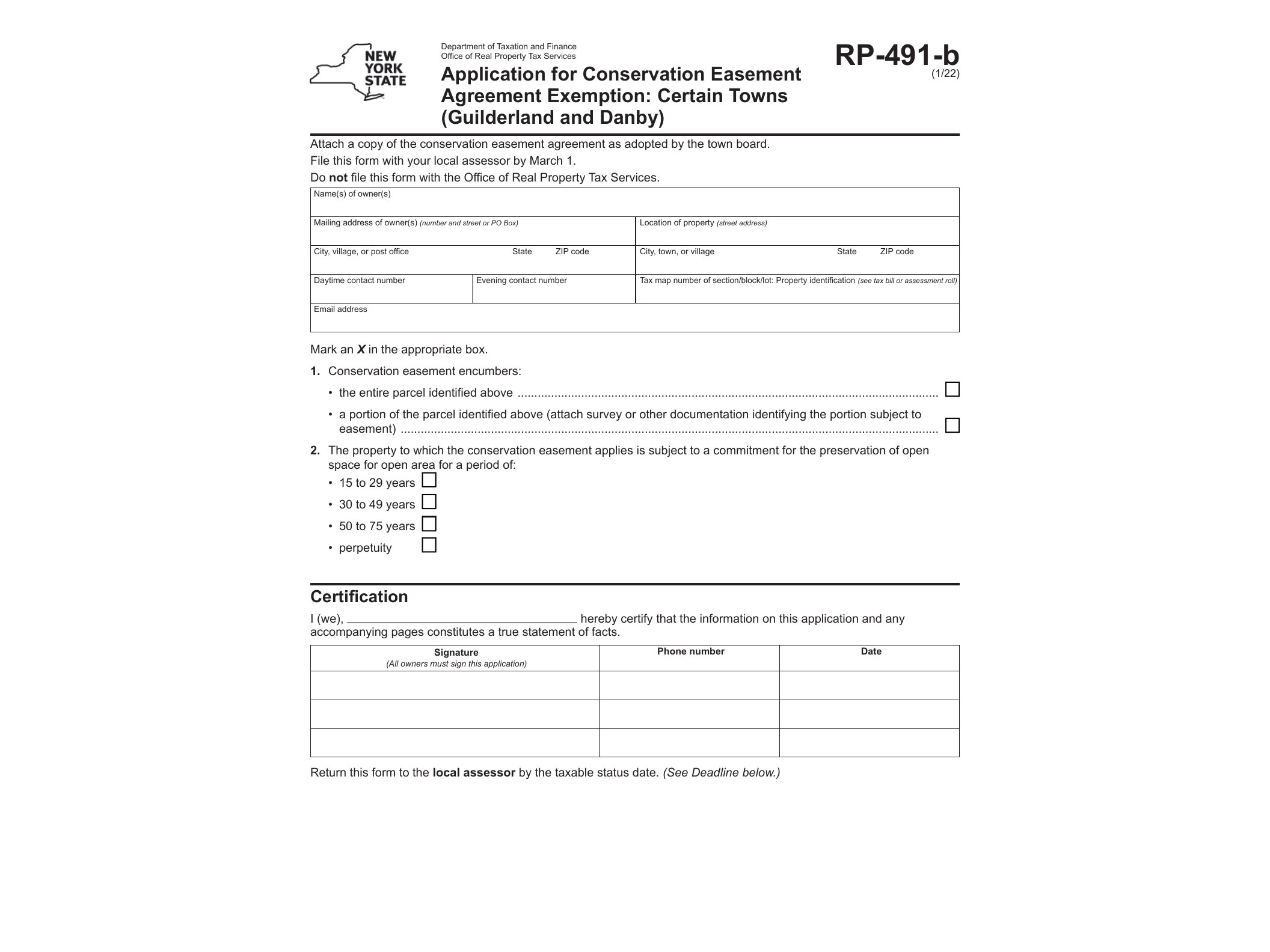
Form RP-491-B is a New York State property tax form issued by the Department of Taxation and Finance. Unlike most exemption applications that apply statewide, this one is narrowly written for landowners in just two municipalities: the Town of Guilderland in Albany County and the Town of Danby in Tompkins County. If your property sits within one of these towns and you’ve entered into a conservation easement agreement, this is the form that lets you apply for the associated tax exemption.
A conservation easement is a legal agreement between a property owner and a qualified organization (often a land trust, municipality, or conservation agency) that restricts certain types of development or land use on a parcel, usually to preserve open space, farmland, wetlands, or scenic value. In exchange for voluntarily limiting what can be done with the land, some jurisdictions offer a reduction in assessed value for tax purposes. Guilderland and Danby have local laws authorizing this specific exemption, and RP-491-B is the standardized application both towns use to process it.
Who Needs to File This Form
You need Form RP-491-B if all of the following apply to your situation:
- Your property is physically located in the Town of Guilderland or the Town of Danby.
- You have signed a conservation easement agreement covering some or all of that property.
- The easement meets the criteria established under the local exemption law adopted by the town.
- You have not already claimed this exemption for the property, or you’re renewing/updating a prior filing.
Property owners outside these two towns cannot use this form. If your municipality has a different conservation easement exemption program, or none at all, you’ll want to check with your local assessor’s office to see what options, if any, exist for your parcel.
When to Submit the Application
Like most property tax exemption applications in New York, RP-491-B needs to be filed with the local assessor by the taxable status date, which is typically March 1 in most towns, though local dates can vary. Filing after this deadline generally means the exemption won’t take effect until the following assessment year. Because the exemption is tied to an active easement agreement, you’ll also need documentation proving the easement is valid, recorded, and still in force at the time of filing.
If your conservation easement changes, is modified, or is terminated, you’re responsible for notifying the assessor, since this can affect your continued eligibility for the exemption.
How to Get and Complete the Form
The form is available directly from the New York State Department of Taxation and Finance website as a fillable PDF (AcroForm), meaning you can type your information directly into the document on a computer before printing it for signature and submission. Filing typically requires:
- Basic property identification information, including the tax map number or parcel ID.
- Owner name and mailing address.
- Details about the conservation easement, including the date it was executed and the organization or entity holding the easement.
- A copy of the recorded easement agreement, which most assessors will want attached to the application.
Once completed, the form is submitted to the local assessor’s office for the Town of Guilderland or Town of Danby, not to the state tax department directly. The assessor reviews the application and supporting documents, verifies eligibility under the local law, and determines the exemption amount, if approved.
This isn’t the only narrow-scope property exemption form New York offers. If you’re researching how railroad property is treated for tax purposes, you might also find the overview of Form RP-489-D and RP-489-DD for subsidized railroad property exemptions useful for comparison. And if you previously claimed an exemption on a property but circumstances have changed, it’s worth reviewing Form RP-496, used to formally renounce a previously granted exemption. Property owners dealing with equalization rate questions in village assessments may also want to look at Form RP-5023.1 for tentative equalization rate objections.
Because this exemption depends heavily on local law specifics in Guilderland and Danby, it’s worth contacting the town assessor’s office directly before filing to confirm current documentation requirements and any local variations in the application process.
Download Official Form RP491B (PDF)
Opens the official government PDF in a new tab