
Download Official Form RP487 (PDF)
Opens the official government PDF in a new tab
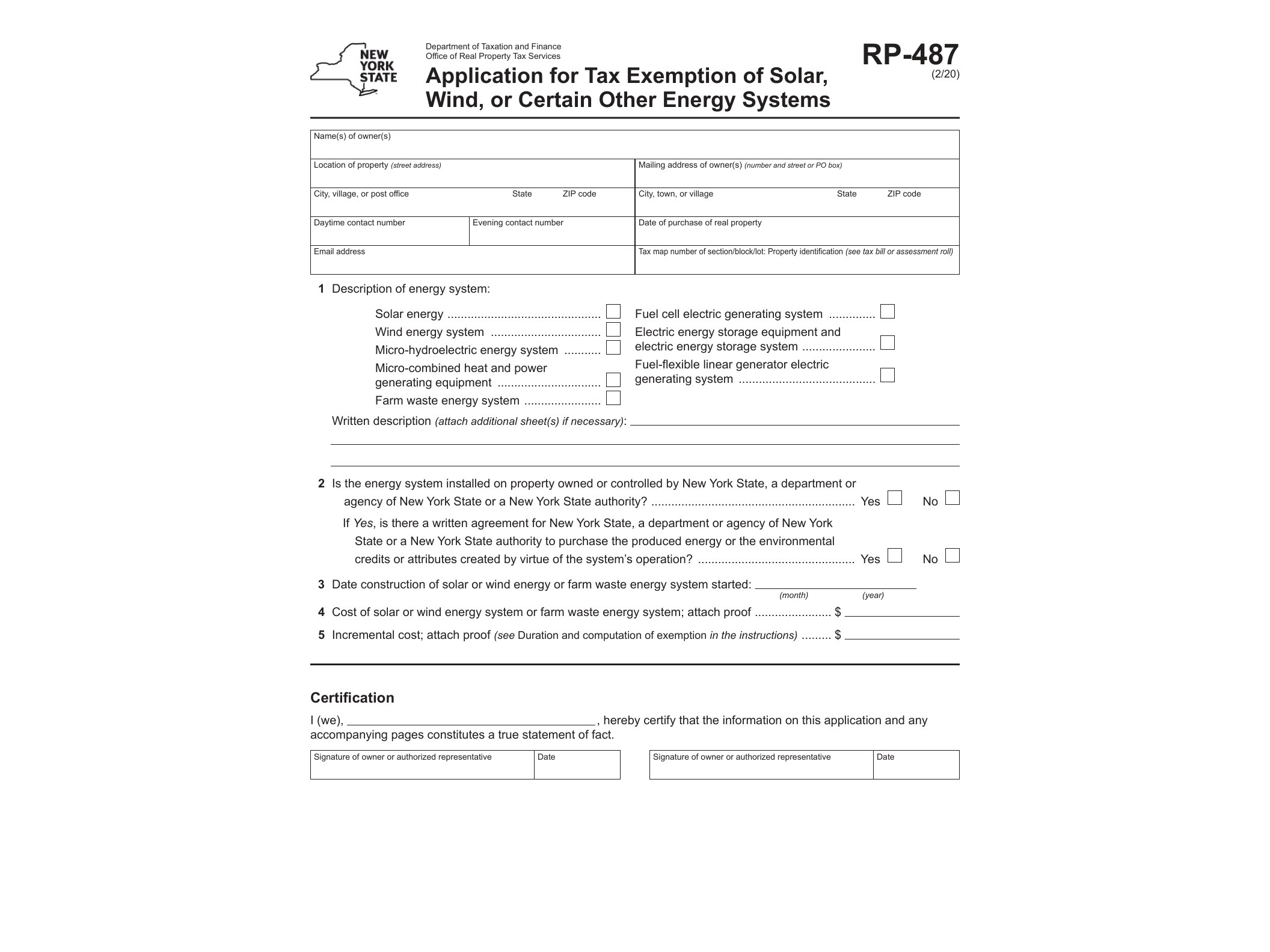
Form RP-487 is the application New York property owners use to request a property tax exemption for wind energy systems, solar energy systems, farm waste energy systems, and micro-hydroelectric energy systems installed on their land. It’s issued by the New York State Department of Taxation and Finance, but the completed form doesn’t go to Albany — it gets filed directly with your local assessor’s office.
The exemption exists because New York wants to encourage property owners to invest in renewable energy without getting hit with a jump in their assessed value once that equipment goes in. Installing a wind turbine, solar array, or similar system can add real value to a parcel, and without this exemption, that added value would typically translate into a higher property tax bill. RP-487 lets qualifying systems be exempt from that increased assessment for a set period, generally 15 years from the date of completion, unless the local municipality has opted out of offering the exemption.
Who Needs This Form
You’ll need Form RP-487 if you own residential, commercial, or agricultural property in New York and you’ve installed — or are planning to install — one of the covered energy systems on or after January 1, 1991 (for solar and wind) or within the applicable timeframes set for farm waste and micro-hydro systems. This includes homeowners who put solar panels on their roof, farmers who install wind turbines on agricultural land, and businesses adding renewable energy infrastructure to commercial property.
It’s worth checking first whether your city, town, village, or school district has passed a local law opting out of the exemption. Some municipalities choose not to offer it, or they modify the terms. Your assessor’s office can tell you quickly whether the exemption is active in your jurisdiction before you spend time filling out paperwork.
When to File
The form needs to be submitted to your local assessor no later than the taxable status date for your municipality, which varies by locality but is often March 1st in many areas outside New York City. If you miss that date, you’ll generally have to wait until the next assessment cycle to apply. Because deadlines differ from one town to another, it’s smart to call the assessor’s office as soon as your energy system is installed, rather than assuming a standard date applies statewide.
What Information You’ll Need
RP-487 asks for details about the property, including the tax map number or property identifier, and specifics about the energy system itself — the type of system, installation date, cost, and capacity. You’ll also need to identify the property owner and provide contact information. Since the form has fillable AcroForm fields, you can complete it electronically on your computer before printing it for signature, which cuts down on handwriting errors and makes the document easier to read when it lands on the assessor’s desk.
Supporting documentation often helps your case, even though it’s not always explicitly required. Installation contracts, manufacturer specifications, and receipts showing the cost of the system can back up the numbers you’re reporting and speed up processing if the assessor has questions.
How the Exemption Works Once Approved
Once your assessor approves the application, the exemption applies to the increase in assessed value attributable to the energy system — not the entire property assessment. Your land and any pre-existing structures continue to be taxed as before; it’s specifically the added value from the wind turbine, solar panels, or other qualifying system that gets excluded from taxation for the exemption period.
This is similar in spirit to other property-specific exemptions New York offers, like the one covered in our guide to Form RP-491-B for conservation easement agreements, where a particular use or feature of the property triggers a targeted tax break rather than a blanket exemption. If your property involves other specialized exemptions, such as subsidized railroad property covered under Forms RP-489-d and RP-489-dd, it’s worth reviewing those alongside RP-487 if your parcel has multiple qualifying features.
If you later disagree with how your assessor valued your property, including any dispute tied to equalization rates, resources like our overview of Form RP-5023.1 for villages explain the objection process, though that’s a separate track from the exemption application itself.
Keep a copy of your filed RP-487 and any assessor correspondence for your records. Since the exemption period runs for years, having documentation on hand makes it easier to resolve any questions that come up on future tax bills or during a reassessment.
Download Official Form RP487 (PDF)
Opens the official government PDF in a new tab