
Download Official Form RP523DCL (PDF)
Opens the official government PDF in a new tab
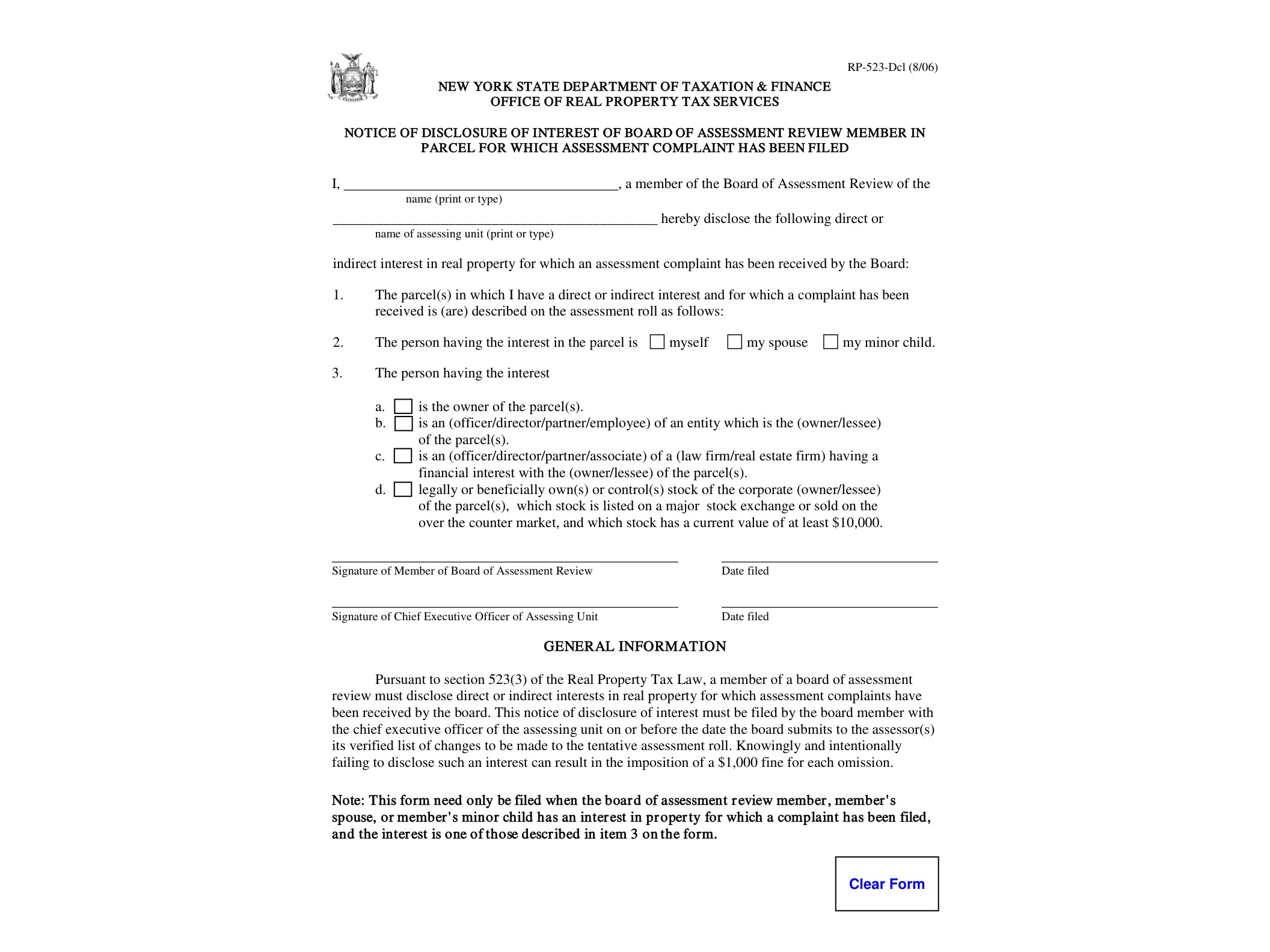
Form RP-523-Dcl is a disclosure form issued by the New York State Department of Taxation and Finance, specifically through its Office of Real Property Tax Services (ORPTS). Its full title is “Notice of Disclosure of Interest of Board of Assessment Review Member in Parcel for Which Assessment Complaint has been Filed.” Despite the long name, the purpose is fairly narrow: it exists to flag a conflict of interest, or the appearance of one, when a member of a local Board of Assessment Review (BAR) has a personal connection to a property whose assessment is being challenged.
Boards of Assessment Review are the local panels that hear complaints from property owners who believe their assessments are too high. These boards are typically made up of local residents appointed by the town or city, which means it’s entirely possible for a board member to know the property, the owner, or even have a financial or family interest in the parcel under review. New York State requires that this kind of connection be disclosed formally, rather than handled informally or ignored.
Who needs to file Form RP-523-Dcl
This form is used specifically by a member of the Board of Assessment Review, not by the property owner filing the complaint. If a BAR member realizes that a parcel under complaint is one in which they have an interest, whether that’s ownership, a family relationship with the owner, a business relationship, or any other situation that could reasonably be seen as a conflict, that member is required to disclose it using this form before the board proceeds with the case.
This matters because assessment complaints are quasi-judicial proceedings. The property owner filing the grievance has a right to expect an impartial hearing, and the disclosure process protects the integrity of that hearing. It also protects the board member, since documenting the disclosure creates a clear record that the interest was reported rather than concealed.
When this form comes into play
Form RP-523-Dcl becomes relevant during the grievance process, after a property owner has already filed a formal complaint. That complaint typically starts with a form like Form RP-553, which the assessor uses to bring the matter before the board. Once the board is reviewing complaints for a given assessment cycle, any member who spots a personal connection to one of the parcels involved should file the disclosure before deliberations move forward on that specific case.
The timing is important. Disclosure needs to happen early enough that the board can decide how to handle the situation, whether that means the conflicted member recuses themselves from voting on that particular parcel, or the board documents the disclosure and proceeds with appropriate transparency. Waiting until after a decision has already been made defeats the purpose of the form.
How to get and complete the form
Form RP-523-Dcl is available directly from the New York State Department of Taxation and Finance as a fillable PDF, meaning it can be completed digitally using standard PDF software before printing or submitting it. The form itself is short and asks for basic identifying information: the name of the board member making the disclosure, the parcel or property involved, the nature of the interest being disclosed, and the date.
Because this is a formal disclosure tied to a specific complaint, it should be kept with the official records of that grievance case, alongside other related paperwork. Once the board reaches its decision on the complaint, that outcome is documented using Form RP-525, the Notice of Determination. If the disclosure affected how the board handled the case, that context is often referenced in the local record even though it isn’t part of the determination form itself.
Local assessors’ offices dealing with property records more broadly may also work with correction forms such as the RP-5217-ACR-Village correction form, though that document serves a different administrative purpose related to property transfer reporting rather than board conflicts of interest.
For anyone serving on a Board of Assessment Review, keeping a blank copy of RP-523-Dcl on hand is a reasonable precaution. Conflicts of interest aren’t always obvious until a specific parcel address comes up on the complaint list, and having the form ready makes it easier to handle disclosure promptly rather than scrambling once the issue is identified.
Download Official Form RP523DCL (PDF)
Opens the official government PDF in a new tab