
Download Official Form RP525 (PDF)
Opens the official government PDF in a new tab
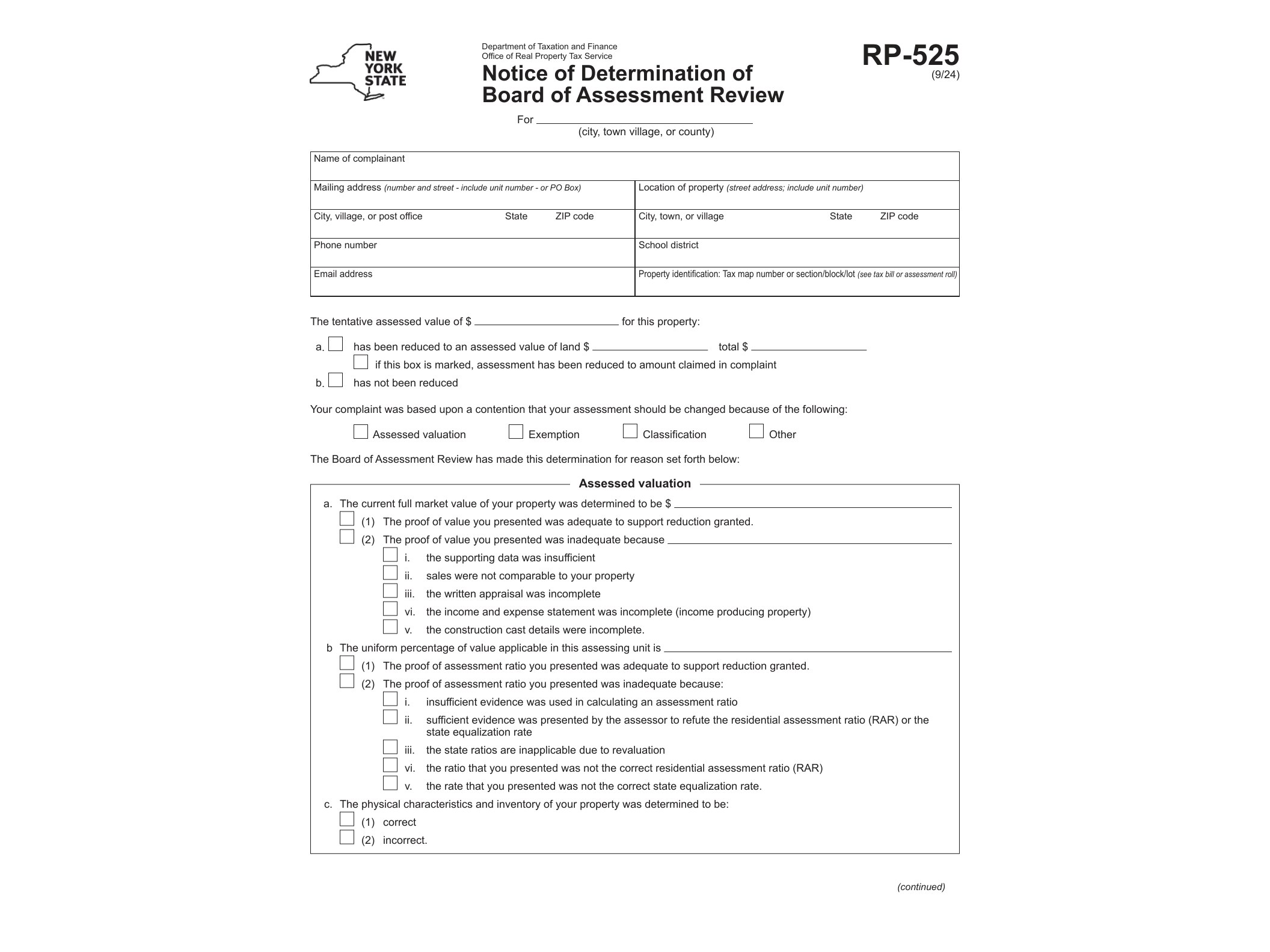
Form RP-525, officially titled “Notice of Determination of Board of Assessment Review,” is the document a local Board of Assessment Review (BAR) issues after reviewing a property owner’s grievance over their assessed value. If you filed a complaint challenging your property’s assessment, this form is how the board tells you what it decided — whether your assessment was reduced, left unchanged, or adjusted in some other way.
The form is issued by New York State municipalities under guidance from the New York State Department of Taxation and Finance, but it’s the local BAR — not the state — that fills it out and sends it to you. Every town, city, or county that conducts assessment review hearings uses this same standardized form so that outcomes are recorded consistently across the state.
Who Needs This Form
You’ll receive Form RP-525 if you’re a property owner who filed a formal grievance with your local Board of Assessment Review, typically using Form RP-524 (Complaint on Real Property Assessment). After the board holds its hearing — usually on Grievance Day, which varies by municipality but often falls in May — it reviews the evidence you submitted and issues its determination using RP-525.
This isn’t a form you fill out and submit yourself in most cases. Instead, it’s generated by the assessor’s office or the board’s clerk and mailed to you as official notice of the outcome. That said, some assessors provide the fillable PDF version so staff can complete it digitally and keep clean, legible records rather than relying on handwritten notices.
What the Notice Contains
Form RP-525 typically includes the property’s identification information (tax map number, address, owner name), the assessed value being grieved, the board’s final determination, and the reasoning behind that decision. It also states your rights going forward — most importantly, your right to further appeal if you’re dissatisfied with the outcome.
If the BAR denies your grievance or doesn’t reduce the assessment enough to satisfy you, the notice generally explains your next options: filing a Small Claims Assessment Review (SCAR) petition for residential property, or pursuing a certiorari proceeding in State Supreme Court for other property types. There are strict deadlines for these next steps, so don’t set the notice aside once it arrives — read it promptly and calendar any filing deadlines mentioned.
When It’s Used
This form comes into play only after the annual grievance process runs its course. Property owners contest assessments once a year during the town or city’s designated grievance period, and the BAR issues determinations shortly afterward, often within a few weeks of the hearing date. Since assessment rolls are typically finalized by early summer in many municipalities, boards work under time pressure to get these notices out before the roll is filed.
It’s worth noting that RP-525 deals specifically with assessment disputes, which is a different track from corrections related to clerical errors or omissions. If your issue is actually about a mistake on the tax roll rather than a disagreement over value, you may be better served by Form RP-554, the Application for Corrected Tax Roll, or by reviewing how Form RP-551-Ntc handles pro-rated tax and omission notices. Property owners dealing with recent sale reporting discrepancies might also want to check out Form RP-5217-CF for correcting real property transfer sale information, since assessment disputes and sale data corrections sometimes surface around the same time.
How to Get and Use the Form
The official fillable version of Form RP-525 is published by the New York State Department of Taxation and Finance and is available directly from the tax.ny.gov website as a PDF with AcroForm fields, meaning it can be typed into and saved electronically before printing or emailing. Assessors and board clerks use this version to fill in property details, hearing dates, and determinations without relying on handwriting.
If you’re a property owner waiting on a determination, you generally don’t need to download the form yourself — it will come to you by mail or, in some municipalities, by email if you provided one on your original grievance complaint. Keep a copy in your records regardless of the outcome, since you may need it as proof of your grievance history if you decide to appeal further or if questions arise in future assessment cycles.
Download Official Form RP525 (PDF)
Opens the official government PDF in a new tab