
Download Official Form RP5850 (PDF)
Opens the official government PDF in a new tab
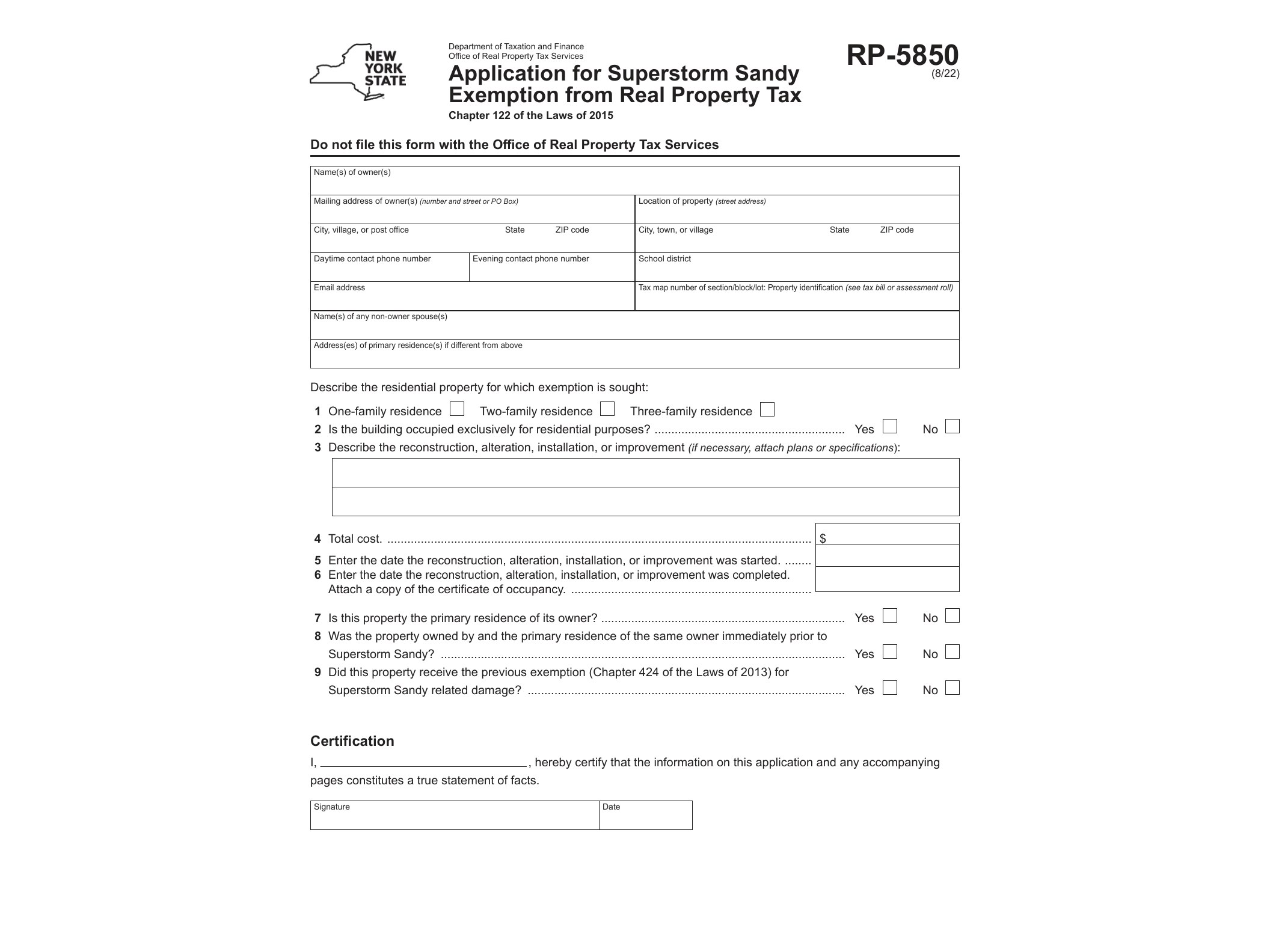
Form RP-5850, issued by the New York State Department of Taxation and Finance, is the application property owners use to request a real property tax exemption tied to reconstruction or improvements made after damage caused by Superstorm Sandy. This exemption recognizes that homeowners who rebuilt or repaired storm-damaged property shouldn’t automatically face a higher assessed value — and therefore a higher tax bill — simply because they restored what the storm destroyed.
The exemption applies specifically to increases in assessed value that result from reconstruction, repairs, or improvements made to a property damaged by Superstorm Sandy in October 2012. Without this exemption, a homeowner who rebuilds a damaged structure could see their assessment jump to reflect the new construction, effectively penalizing them for restoring their home. Form RP-5850 allows eligible owners to exclude that increase from their taxable assessed value for a set period, easing the financial burden of recovery.
Who Needs to File This Form
This form is intended for owners of residential or other eligible property located in areas affected by Superstorm Sandy who completed reconstruction, repair, or improvement work on storm-damaged property. To qualify, the work generally must be connected directly to storm damage — routine renovations unrelated to the storm don’t fall under this exemption. Property owners in coastal counties and other regions hit hardest by the 2012 storm are the primary users of this application, though eligibility depends on local assessor determinations and specific program rules established by the taxing jurisdiction.
Owners should also confirm whether their local municipality or county adopted the exemption, since real property tax exemptions in New York often require local option adoption before residents can apply. Checking with the local assessor’s office before submitting the form can save time and prevent an application from being rejected on technical grounds.
When to Use Form RP-5850
The form should be filed after reconstruction or repair work related to Superstorm Sandy damage has been completed, and before the applicable taxable status date for the assessment roll in question. Because exemption applications in New York are tied to strict filing deadlines set by each municipality, missing the taxable status date typically means waiting until the following assessment year to apply. Property owners who are unsure about their specific deadline should contact their local assessor’s office directly, since dates can vary between counties, towns, and cities.
This exemption is one of several property-specific relief and correction mechanisms available through the New York State Department of Taxation and Finance. Property owners dealing with other assessment issues may also want to review related processes, such as the Lake Ontario and Connected Waterways Assessment Relief Act complaint form, which addresses a different type of storm and water-level related assessment relief, or the Application for Corrected Village Tax Roll, used when a village tax roll contains errors unrelated to storm damage.
How to Get and Complete the Form
Form RP-5850 is available as a fillable PDF directly from the New York State Department of Taxation and Finance website. Because it’s an AcroForm, applicants can type their information directly into the document using standard PDF software before printing it for signature and submission — no need to fill it out by hand.
When completing the form, applicants generally need to provide the property’s identification information (such as the tax map or parcel number), a description of the reconstruction or repair work performed, the date the work was completed, and documentation supporting that the damage was caused by Superstorm Sandy. Supporting evidence might include contractor invoices, permits, or prior assessment records showing the property’s condition before and after the storm.
Once completed, the form must be signed and filed with the local assessor’s office in the municipality where the property is located, not with the state tax department directly. Assessors review the application to confirm eligibility and calculate the portion of increased assessed value that qualifies for exemption. If a property involves a transfer of ownership around the same time reconstruction occurred, owners may also need to reference related transfer reporting requirements, similar to those outlined in the Real Property Transfer Report instructions, to keep property records consistent across filings.
Download Official Form RP5850 (PDF)
Opens the official government PDF in a new tab