
Download Official Form RP6371BAR (PDF)
Opens the official government PDF in a new tab
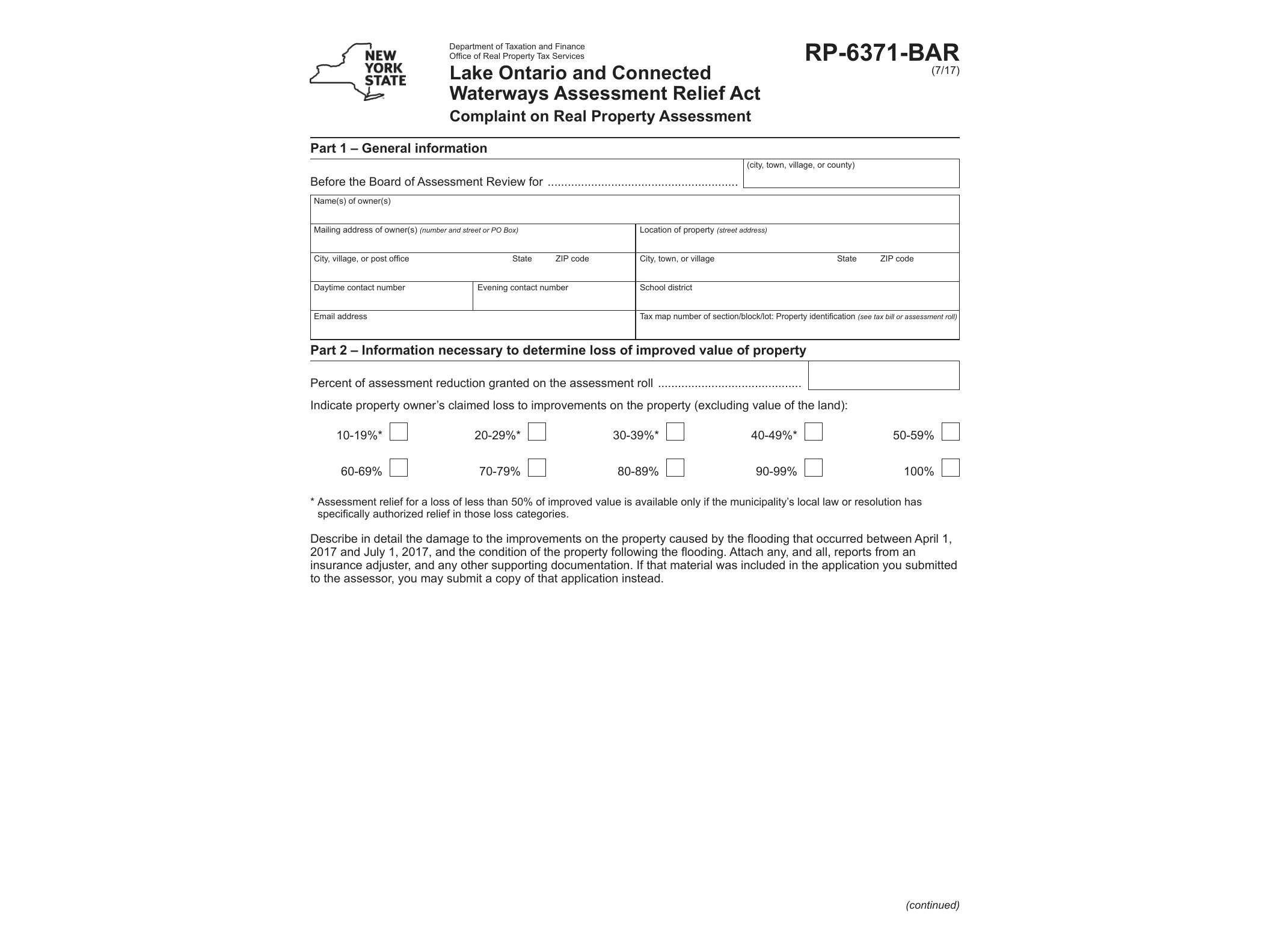
Form RP-6371-BAR, issued by the New York State Department of Taxation and Finance, is a specialized complaint form tied to the Lake Ontario and Connected Waterways Assessment Relief Act. Property owners whose land or structures along Lake Ontario or its connected waterways suffered damage from high water levels, flooding, or erosion use this form to challenge their property assessment before a local Board of Assessment Review (BAR).
The relief act was created after repeated flooding events affected shoreline communities in counties bordering Lake Ontario, as well as areas connected to waterways like the St. Lawrence River, Oneida Lake, and other tributaries. When flooding or erosion physically damages a property, its market value often drops, at least temporarily. Without a mechanism to adjust the assessed value, owners could end up paying taxes based on a valuation that no longer reflects the true condition of their property. Form RP-6371-BAR exists specifically to address that gap.
Who Needs This Form
This form is for owners of residential, seasonal, or commercial property located along Lake Ontario or a connected waterway who believe their assessment does not reflect damage caused by high water conditions covered under the relief act. It’s not a general-purpose grievance form — it applies narrowly to properties eligible under the specific legislation. If your property sustained flood or erosion damage but isn’t located in one of the designated waterway areas, you would likely need a standard grievance form instead, such as the one described in our overview of Form RP-552, the Verified Statement of Assessor to Board of Assessment Review, which covers more conventional assessment disputes.
When to File
Timing matters with this complaint. Local assessment calendars vary, but owners generally need to file during the designated grievance period set by their municipality, which is often a single day in May known as Grievance Day, though some jurisdictions allow a short window around it. Because eligibility depends on documented flood or high-water damage, it helps to gather photos, repair estimates, insurance claims, or FEMA-related paperwork ahead of time. Waiting until the last minute to assemble that evidence can weaken your case in front of the board.
What the Form Covers
Form RP-6371-BAR asks for basic identifying information about the property — parcel number, owner name, and location — along with the current assessed value and the value the owner believes is accurate given the water-related damage. There’s space to describe the nature of the damage, when it occurred, and how it affected the property’s condition or usability. Supporting documentation should be attached rather than summarized only in the narrative section.
Because this form has fillable AcroForm fields, you can complete it directly on a computer using Adobe Acrobat Reader or a similar PDF program before printing it for signature and submission. Digital completion reduces errors and makes the text easier to read for the board members reviewing your complaint, which can matter when they’re processing dozens of similar cases from the same flooding event.
How to Get and Submit It
The form is available directly from the New York State Department of Taxation and Finance as a fill-in PDF. Once completed, it’s submitted to your local Board of Assessment Review, not mailed to the state agency itself. Check with your town or county assessor’s office for the exact filing address and deadline, since these can differ by municipality even though the form itself is standardized statewide.
If your complaint gets denied or you disagree with the board’s determination, you may have further appeal options through Small Claims Assessment Review or a formal court proceeding, depending on the property type. It’s worth asking your local assessor’s office about these next steps when you file, so you’re not caught off guard later. For owners also dealing with related property record corrections, it may help to review how similar assessment paperwork works, such as the process outlined in our guide to the Application for Corrected Village Tax Roll, or how property transfer values are documented in our breakdown of Form RP-5217-PDF instructions, since assessment history often comes up during these disputes.
Keep a copy of everything you submit, including any attachments and proof of filing date. Assessment complaints tied to natural disaster relief acts tend to generate high volumes of paperwork at local offices during peak flood-damage years, and having your own records makes it easier to follow up if there’s a delay in scheduling your hearing.
Download Official Form RP6371BAR (PDF)
Opens the official government PDF in a new tab