
Download Official Form IT230I (PDF)
Opens the official government PDF in a new tab
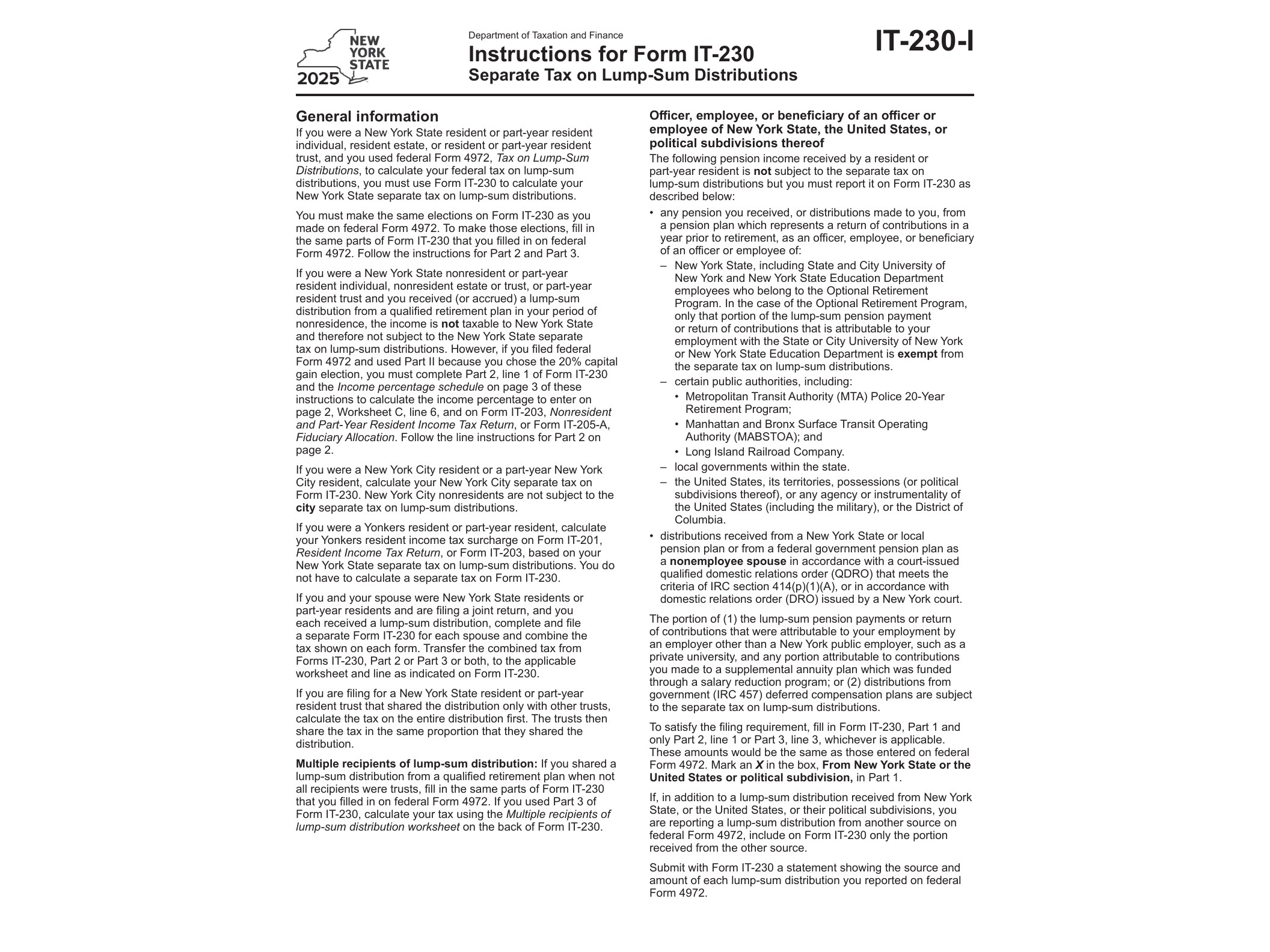
Form IT-230 covers a narrow but important situation: what happens on your New York State return when you receive a lump-sum distribution from a qualified retirement plan and you also had to compute a separate federal tax on that distribution. The IT-230-I instructions walk you through the calculation, but before you get to the worksheet, it helps to understand whether this form even applies to your situation.
A lump-sum distribution is a one-time payment of your entire balance from a qualified pension, profit-sharing, or retirement plan, paid out because of your separation from service, reaching age 59½, disability, or death. In rare cases, taxpayers born before January 2, 1936, who received such a distribution may qualify for special federal tax treatment using the 10-year averaging method on federal Form 4972. If you used that method on your federal return, New York requires you to compute a separate state tax on the same distribution using Form IT-230, because the state doesn’t automatically piggyback on the federal averaging calculation the same way for all purposes.
Who actually needs this form
Realistically, this form applies to a small group of taxpayers. Because the federal 10-year averaging option was tied to a birth date requirement (born before January 2, 1936), the pool of people eligible to file Form 4972 with that election shrinks every year. If you fall into that group and elected special averaging treatment for a lump-sum distribution during 2025, you’ll need to complete IT-230 alongside your New York income tax return. If you didn’t use Form 4972’s averaging method, you almost certainly don’t need this form at all — the distribution gets reported as ordinary income on your New York return instead.
It’s also worth checking whether your distribution came from a government pension or certain other exempt sources, since those may already receive different treatment on your state return regardless of how you reported them federally.
When and how it’s used
Form IT-230 is filed together with your New York State income tax return for the same year you received the lump-sum distribution and elected special federal averaging. The form calculates a separate state tax liability on the distribution amount, using rates and a worksheet structure similar in spirit to the federal averaging method, but applied under New York’s own rules. The resulting tax gets added to your regular New York tax liability rather than being blended into your ordinary income tax bracket calculation.
The IT-230-I instructions booklet explains each line of the worksheet step by step: how to identify the taxable amount of the distribution, how to apply the separate tax rate schedule, and how to transfer the final figure to your main state return. Because the underlying federal election is uncommon, the instructions assume you’ve already completed Form 4972 and have those figures on hand before you start the New York worksheet.
Getting and completing the form
Form IT-230 and its instructions are published by the New York State Department of Taxation and Finance as a fillable-look PDF, but the form itself is not digitally fillable — you’ll need to download it, print it, and complete it by hand using a pen. There’s no online submission option for this particular worksheet; it gets attached to your paper or e-filed return package as supporting documentation, depending on how your overall return is submitted.
Before diving into IT-230, double check that you’re not confusing it with other New York credit and deduction forms that get filed alongside similar return packages. For example, taxpayers dealing with historic property renovations often need the separate Form IT-238 instructions for the Rehabilitation of Historic Properties Credit, while parents claiming childcare costs should look at the Form IT-216 instructions for the Child and Dependent Care Credit. Neither of those relates to lump-sum distributions, but they’re common companion forms in a typical New York filing. If you’re also claiming credits tied to charitable or fund contributions, the IT-228 instructions cover that separate credit.
Keep a copy of your completed Form 4972 with your records, since the New York worksheet references figures directly from that federal form. If you’re unsure whether your distribution qualifies for this treatment, reviewing the eligibility rules on Form 4972 first will save you time before working through the New York-specific calculation.
Download Official Form IT230I (PDF)
Opens the official government PDF in a new tab