
Download Official Form IT248I (PDF)
Opens the official government PDF in a new tab
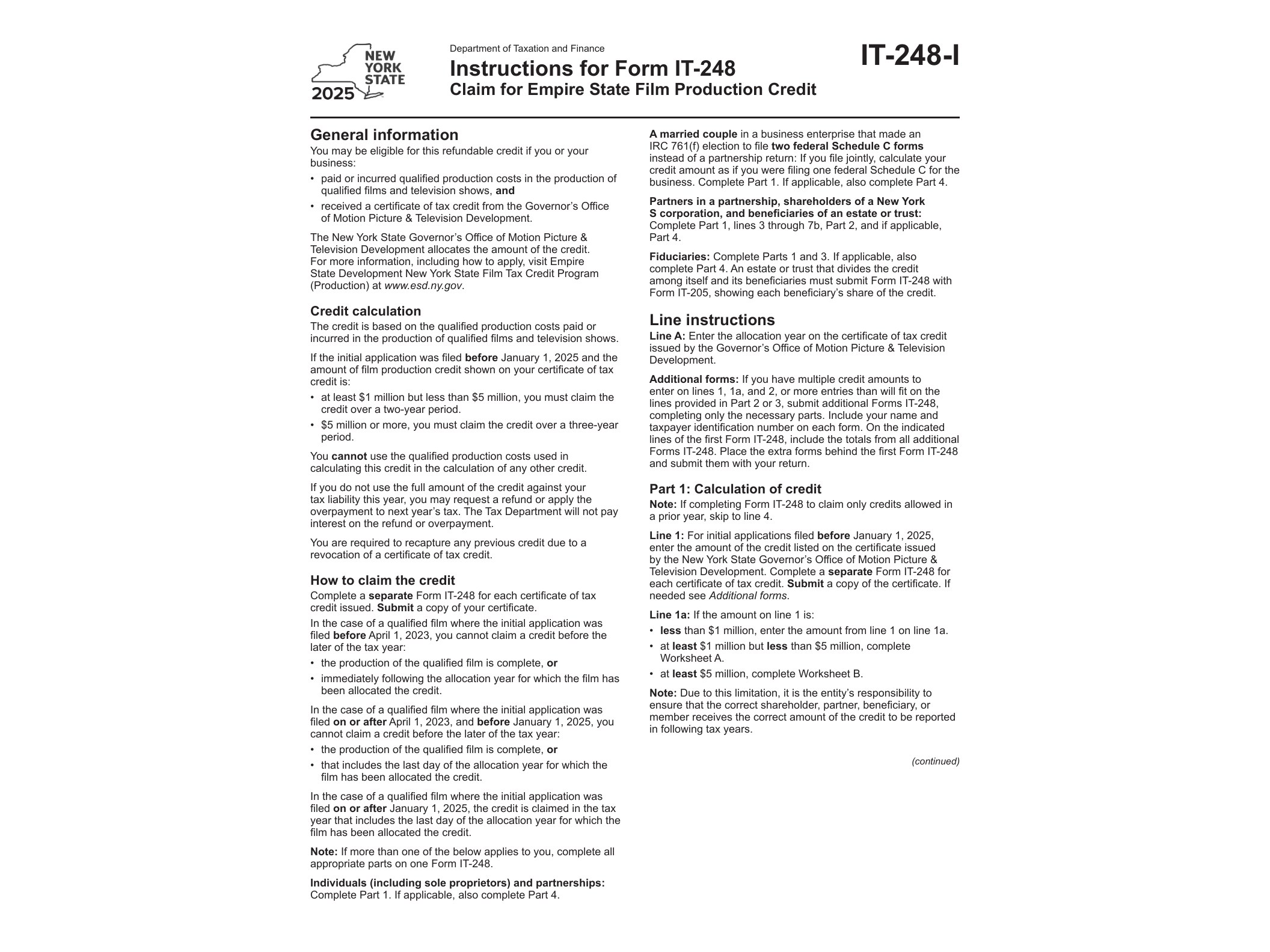
Form IT-248-I contains the official instructions from the New York State Department of Taxation and Finance for completing Form IT-248, Claim for Empire State Film Production Credit. This credit was created to encourage film and television production companies to shoot projects within New York State rather than taking that business elsewhere. If you’re a production company owner, a partner in a production entity, or a shareholder claiming a share of this credit on your personal or corporate return, these instructions walk you through exactly how the numbers flow from your certificate of tax credit to the actual claim form.
The Empire State Film Production Credit isn’t something every taxpayer stumbles into. It applies specifically to qualified film production companies that have already gone through New York’s certification process with the Governor’s Office of Motion Picture and Television Development. That office issues a certificate confirming the amount of credit allocated to a project based on qualified production costs incurred in New York. Form IT-248 is the vehicle for actually claiming that pre-approved credit amount on your state tax filing.
Who needs this form? Primarily corporations, partnerships, and individual taxpayers who have received an allocation certificate for a film or television production that met New York’s qualified production requirements. This includes principal photography, post-production work, and other eligible costs tied to productions filmed at qualified facilities or on location within the state. If your production company received notification of a credit allocation for tax year 2025, you’ll need this form paired with its instructions to file correctly.
The instructions cover several practical points that trip people up. First, they explain how to report the credit if you’re claiming it as a partner, shareholder of an S corporation, or beneficiary of an estate or trust — in these cases, the credit passes through and each party reports their allocated share rather than the full production credit. Second, they clarify the treatment of any credit recapture, which can happen if the production later fails to meet certification conditions. Third, they detail how this credit interacts with the related Empire State Film Post-Production Credit, since productions sometimes qualify for pieces of both and need to avoid double-claiming the same costs.
Timing matters here too. You claim the credit for the tax year in which the certificate of tax credit is issued, not necessarily the year filming wrapped. The instructions specify how to handle situations where the certificate arrives after your original filing deadline, including guidance on amended returns when necessary.
Since Form IT-248 has no digital fill-in fields, you’ll need to print the PDF and complete it by hand before attaching it to your New York State return. Keep your certificate of tax credit and any supporting documentation from the film office on hand while filling this out, since several line items require you to transcribe figures directly from that certificate rather than calculate them yourself.
This credit is one of several New York offers to incentivize specific types of economic activity within the state. If you’re also researching other New York credits tied to specialized industries or circumstances, the rehabilitation of historic properties credit instructions cover a similarly certificate-based process for property owners. Taxpayers juggling multiple New York credits in the same filing year, including those with lump-sum distributions from retirement plans, may also want to check the instructions for Form IT-230, which cover a completely different but commonly encountered New York tax situation.
Because film production credits often involve partnerships or multiple pass-through entities, it’s worth double-checking your entity type against the specific worksheet referenced in the IT-248-I booklet before submitting anything. Misreporting a pass-through share is one of the more common reasons these claims get flagged for review. And if your household also handles more everyday credits like the child and dependent care credit, remember that each credit form on your New York return is filed independently, so errors on one won’t affect the other, but all schedules still need to reconcile with your main IT-201 or IT-203 filing.
Download Official Form IT248I (PDF)
Opens the official government PDF in a new tab