
Download Official Form IT219 (PDF)
Opens the official government PDF in a new tab
If you run a sole proprietorship or work as a partner in a business based in New York City, you may already be familiar with the Unincorporated Business Tax (UBT) — a local tax charged on top of your regular state and federal obligations. Form IT-219, issued by the New York State Department of Taxation and Finance, exists to soften that double burden by letting eligible taxpayers claim a credit against their New York State personal income tax for UBT paid to the city.
This form matters because without it, income earned through an unincorporated business operating in NYC could effectively get taxed twice: once by the city through the UBT, and again by the state through personal income tax on that same business income. IT-219 reconciles the two by giving you a dollar credit calculated from what you actually paid in city UBT.
Who Needs to File Form IT-219
You generally need this form if you are a New York State resident or nonresident individual, estate, or trust that:
- Paid or accrued New York City Unincorporated Business Tax during the tax year
- Reported that unincorporated business income on your New York State personal income tax return
- Is looking to offset part of your state tax liability using the UBT already paid
Partners in partnerships subject to UBT can also use this credit, provided the UBT was actually paid at the entity level and passed through to them. If you’re a sole proprietor filing Schedule C-equivalent income on your New York return and you paid UBT directly to the city, this form applies to you as well.
Corporations don’t use IT-219 — this credit is specifically designed for individuals, estates, and trusts dealing with the personal income tax side of things. If your business structure is a corporation dealing with other city or state compliance issues, you’ll want different paperwork entirely, similar to how business tax program confidentiality statements serve a completely different compliance purpose at the entity level.
When to Use It
Form IT-219 is filed alongside your annual New York State personal income tax return, for the same tax year in which the UBT was paid. For tax year 2025, that means submitting it with your 2025 state return, typically due the following spring unless you’ve filed for an extension. You can’t file this credit form on its own — it always accompanies your main IT-201 (resident) or IT-203 (nonresident/part-year resident) return.
Timing matters here because the credit amount depends on UBT actually paid or accrued during the year in question. If you’re still working through outstanding city tax liabilities, or if your business is facing broader financial difficulties, it may be worth exploring options like those described for entities dealing with offers in compromise for business tax debt before finalizing what you’ll report on IT-219.
How to Fill Out and File the Form
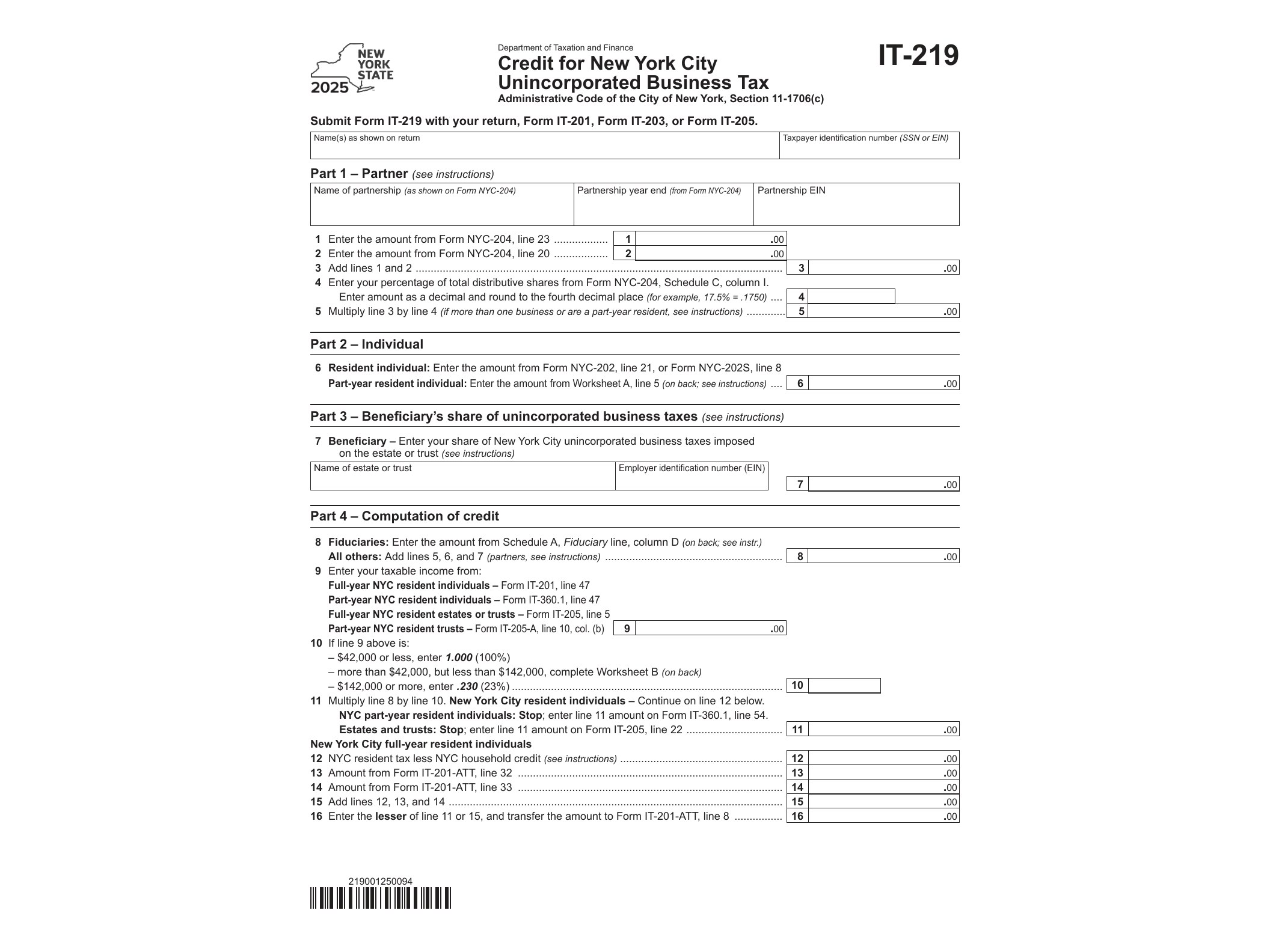
The 2025 version of IT-219 is a fillable PDF, meaning you can type directly into the form fields using Adobe Reader or similar software before printing or attaching it electronically. The form asks for:
- Your identifying information matching your state return
- The amount of UBT paid to New York City for the tax year
- Calculations tying that payment to your reported unincorporated business income
- The final credit amount to transfer onto your IT-201 or IT-203
Make sure the UBT figures you enter match what you actually paid or what was reported to you by the partnership, since discrepancies here are a common reason for processing delays or follow-up notices from the department.
Once completed, IT-219 gets submitted together with your full state income tax return, not separately. If you’re filing electronically through approved software, the form is typically integrated into the e-file package automatically. Paper filers should attach it directly behind their main return pages.
Businesses winding down or restructuring their New York operations sometimes deal with IT-219 during a transition year, particularly if they’re also handling dissolution paperwork like voluntary dissolution requests for a related corporate entity. In those cases, keeping your UBT records organized and matching them to the correct tax year becomes especially important, since final-year credits can get complicated if business income and tax payments span two filing periods.
The official fillable version is available directly from the New York State Department of Taxation and Finance, and it’s worth downloading the current year’s form each time rather than reusing an old copy, since field labels and instructions occasionally shift between tax years.
Download Official Form IT219 (PDF)
Opens the official government PDF in a new tab