
Download Official Form 712 (PDF)
Opens the official government PDF in a new tab
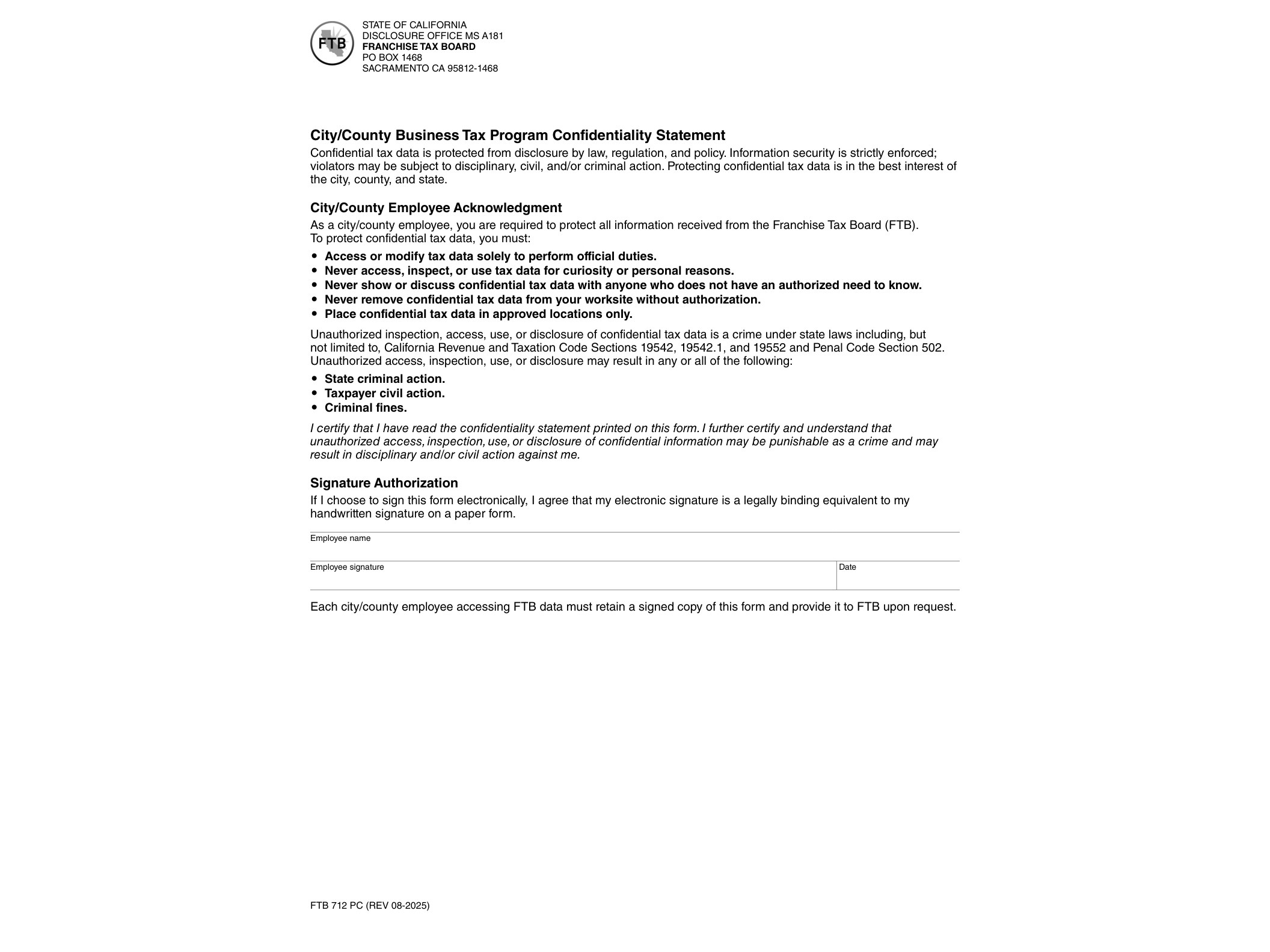
FTB Form 712 is a confidentiality agreement tied to California’s City/County Business Tax Program, a data-sharing arrangement between the Franchise Tax Board and local tax agencies. Cities and counties that participate in this program get access to state tax information to help them identify businesses operating within their jurisdiction that may not be properly registered or paying local business taxes. Because that information includes taxpayer data protected under state law, anyone at the city or county level who touches it has to sign this statement first.
The form itself is short, but it carries real legal weight. It requires the signer to acknowledge that state tax return information is confidential under California Revenue and Taxation Code, and that unauthorized disclosure can lead to criminal penalties, including fines and possible jail time. It’s not a form businesses fill out on their own behalf — it’s an internal compliance document used by government employees who work with FTB-shared data as part of local tax enforcement efforts.
Who Actually Needs to Sign Form 712
This form applies to employees, contractors, or officials working for a participating city or county who will have access to business tax information supplied by the FTB. That typically includes staff in local finance departments, business license divisions, or tax compliance units. Before any of these individuals can view or use FTB data as part of the City/County Business Tax Program, their local agency has to make sure Form 712 is on file, signed and dated, confirming they understand the confidentiality rules.
If you’re a business owner researching FTB paperwork, this particular form isn’t something you’ll ever need to submit. It exists behind the scenes, between the state and local government agencies that cooperate to track business tax compliance. Business owners are more likely to encounter forms tied to entity status or tax settlements, such as the Offer in Compromise process for business entities, which deals with settling outstanding tax debt rather than confidentiality obligations.
When Form 712 Comes Into Play
Local agencies typically request new signatures on Form 712 whenever a new employee joins a role that involves access to shared FTB business tax data, or when an existing employee’s job duties change to include that kind of access. Some jurisdictions also renew these statements periodically as part of their internal compliance audits, since the program depends on strict adherence to state confidentiality standards to keep operating.
The form matters because the City/County Business Tax Program only works if local governments can be trusted with sensitive state tax records. Without a signed confidentiality statement on file, a city or county employee generally won’t be granted access to the FTB’s shared databases or reports used to cross-check business registrations and tax filings at the local level.
How to Get and Complete FTB Form 712
The form is a fillable PDF available directly from the Franchise Tax Board’s website, and it supports digital entry, so it can be filled out on a computer before printing for signature. It asks for basic identifying information: the employee’s name, job title, the city or county agency they work for, and the date. There’s also a statement section where the signer formally agrees to keep any FTB-provided information confidential and to use it only for purposes authorized under the Business Tax Program agreement.
Once completed, the form usually stays on file with the local agency’s records rather than being sent back to the FTB, since it serves as internal documentation that the confidentiality requirement has been met before data access is granted. Agencies participating in the program should check with their FTB liaison for specific retention and submission procedures, since these can vary slightly depending on the county or city’s existing agreement with the state.
For business owners dealing with separate compliance issues, like reinstating a suspended entity or handling a formal dissolution, other FTB forms are more directly relevant. The voluntary administrative dissolution request and the limited partnership revival confirmation application address entity-level issues that businesses actually need to file themselves, unlike Form 712, which stays strictly within government agency operations.
Download Official Form 712 (PDF)
Opens the official government PDF in a new tab