
Download Official Form AU473 (PDF)
Opens the official government PDF in a new tab
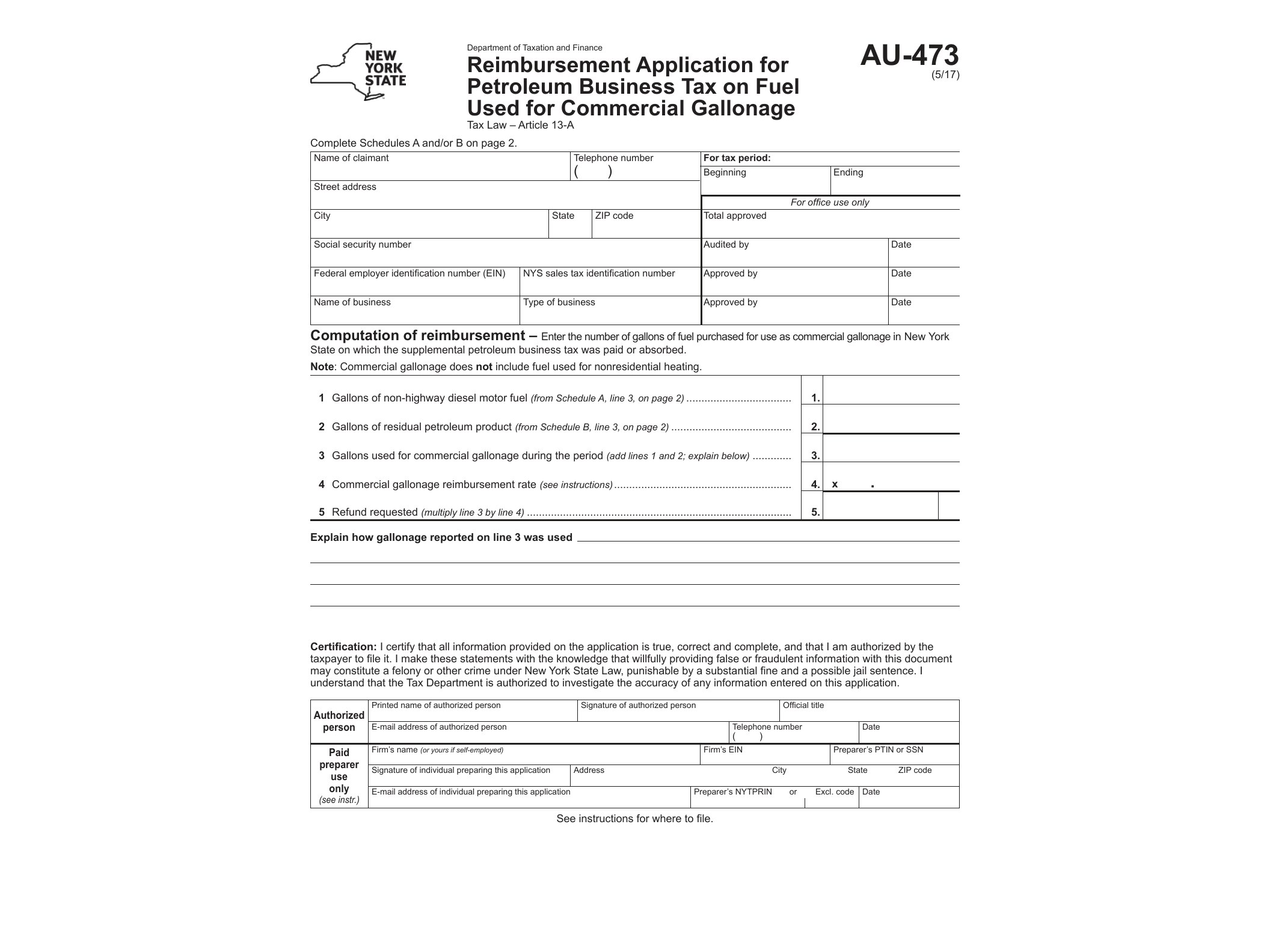
Form AU-473 is issued by the New York State Department of Taxation and Finance and is used to request reimbursement of the Petroleum Business Tax (PBT) paid on fuel consumed as commercial gallonage. This applies to certain diesel motor fuel and residual petroleum products that were purchased with the tax already included in the price, but that were ultimately used in a way that qualifies for a refund under New York tax law.
The term “commercial gallonage” refers to fuel used to operate certain commercial vessels, tugboats, or other qualifying equipment where the fuel does not fall under the standard taxable use categories. Because the PBT is typically built into the price at the pump or at the point of delivery, businesses that qualify for an exemption or reduced tax rate on this type of fuel usage often end up overpaying. Form AU-473 exists specifically to let those businesses claim that money back from the state.
Who Needs to File This Form
This form is meant for businesses and operators that purchase diesel motor fuel or residual petroleum product in New York State, pay the petroleum business tax at the time of purchase, and then use that fuel for a qualifying commercial gallonage purpose. Common filers include companies operating tugboats, barges, or other vessels used in commercial transportation or towing activities on New York waterways.
If your business doesn’t use fuel in this specific commercial gallonage context, this probably isn’t the right form. Many petroleum tax reimbursement claims in New York fall under a more general process, which is why the Department of Taxation and Finance also maintains Form AU-630 for other types of petroleum business tax reimbursement claims. It’s worth checking both forms before filing to make sure you’re using the correct one for your situation, since submitting the wrong application can delay your refund.
When to Use Form AU-473
You should file this form after you’ve already paid PBT on fuel used for qualifying commercial gallonage purposes during a specific filing period. The state requires documentation showing the amount of fuel purchased, the tax paid, and proof that the fuel was used in a manner that qualifies for reimbursement. There are filing deadlines tied to the period in which the fuel was purchased and used, so it’s best not to let purchase records pile up for too long before submitting a claim — older claims can become harder to substantiate and may run into filing period limitations.
How to Complete and Submit the Form
Form AU-473 is not fillable digitally. It needs to be downloaded, printed, and completed by hand, then mailed to the Department of Taxation and Finance along with any required supporting documentation, such as fuel purchase invoices and records showing the qualifying use. Because the form involves calculations related to gallonage, tax rates, and reimbursement amounts, it’s a good idea to work through the accompanying Form AU-473-I instructions before filling anything out. The instructions walk through each line item and clarify what documentation the Department expects to see attached to the claim.
Double-check your fuel purchase records against what you report on the form. Mismatched numbers or missing invoices are among the most common reasons reimbursement applications get delayed or sent back for correction. If you’re also filing a separate PBT reimbursement claim under the general process, reviewing the Form AU-630I instructions can help you understand how that companion process differs from the commercial gallonage claim covered here.
Once completed, mail the form and all supporting documents to the address listed on the form itself. Keep copies of everything you submit, since processing can take time and you may need to reference your original submission if the Department has questions about your claim.
Download Official Form AU473 (PDF)
Opens the official government PDF in a new tab