
Download Official Form IT2106 (PDF)
Opens the official government PDF in a new tab
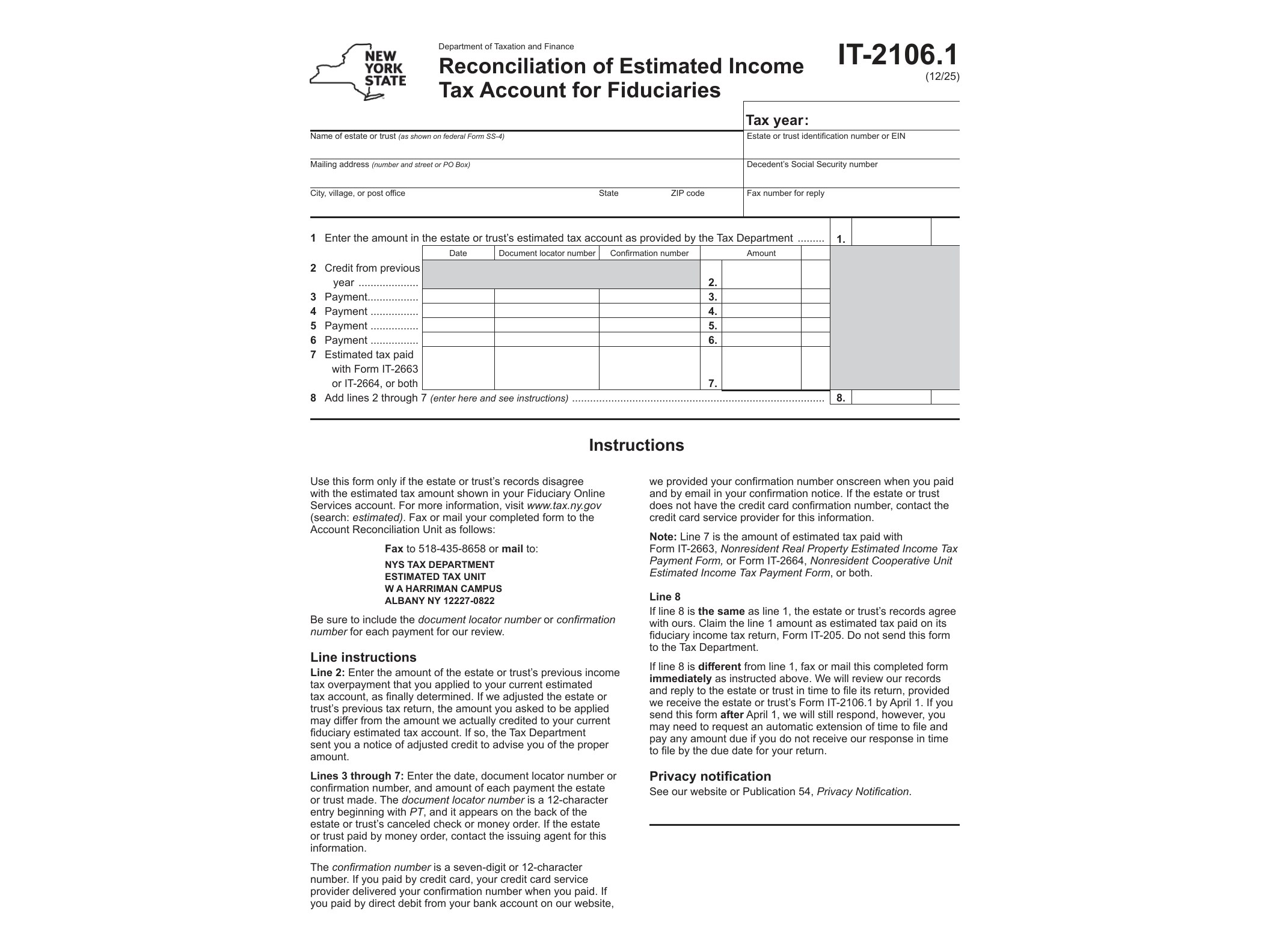
Form IT-2106.1, Reconciliation of Estimated Income Tax Account for Fiduciaries, is issued by the New York State Department of Taxation and Finance. It’s used by fiduciaries — executors, administrators, and trustees — who manage estimated tax accounts on behalf of estates or trusts and need to reconcile payments after a change in the entity’s tax situation, such as a distribution of income to beneficiaries or a termination of the estate or trust during the year.
Estates and trusts that make estimated tax payments under Form IT-2106 sometimes end up with a mismatch between the estimated tax paid and the actual tax owed once income is distributed or the fiduciary relationship ends. Form IT-2106.1 exists to sort that out. It allows the fiduciary to allocate estimated tax payments already made to the beneficiaries who are now responsible for reporting that income, or to adjust the account when the estate or trust closes before the end of the tax year.
Who Needs to File Form IT-2106.1
This form applies specifically to fiduciaries of New York estates and trusts that have an open estimated tax account. You’ll typically need it if:
- The estate or trust distributed income to one or more beneficiaries during the tax year and estimated tax payments need to follow that income.
- The estate or trust terminated before the end of the tax year, requiring a final reconciliation of any estimated payments on file.
- There’s a discrepancy between what was paid in estimated tax and what the final return shows is actually owed, and the fiduciary needs to request a credit transfer to beneficiaries.
If none of these situations apply — meaning the estate or trust simply pays its estimated tax and files its return without any distribution or early termination issues — this reconciliation form generally isn’t needed.
When to Use This Form
Form IT-2106.1 is filed after the fact, once the fiduciary knows how income was distributed or that the estate/trust has closed. It’s not a substitute for the regular estimated tax voucher (Form IT-2106); rather, it’s a follow-up document that reallocates or reconciles what was already paid. Fiduciaries should file it as soon as the relevant distribution or termination event is finalized, since beneficiaries may need the reallocated estimated tax credit reflected on their own personal income tax returns for the same year.
Timing matters here because if the reconciliation isn’t filed promptly, beneficiaries could end up filing their own returns without the estimated tax credit they’re entitled to, leading to discrepancies that the Department of Taxation and Finance may later need to correct manually.
How to Fill Out and Submit Form IT-2106.1
The version revised 12/25 is available as a fillable PDF, so it can be completed digitally before printing or submitting. The form generally requires:
- Identifying information for the estate or trust, including the fiduciary’s name and the entity’s employer identification number.
- Details on the estimated tax payments already made under the IT-2106 account.
- A breakdown of how those payments should be reallocated — either to specific beneficiaries or reflected in a final account closure.
- Beneficiary information, including names and identification numbers, when payments are being distributed among multiple parties.
Because this form deals with account reconciliation rather than a simple filing, accuracy in the numbers is critical. Any mismatch between what’s reported here and what appears on the estate’s or trust’s final fiduciary return can delay processing or trigger a request for clarification from the state.
Fiduciary tax situations often overlap with other New York withholding and exemption matters. For instance, if a beneficiary works under the START-UP NY program, it’s worth reviewing Form IT-2104-SNY to understand how withholding exemptions apply separately from estate distributions. Similarly, fiduciaries handling accounts for enrolled tribal members should be aware of the distinct rules covered in Form IT-2104-IND, since tribal exemption status can affect how income and withholding are treated.
Since Form IT-2106.1 isn’t an annual filing tied to a fixed deadline like a standard tax return, fiduciaries should check current instructions from the New York State Department of Taxation and Finance for any specific submission windows tied to the estate’s or trust’s closing date. Keeping thorough records of distributions and payment dates will make completing this form considerably easier when the time comes.
Download Official Form IT2106 (PDF)
Opens the official government PDF in a new tab