
Download Official Form IT269 (PDF)
Opens the official government PDF in a new tab
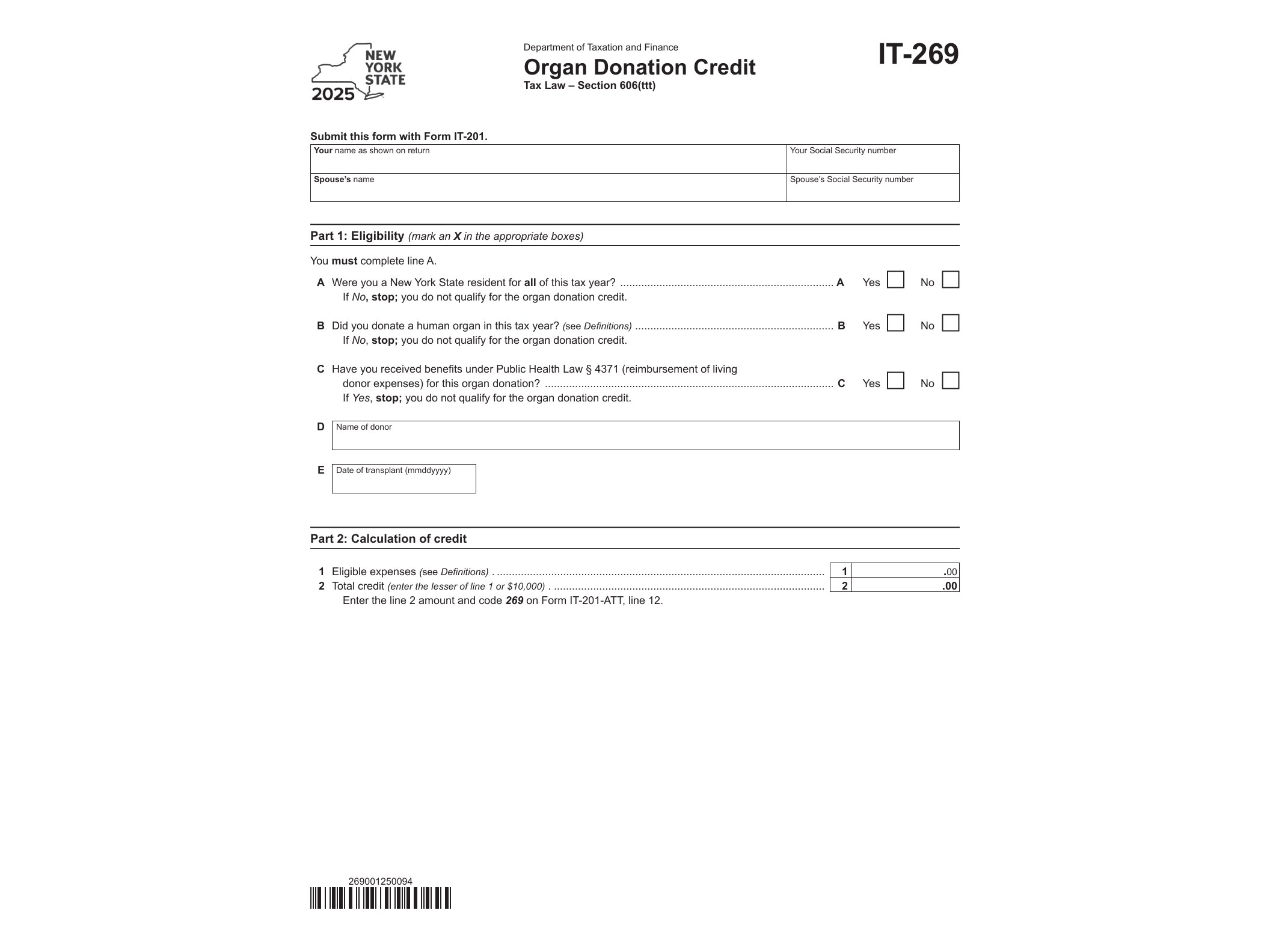
Form IT-269 is the New York State Department of Taxation and Finance form used to claim the Organ Donation Credit. It’s a lesser-known credit, but for the taxpayers who qualify, it can offset some real costs tied to becoming a living organ donor. If you or someone in your household donated an organ during the tax year, this form is worth a close look before you file.
The credit exists to ease the financial burden that comes with living organ donation. New York allows eligible donors to claim a credit for unreimbursed expenses directly related to the donation of an organ such as a kidney, liver, lung, pancreas, or bone marrow. This includes costs like travel, lodging, and lost wages connected to the donation process, up to the maximum allowed under the program.
Who Needs Form IT-269
You need this form if you’re a New York State resident, part-year resident, or nonresident who donated a human organ during the tax year and incurred expenses that weren’t reimbursed by insurance, an employer, or any other source. The credit is capped at $10,000 in eligible unreimbursed expenses, and it can only be claimed once per taxpayer over their lifetime, not once per tax year.
Eligible expenses generally fall into three categories: travel costs, lodging, and lost wages related to the surgery and recovery period. If your expenses were fully covered by insurance or an employer program, you won’t have anything left to claim. The form is specifically for out-of-pocket costs that nobody else picked up.
When to File Form IT-269
Form IT-269 is filed alongside your New York State personal income tax return for the year in which the organ donation and related expenses occurred. For tax year 2025, that means it accompanies your 2025 IT-201 (resident) or IT-203 (nonresident/part-year resident) return, filed in early 2026. You can’t submit this form on its own — it’s an attachment to your main state income tax filing, and the credit amount calculated on IT-269 flows through to your return.
Keep documentation. The Department of Taxation and Finance doesn’t require you to submit receipts with your return, but you should retain records of travel expenses, hotel stays, and any documentation showing lost income during recovery, in case of an audit or verification request.
How to Get and Fill Out Form IT-269
The form is available as a fillable PDF directly from the New York State Department of Taxation and Finance website. Because it uses AcroForm fields, you can type your information directly into the PDF on your computer before printing or attaching it to an e-filed return, which cuts down on handwriting errors and makes the form easier to review before submission.
Filling it out involves reporting basic identifying information, the type of organ donated, the date of the donation, and a breakdown of your unreimbursed expenses by category. The form walks you through calculating the total credit, which then gets carried over to the appropriate line on your IT-201 or IT-203. If your calculated credit exceeds your tax liability for the year, New York allows any excess to be refunded, since this is a refundable credit — a detail that makes it more valuable than a typical non-refundable credit for lower-income filers.
This isn’t the only state-specific credit New York residents should know about. If you’re also checking eligibility for other niche credits, it’s worth reviewing Form IT-270, the New York City Income Tax Elimination Credit, which applies to a different but equally specific group of filers. Taxpayers who’ve moved between states or who also file in California might find parallels in credits like the California Credit for Prior Year Alternative Minimum Tax, another example of a state-level credit built for a narrow set of circumstances.
Since the Organ Donation Credit can only be claimed once in a lifetime, double-check your math and your documentation before filing. If your situation is complicated — say, you donated an organ but also have other state tax credits to sort out — it may be worth having a tax preparer review your IT-269 alongside the rest of your New York return before you submit it.
Download Official Form IT269 (PDF)
Opens the official government PDF in a new tab