
Download Official Form RP459B (PDF)
Opens the official government PDF in a new tab
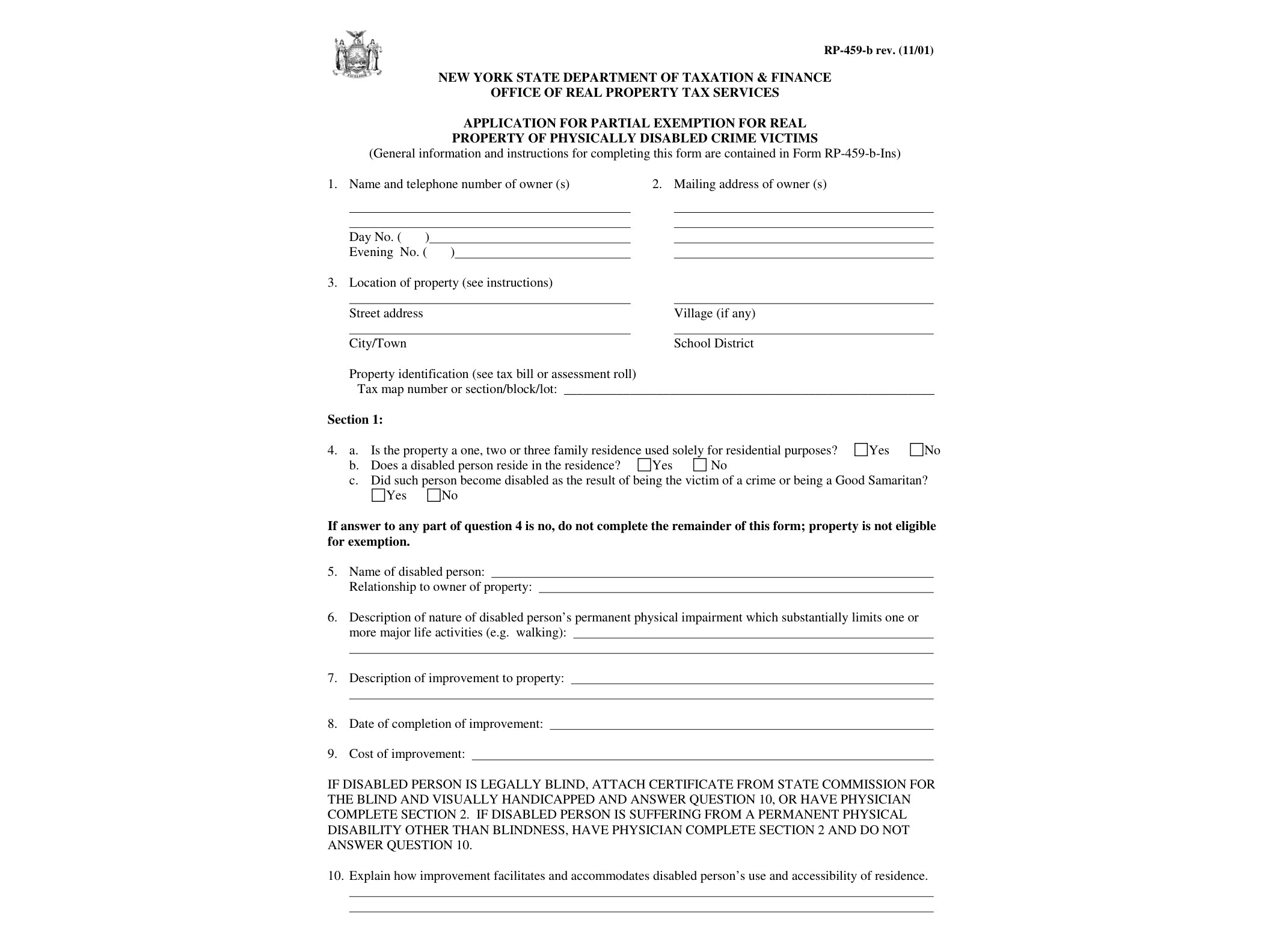
Form RP-459-B is issued by the New York State Department of Taxation and Finance, specifically through the Office of Real Property Tax Services (ORPTS). Its full title is “Application for Partial Exemption for Real Property of Physically Disabled Crime Victims,” and it exists to give a measure of financial relief to homeowners who became physically disabled as a direct result of a crime committed against them. If you or a family member living in your home was injured during a criminal act and now has a qualifying physical disability, this form is the mechanism for reducing the assessed value of your property for local tax purposes.
The exemption isn’t automatic. Local municipalities in New York have the option to adopt this exemption under Real Property Tax Law, so before filing you should confirm with your local assessor’s office that your town, city, or county actually offers it. Not every jurisdiction does, and the percentage of exemption granted can vary from one municipality to another depending on the local law adopted.
Eligibility generally requires that the applicant, or a member of the household, sustained a physical disability caused by a criminal act — this is different from disability exemptions tied to age or general limited income, which fall under other forms. The property must also be the primary residence of the disabled crime victim, and ownership requirements typically follow the standard real property exemption rules used across New York State assessment law.
Because this exemption is narrowly focused on disability resulting from criminal victimization, it’s worth distinguishing it from other similar-sounding programs. For example, homeowners with disabilities and limited income who were not necessarily crime victims should instead look at Form RP-459-C, which covers a broader disability and income-based exemption. If your situation involves a religious organization’s residence for clergy rather than a private disability case, that falls under a completely different category covered by Form RP-462 for parsonages and manses.
When to File Form RP-459-B
Like most New York property tax exemption applications, RP-459-B needs to be submitted to your local assessor by the taxable status date set by your municipality — this date varies by county and city, so check with your assessor’s office directly rather than assuming a statewide deadline. Filing after this date usually means waiting until the following assessment cycle, so it pays to plan ahead if you know you’ll need to apply.
Supporting documentation is a key part of the process. Applicants typically need to provide medical evidence establishing the physical disability, along with documentation connecting that disability to the criminal act — this might include police reports, court records, or certification from the New York State Office of Victim Services. The assessor’s office can clarify exactly what proof they require, since local practices sometimes differ slightly in what they accept.
How to Fill Out and Submit the Form
Form RP-459-B is available as a fillable PDF (AcroForm), which means you can complete it directly on your computer before printing it for signature and submission — most assessors still require a physical signature and hard copy, since electronic filing isn’t standard for these applications. The form asks for basic identifying information about the property and owner, details about the disability and its connection to a crime, and a certification section where you attest that the information provided is accurate.
If your local assessor also asks for supplemental worksheets during the review process, it may be useful to look at how similar assessment worksheets are structured, such as the one described in our guide on the RP-305-R-WS assessor’s worksheet, since ORPTS forms tend to follow a similar layout and logic across programs.
Once submitted, the assessor reviews the application and supporting evidence, determines whether the property qualifies, and applies the exemption percentage adopted by the local government to the assessed value. If your application is denied or you disagree with the exemption amount granted, you generally have the right to challenge the determination through your local Board of Assessment Review during grievance days.
Download Official Form RP459B (PDF)
Opens the official government PDF in a new tab