
Download Official Form RP466J (PDF)
Opens the official government PDF in a new tab
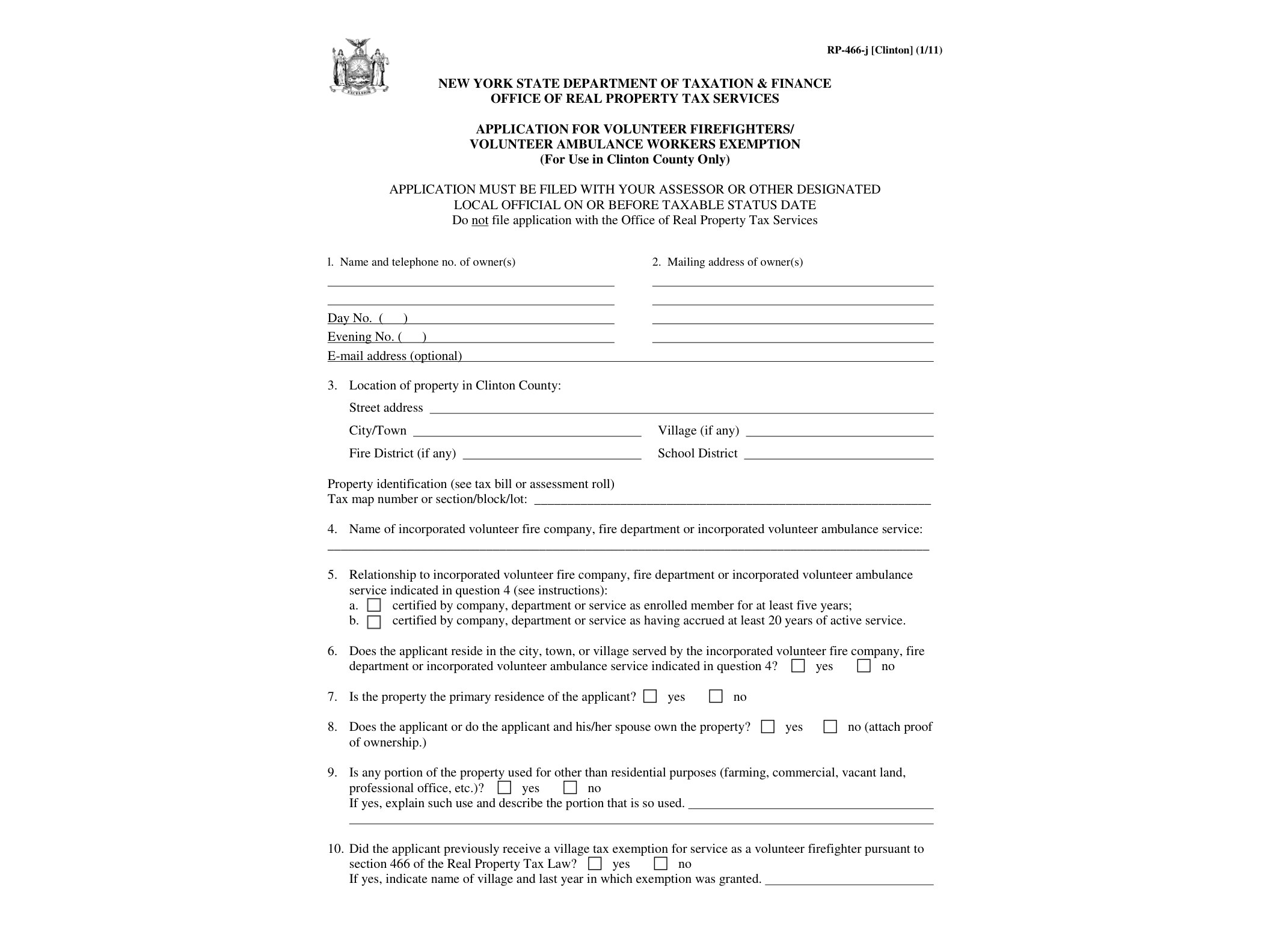
Form RP-466-J-Clinton is a New York State property tax exemption application issued by the New York State Department of Taxation and Finance, specifically drafted for local use under the option adopted by the taxing jurisdiction of Clinton. It allows enrolled volunteer firefighters and volunteer ambulance workers who own a primary residence in that jurisdiction to apply for a reduction in the assessed value of their property, lowering their annual property tax bill as a way of recognizing years of unpaid emergency service.
This exemption is authorized under Real Property Tax Law Section 466-j, which lets individual towns, villages, cities, and counties opt into a local law establishing the benefit. Because each municipality can set its own exemption percentage (up to 10% of assessed value in many cases) and its own minimum years of service requirement, the form itself is customized to the specific locality — in this case, Clinton. That’s why you’ll see similar forms tied to other municipalities, such as Form RP-466-C for Cattaraugus, each carrying the same general purpose but different local rules baked into the paperwork.
Who needs this form
You need Form RP-466-J-Clinton if you are an enrolled member of an incorporated volunteer fire company or volunteer ambulance service operating within the Clinton jurisdiction, you own the residential property you’re applying for (either individually or jointly), and that property is your primary residence. Most local laws under this statute also require a minimum number of years of active service — commonly five years — before you’re eligible, though some municipalities offer a permanent, unconditional exemption once a volunteer reaches 20 years of active duty, even after retirement, as long as they remain a resident of the same municipality.
If you’re unsure whether Clinton’s local law matches the version you have on hand, it’s worth confirming with your town or city assessor’s office, since exemption percentages and service thresholds vary by jurisdiction even though the underlying form structure is nearly identical across the state.
When to use it
The form is filed once with the local assessor to establish initial eligibility, and in many jurisdictions it must be renewed annually to confirm continued volunteer status and residency, unless you qualify for the permanent exemption after 20 years of service. Deadlines are tied to the taxable status date set by the municipality — typically March 1 in most of New York State, though some counties and cities set different dates. Missing that deadline generally means waiting until the following assessment cycle, so it pays to file early rather than close to the cutoff.
How to fill it out and submit it
Form RP-466-J-Clinton includes fillable AcroForm fields, meaning you can complete it digitally on your computer before printing, rather than filling it out by hand. You’ll need to provide basic identifying information about the property owner(s), the property’s tax map or parcel number, and certification details from your fire company or ambulance service confirming your enrollment status and years of active service. That certification section usually needs a signature from an authorized officer of your volunteer organization, so it’s not something you can complete entirely on your own — plan to coordinate with your company’s leadership before submission.
Once completed and signed, the form goes to the assessor’s office for the municipality where the property is located — not to the state tax department directly. Keep a copy of what you submit, along with any proof of service your fire company or ambulance corps provides, since assessors occasionally request documentation during renewal periods.
Volunteers who don’t yet meet the minimum service requirement, or who live in a municipality that hasn’t adopted this specific local law, might still have options worth exploring. For example, related property tax relief programs exist for other groups, such as the exemption described in Form RP-459 for New Yorkers with physical disabilities. And if your property happens to fall under a different municipality’s version of the volunteer exemption law, checking Form RP-466-A can clarify how the general statewide framework applies before you assume Clinton’s specific form is the right one for your situation.
Download Official Form RP466J (PDF)
Opens the official government PDF in a new tab