
Download Official Form RP466C (PDF)
Opens the official government PDF in a new tab
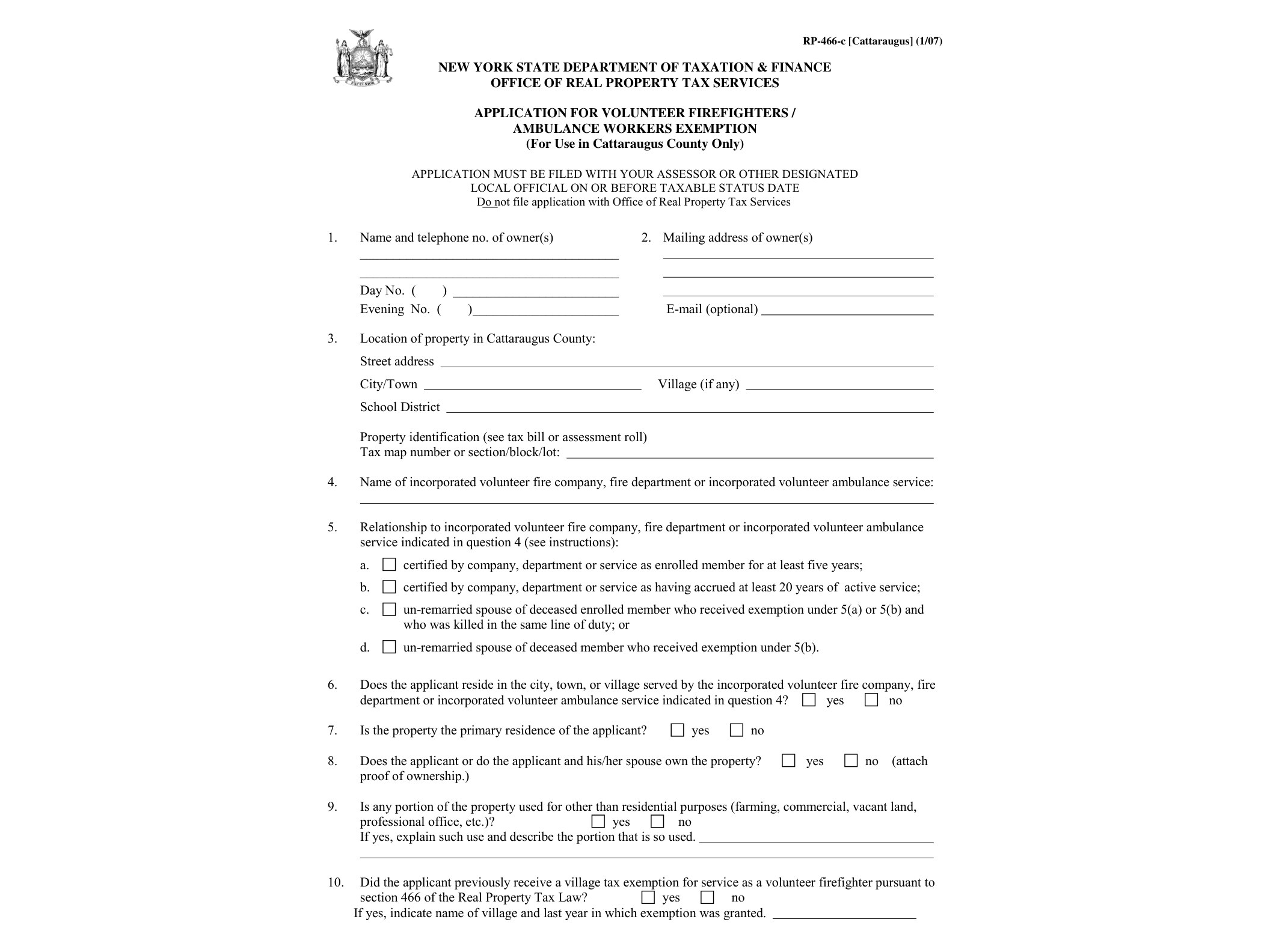
Form RP-466-C is the Cattaraugus County version of New York’s application for the volunteer firefighters and ambulance workers property tax exemption. It’s issued by the New York State Department of Taxation and Finance, but tailored specifically for taxing jurisdictions within Cattaraugus County that have adopted this local option exemption under Real Property Tax Law Section 466-c. If you live in this county and serve as a volunteer, this is the form your local assessor will expect to see, rather than the general statewide version.
The exemption exists because many towns, villages, and school districts in New York want to recognize the unpaid service of volunteer firefighters and ambulance workers by reducing their property tax burden. Cattaraugus County municipalities that opted into this program use RP-466-C rather than the standard form, since local governments can customize percentage reductions and eligibility thresholds when they adopt the exemption locally.
Who Needs This Form
You need Form RP-466-C if you are an active volunteer firefighter or volunteer ambulance worker residing in a Cattaraugus County municipality that has enacted the local exemption law, and you own the property where you claim the exemption. Typically, applicants must meet a minimum number of years of active service (often five years, though this varies by locality) and must occupy the property as their primary residence.
Surviving spouses of volunteers who were killed in the line of duty, or who had accrued a certain number of years of service before death, may also qualify to continue receiving the exemption. Each municipality sets its own specific rules within the boundaries allowed by state law, so the exact service requirements can differ slightly from town to town within the county.
This form is closely related to Form RP-466-A, which serves the same purpose for other counties statewide. If your municipality isn’t in Cattaraugus County, you’ll want that version instead. Both forms accomplish the same goal — reducing assessed value for qualifying volunteers — but they’re formatted for different local jurisdictions.
When to File
Applications must be submitted to your local assessor’s office by the taxable status date, which in most New York municipalities falls on March 1, though some cities and counties use different dates. Missing this deadline generally means waiting until the following assessment year, so it’s worth confirming the exact date with your local assessor’s office well ahead of time.
Once approved, the exemption typically doesn’t need to be renewed every single year in many jurisdictions, provided your eligibility status doesn’t change. However, local rules vary, and some assessors do require periodic renewal documentation, so checking with your specific town or village assessor is a smart move before assuming your exemption will carry forward automatically.
How to Complete and Submit RP-466-C
The form itself comes as a fillable PDF, meaning you can type your information directly into the document on your computer before printing it for signature and submission. You’ll need to provide basic property information, details about your fire department or ambulance service affiliation, years of active service, and a certification from your fire chief or ambulance service supervisor confirming your volunteer status.
Because this exemption reduces assessed value rather than providing a direct payment, the savings show up on your school and municipal tax bills going forward, not as a refund check. Property owners who also qualify for other exemptions, such as those related to disability, should look into whether exemptions can be combined. For instance, homeowners exploring accessibility-related tax relief might also want to review Form RP-459 for physically disabled New Yorkers, or Form RP-459-A if the property has been modified for accessibility purposes.
Once completed, the form goes to your local assessor’s office — not to the state Department of Taxation and Finance directly. Keep a copy of your signed application and any supporting certification letters from your fire or ambulance company, since assessors may request additional documentation if your years of service or residency status come into question during review.
Download Official Form RP466C (PDF)
Opens the official government PDF in a new tab