Download Official Form RP459CWK (PDF)
Opens the official government PDF in a new tab
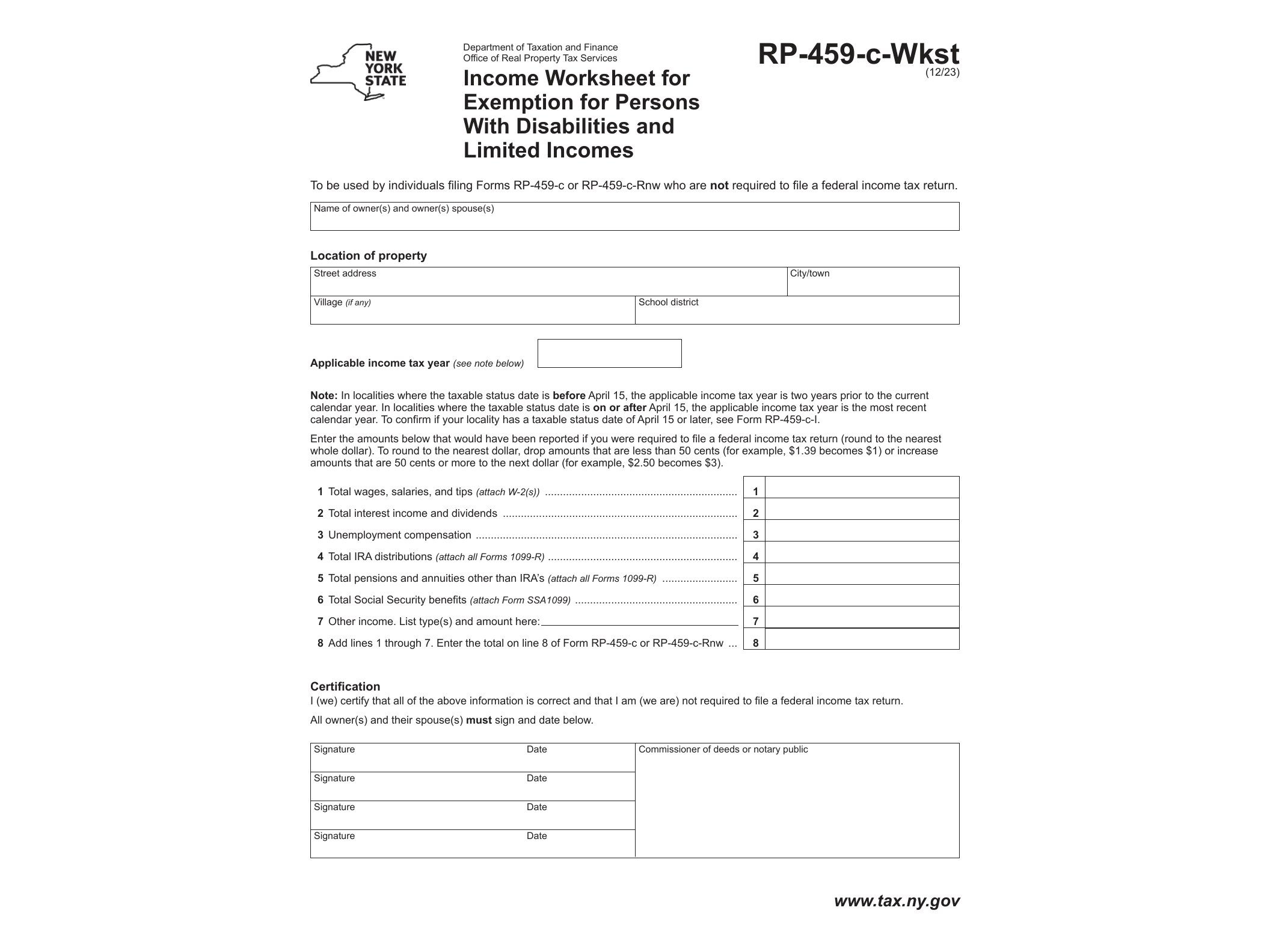
Form RP-459-c-Wkst is an income worksheet issued by the New York State Department of Taxation and Finance. It’s designed to help homeowners calculate and report annual income when applying for the partial property tax exemption available to persons with disabilities and limited incomes. This worksheet doesn’t replace the main application — it’s a supporting document that walks you through the income calculation the assessor needs to determine whether you qualify and how large your exemption will be.
If you’re applying for the exemption itself, you’ll want to file it alongside Form RP-459-c, the actual application for partial tax exemption for real property of persons with disabilities and limited incomes. The worksheet feeds directly into that form, since income eligibility is one of the core requirements local assessors check before granting any reduction in assessed value.
Who needs this worksheet
This form is meant for homeowners who are disabled and whose household income falls below the limit set by their local taxing jurisdiction — county, city, town, school district, or village. Because income limits and rules can vary slightly by municipality, this worksheet standardizes how income is reported so assessors across New York State can evaluate applications consistently.
You’ll typically need this worksheet if:
- You’re a homeowner with a documented disability applying for a property tax reduction.
- Your combined household income (including that of your spouse and any co-owners, with some exceptions) needs to be verified against local income thresholds.
- Your local assessor requires a detailed income breakdown beyond what’s stated on the main application.
What information goes into the worksheet
The RP-459-c-Wkst asks applicants to list all sources of income for the applicant, spouse, and any other owners of the property. This generally includes wages, Social Security benefits, pensions, retirement distributions, interest, dividends, rental income, and any other taxable or non-taxable income sources recognized under the exemption rules. Certain medical and prescription drug expenses can be deducted from total income, which is why the worksheet includes specific lines for those deductions — they can make a real difference in whether you qualify or how much exemption you receive.
Because the form is a fillable AcroForm PDF, you can type your figures directly into the document on a computer before printing it for signature and submission. This makes it easier to keep calculations legible and avoid errors that come from handwriting numbers into small boxes.
When to file
Like most property tax exemption paperwork in New York, this worksheet needs to be submitted to your local assessor’s office by the taxable status date set by your municipality — this date varies by county and town, so it’s worth confirming with your local assessor rather than assuming a statewide deadline. Since the exemption must generally be renewed annually, many homeowners fill out this income worksheet every year alongside their renewal application to reconfirm they still meet the income limits.
If you’re new to this exemption category, it’s also worth checking whether your situation overlaps with other disability-related property tax relief, such as the exemption covered under Form RP-459-B, which applies specifically to physically disabled crime victims. These programs are separate, so make sure you’re applying under the correct category for your circumstances.
How to get and complete the form
The worksheet is available directly from the New York State Department of Taxation and Finance as a fill-in PDF. Because it’s an AcroForm, you can complete it digitally using free PDF readers that support form filling, then print and sign it before mailing or delivering it to your local assessor’s office along with your RP-459-c application and any required proof of income, such as tax returns or benefit statements.
Keep a copy of both the completed worksheet and your supporting documentation for your own records, since assessors may ask for clarification or additional proof before finalizing your exemption. If you own property used for religious or nonprofit purposes rather than as a personal residence, note that different exemption rules apply — for example, Form RP-462 covers exemptions for parsonages and manses, which is a separate process entirely from the disability income exemption discussed here.
Download Official Form RP459CWK (PDF)
Opens the official government PDF in a new tab