
Download Official Form RP466F (PDF)
Opens the official government PDF in a new tab
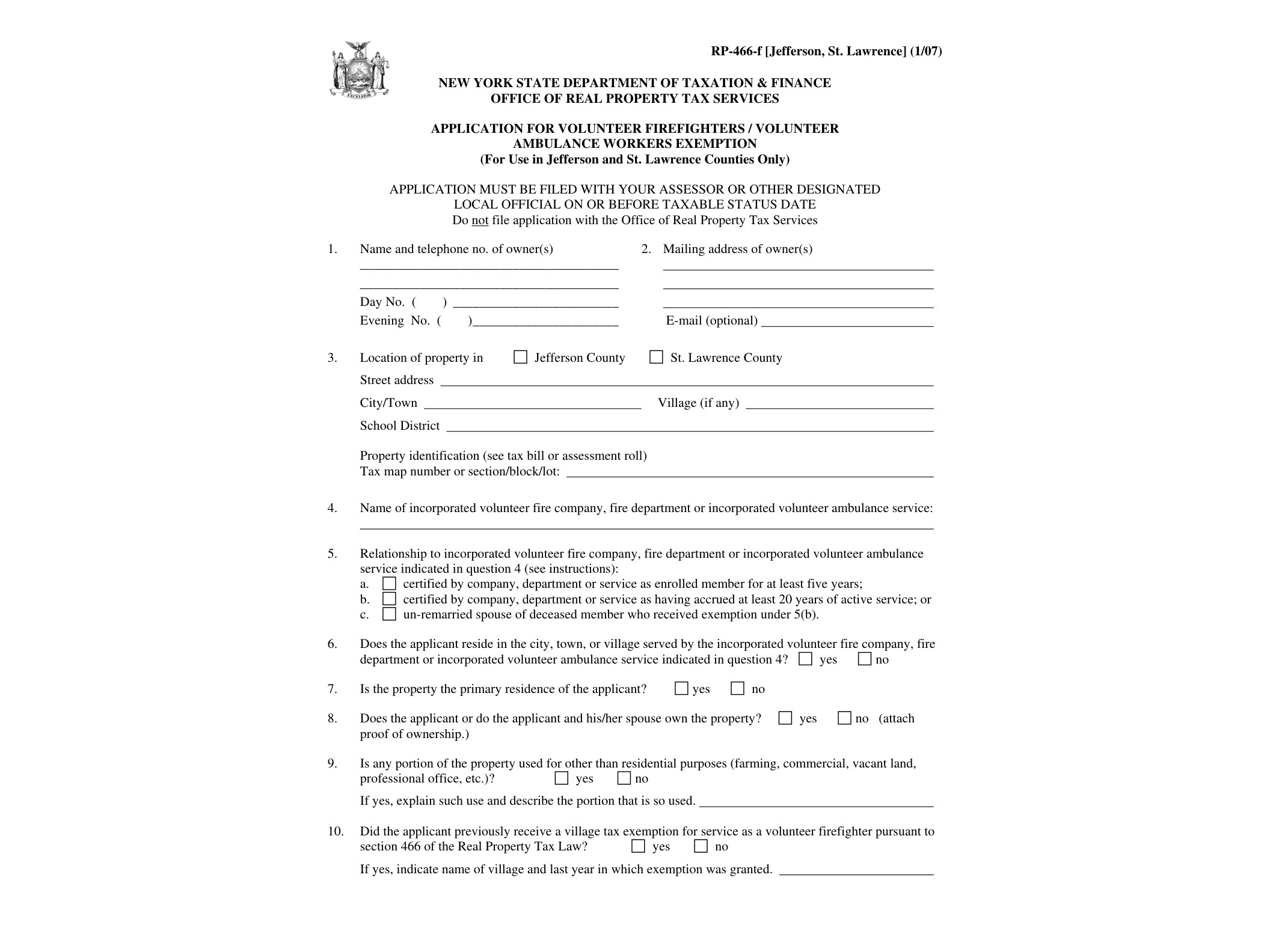
Form RP-466-F is the property tax exemption application used by volunteer firefighters and volunteer ambulance workers who live in Jefferson County or St. Lawrence County, New York. It’s issued by the New York State Department of Taxation and Finance, but like most exemption applications tied to Real Property Tax Law Section 466-a, it only applies where the local municipality has actually adopted the exemption by local option. If your town, village, or fire district hasn’t opted in, this specific form won’t get you an exemption no matter how many years of service you have.
The exemption knocks a percentage off the assessed value of a qualifying volunteer’s primary residence, provided the property is owned by the volunteer (or the volunteer and spouse) and is their primary residence. It’s meant to recognize the unpaid time and risk that volunteer firefighters and ambulance workers put in for their communities, since these are the people responding to emergencies without a paycheck.
Who Should File This Form
You’re a candidate for RP-466-F if you meet all of the following:
- You’re an enrolled member of an incorporated volunteer fire company, fire department, or volunteer ambulance service located in Jefferson or St. Lawrence County
- You’ve met the minimum years of active service required by your local taxing jurisdiction (this varies by town, so check with your local assessor)
- You own the residential property being exempted and it’s your primary residence
- Your city, town, village, or school district has adopted the local law or resolution enabling this exemption
Some jurisdictions also extend the exemption permanently to volunteers with a set number of years of service, even after they stop actively volunteering, and some extend it to surviving spouses. The exact rules depend on the taxing jurisdiction, which is why the form requires certification from the fire company or ambulance service confirming your enrollment and service record before it goes anywhere near the assessor’s office.
When You Need to Submit It
Like other property tax exemption applications in New York, RP-466-F has to be filed with your local assessor by the taxable status date, which is typically March 1 in most of the state, though it can vary by municipality. Missing that date usually means waiting until the following year’s assessment roll. If you’re renewing an exemption you already hold, some jurisdictions require annual recertification of your active volunteer status, so it’s worth confirming with your assessor whether a one-time filing is enough or if you need to refile each year.
How to Fill It Out
The form itself is a fillable PDF (AcroForm), so you can type your information directly into the fields before printing. You’ll need to provide your name, the property address, section/block/lot identification, and details about your volunteer service, including the name of the fire company or ambulance service and your enrollment date. There’s a certification section that must be signed by an authorized officer of the volunteer organization verifying your years of active service — this part doesn’t get filled in by you, so plan ahead and get it signed before your filing deadline.
Once the volunteer service certification is complete, you sign the application yourself and submit it to the assessor’s office for the municipality where the property is located, not to the state tax department. Keep a copy for your records in case questions come up during the assessment review.
If you live in a different part of the state, note that this particular version of the form only applies to properties in Jefferson and St. Lawrence counties. Volunteers elsewhere should look for the version specific to their county, such as Form RP-466-J for Clinton County or Form RP-466-C for Cattaraugus County. New York issues these forms on a county-by-county basis because the underlying local laws differ from place to place.
Homeowners looking into other property tax relief options in New York, such as exemptions tied to a physical disability, may also want to review Form RP-459, which covers a separate partial exemption program with its own eligibility rules.
Download Official Form RP466F (PDF)
Opens the official government PDF in a new tab