
Download Official Form RP477A (PDF)
Opens the official government PDF in a new tab
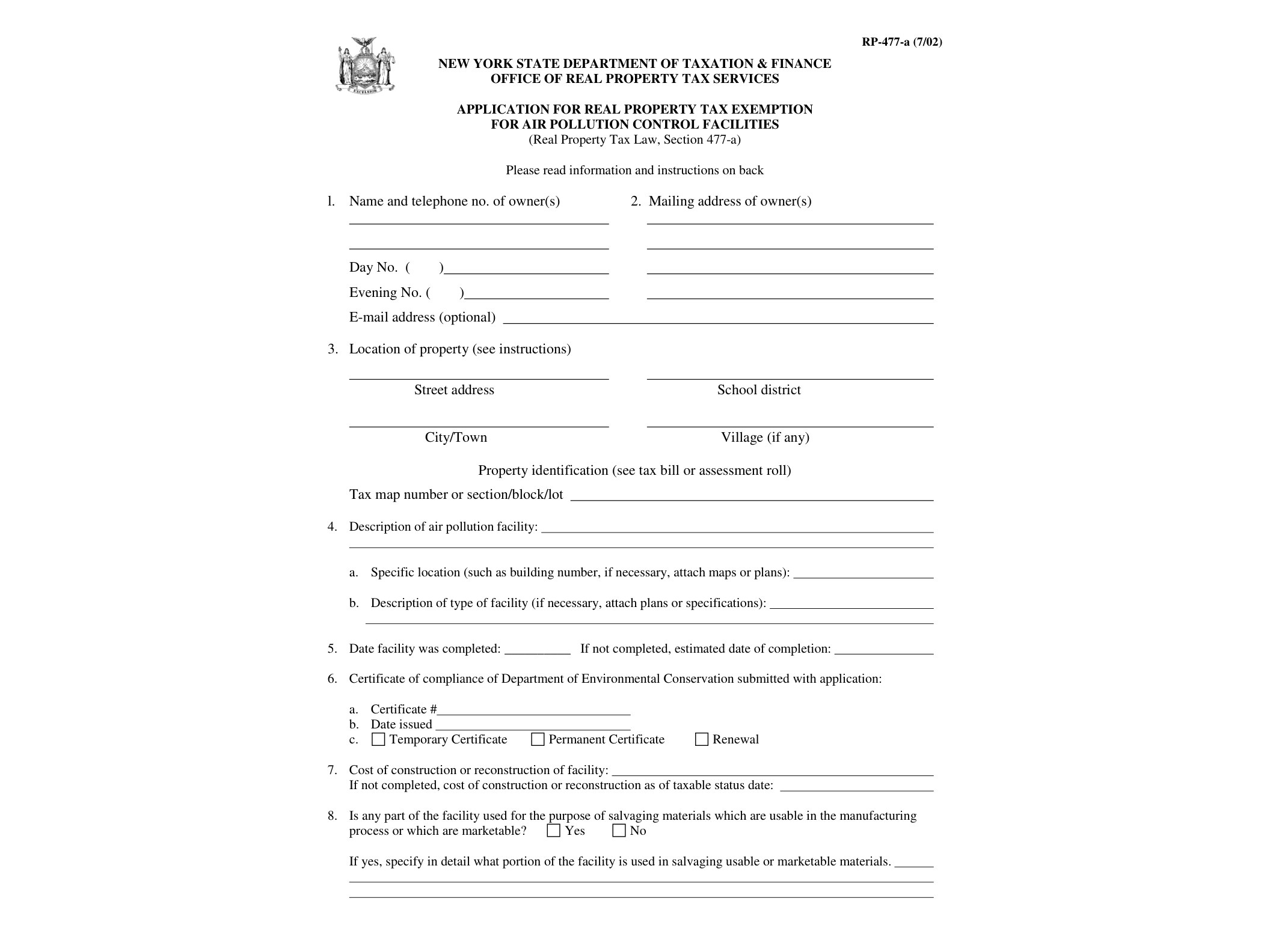
Form RP-477-A is the application New York property owners file to request a real property tax exemption for air pollution control facilities installed on their land or buildings. It’s issued by the New York State Department of Taxation and Finance and processed through the local assessor’s office where the property is located. If you own commercial, industrial, or manufacturing property and have invested in equipment designed to reduce air pollution, this form is how you claim the tax break tied to that investment.
The exemption exists because New York wants to encourage businesses to install pollution control equipment without penalizing them with higher assessed values. Under state Real Property Tax Law, certain facilities used exclusively to prevent, control, or reduce air contamination can be exempted from part or all of the increase in assessed value that would otherwise result from the improvement. In other words, the land and existing structures are still taxed normally, but the added value from qualifying pollution control equipment can be exempted.
Who Needs to File Form RP-477-A
This application is meant for owners of taxable real property who have installed, constructed, or reconstructed facilities specifically for air pollution control purposes. That includes manufacturers, power generation facilities, chemical plants, and other industrial operations that have added scrubbers, filtration systems, emission control units, or similar equipment certified by the appropriate state or federal environmental agency.
To qualify, the facility generally needs certification from the New York State Department of Environmental Conservation (DEC) confirming that the equipment is used primarily for air pollution control and not for another commercial purpose. Without that certification, the local assessor has no basis to grant the exemption, so this step usually needs to happen before or alongside filing RP-477-A.
When to Use This Form
Property owners should file RP-477-A after completing the installation or construction of the qualifying pollution control facility, and before the taxable status date set by their local municipality — typically March 1 in most of New York, though some cities and towns have different deadlines. Filing late can mean waiting an entire additional assessment cycle before the exemption takes effect, so it’s worth confirming the exact deadline with the local assessor’s office as soon as the equipment is operational.
The exemption isn’t automatically renewed forever in every jurisdiction; some assessors require periodic reapplication or documentation showing the facility is still being used for its intended pollution control purpose. It’s a good idea to keep records of the original DEC certification and any correspondence with the assessor in case you need to reapply or respond to a review.
How to Complete and Submit the Form
Form RP-477-A is a fillable PDF, which means you can complete it on a computer using Adobe Acrobat or similar software before printing it for signature and submission. Typical information required includes the property owner’s name and address, the property’s tax map or parcel identification number, a description of the pollution control facility, the date it was completed, its cost, and details of the DEC certification.
Once completed, the form is submitted to the assessor of the city, town, or village where the property is located — not to the Department of Taxation and Finance directly. Local assessors handle the exemption request and determine the exempt amount based on the increase in assessed value attributable to the pollution control facility. If the assessor denies the exemption or you disagree with the amount granted, you generally have the right to challenge the decision through the local grievance process.
Property owners exploring other real property tax exemptions in New York may also want to look at Form RP-485-A for residential-commercial urban exemptions, Form RP-480-A for forest land exemptions, or Form RP-483-C for temporary greenhouse structures, since many property owners qualify for more than one exemption depending on how their land and facilities are used.
Download Official Form RP477A (PDF)
Opens the official government PDF in a new tab