
Download Official Form RP483C (PDF)
Opens the official government PDF in a new tab
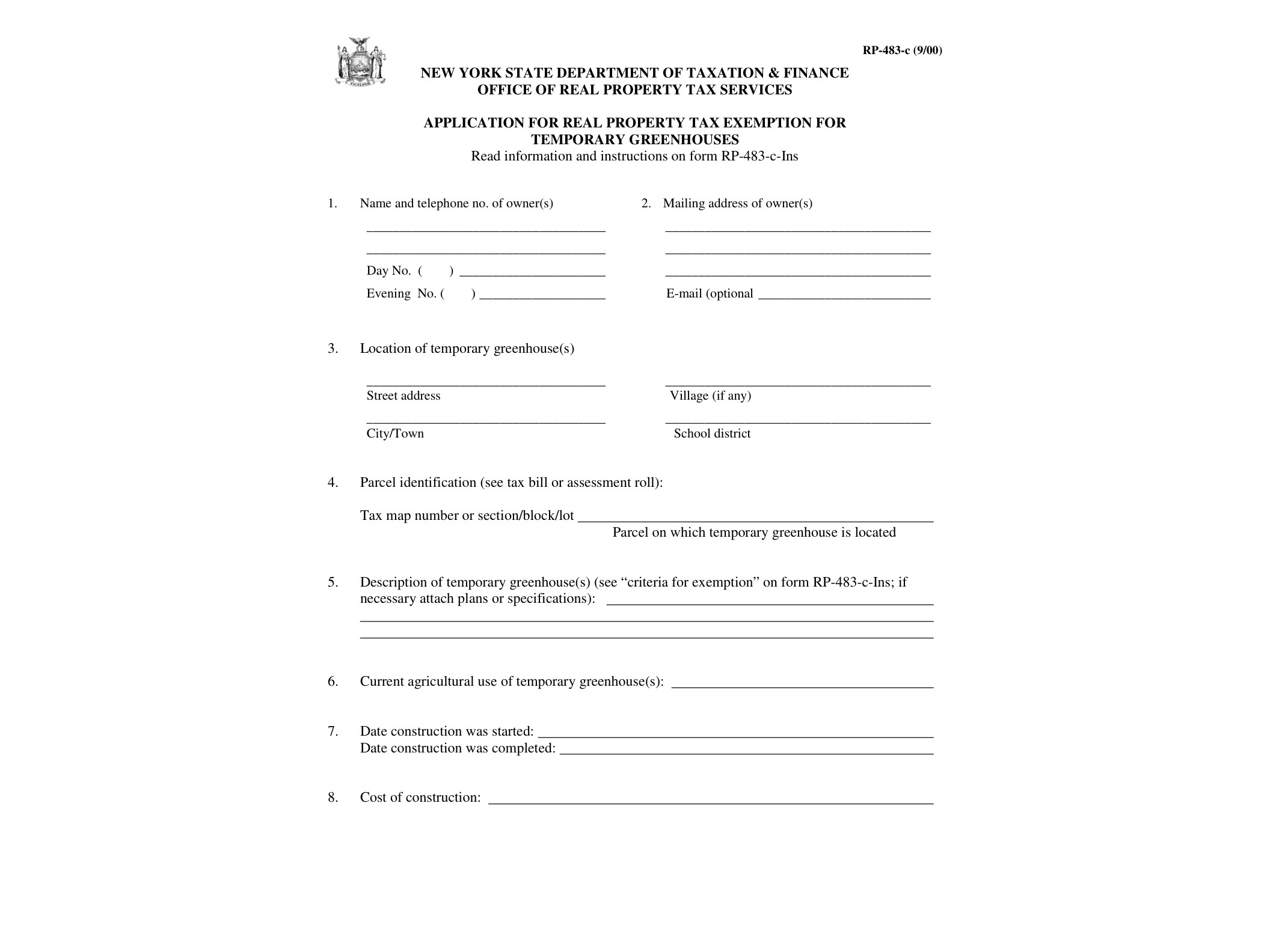
Form RP-483-C is an application used in New York State to claim a real property tax exemption for temporary greenhouses. It’s issued by the New York State Department of Taxation and Finance, specifically through the Office of Real Property Tax Services (ORPTS), and it’s designed for farmers and growers who use seasonal or portable greenhouse structures as part of their agricultural operations.
Unlike permanent farm buildings, temporary greenhouses are typically built with materials like plastic sheeting, PVC framing, or other lightweight components that allow them to be assembled and disassembled depending on the growing season. Because these structures don’t meet the traditional definition of permanent real property improvements, New York provides a specific exemption pathway for them under Real Property Tax Law, separate from the exemption that applies to permanent agricultural and horticultural buildings covered under Form RP-483.
Who Needs Form RP-483-C
This form is intended for property owners who have constructed or installed temporary greenhouses on land used for agricultural production. If you’re growing seedlings, extending a growing season, or protecting crops with a seasonal greenhouse structure, you may qualify for a property tax exemption on the value that structure adds to your land.
To be eligible, the greenhouse generally needs to meet specific criteria set by the local assessor and state guidelines, including how it’s constructed, how it’s used, and whether it’s genuinely temporary in nature rather than a permanent fixture. Farmers who also maintain permanent agricultural structures, labor camps, or commissaries on their property should be aware that other exemption forms exist for those situations, such as Form RP-483-D, which covers farm or food processing labor camps and commissaries.
When to Use This Form
Form RP-483-C should be filed with your local city or town assessor’s office, not directly with the state. Timing matters here — like most property tax exemption applications in New York, there’s a filing deadline tied to the taxable status date in your municipality, which is typically March 1 in most areas, though some counties and cities have different dates. Missing this deadline usually means waiting until the following assessment year to apply, so it’s worth checking with your local assessor early if you’re planning to install a temporary greenhouse.
Keep in mind that this exemption needs to be renewed or reviewed periodically depending on local requirements, since the temporary nature of the structure means assessors may want to confirm it’s still in use and still meets the exemption criteria from year to year.
How to Fill Out and Submit the Form
Form RP-483-C is a fillable PDF, meaning you can complete it digitally on your computer before printing it out for signature and submission. The form asks for basic identifying information about the property owner, a description of the greenhouse structure (including dimensions, materials, and construction date), and details confirming its agricultural use.
Because this is a local exemption, some assessors may request supporting documentation, such as photos of the structure or proof of agricultural activity on the parcel. It’s a good idea to contact your local assessor’s office before submitting the form to confirm exactly what they require alongside the application.
Once completed, the form should be signed and delivered to the assessor’s office for the municipality where the property is located — not mailed to the Department of Taxation and Finance in Albany. Processing times and exemption values can vary by locality since these exemptions are locally administered, even though the form itself is a standard state form.
If you operate a broader agricultural business with multiple types of structures on your land, it may also be worth reviewing exemption categories designed for industrial or processing facilities, like the one covered under Form RP-477, in case any of those apply to other parts of your operation.
Download Official Form RP483C (PDF)
Opens the official government PDF in a new tab