
Download Official Form RP485A (PDF)
Opens the official government PDF in a new tab
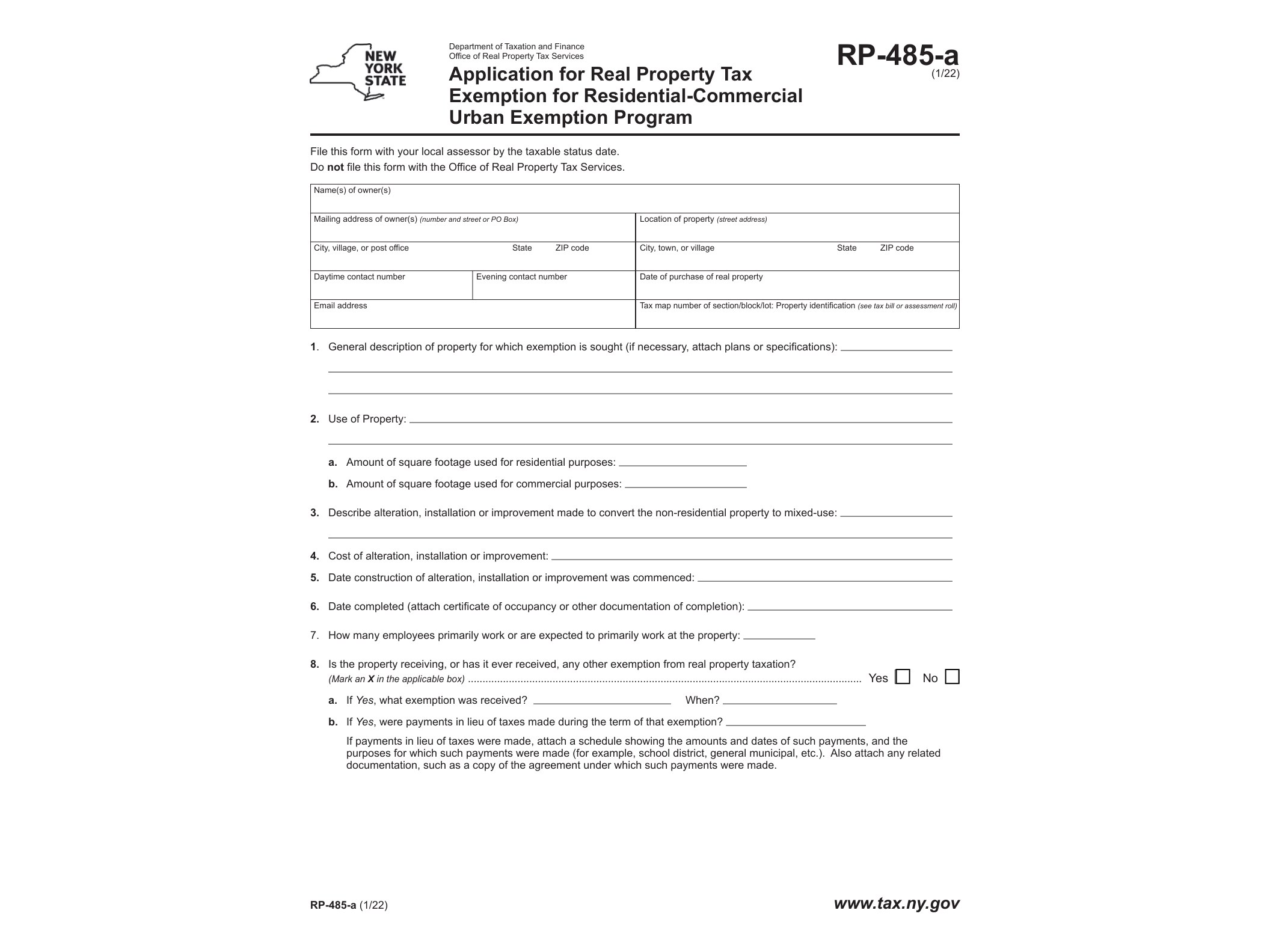
Form RP-485-A is an application filed with local assessors in New York State to request a real property tax exemption under the Residential-Commercial Urban Exemption Program. This program was created to encourage property owners in eligible municipalities to convert, improve, or construct mixed-use buildings that combine residential units with commercial space, particularly in areas where local governments want to spur reinvestment in older commercial corridors or downtown districts.
The New York State Department of Taxation and Finance issues this form, but it’s important to understand that the exemption itself is only available in municipalities that have adopted a local law or resolution opting into the program under Real Property Tax Law Section 485-a. Not every town, city, or village offers this benefit, so before filling out anything, property owners should confirm with their local assessor’s office whether the exemption is even active in their jurisdiction.
Who Needs This Form
Form RP-485-A is meant for owners of real property who are converting non-residential space into a mix of residential and commercial use, or who are constructing new buildings that will serve both purposes. Typical applicants include owners of older commercial buildings above which they plan to add apartments, or developers rehabilitating vacant storefronts into ground-floor retail with residential units on upper floors.
This is different from exemptions aimed at agricultural or forested land. If your project involves farmland structures or greenhouses rather than urban mixed-use conversion, you’d want to look at forms like Form RP-483 for agricultural and horticultural buildings or Form RP-483-C for temporary greenhouses, which serve entirely different property categories.
When to File
Timing matters with this exemption. Property owners generally need to file Form RP-485-A with the local assessor after completing construction or conversion work, but within the filing deadlines set by the assessor’s taxable status date. Because these dates vary between municipalities, applicants should check directly with their local assessment office to avoid missing the window. Filing late can mean losing out on the exemption for that assessment cycle entirely.
The exemption, once granted, typically phases in over a period of years, with the taxable assessed value gradually increasing until the property reaches its full assessed value. The exact schedule and percentage reductions depend on the local law adopted by the municipality, since RPTL 485-a gives local governments some flexibility in how they structure the benefit.
What Information the Form Requires
Form RP-485-A asks for standard property identification details: the owner’s name and address, the property’s tax map number, and a description of the construction or improvement project. Applicants need to describe the nature of the conversion, including square footage devoted to residential versus commercial use, since the mixed-use requirement is central to qualifying under this program.
You’ll also need to provide cost information related to the improvements, along with dates of commencement and completion of construction. Supporting documentation, such as building permits or certificates of occupancy, is often requested by assessors even though it may not be explicitly part of the form itself.
How to Get and Complete the Form
The PDF version of Form RP-485-A, revised January 2022, is available directly from the New York State Department of Taxation and Finance website. This version includes fillable AcroForm fields, meaning you can type your information directly into the PDF using a program like Adobe Acrobat Reader before printing it for signature and submission.
After completing the form electronically, print it, sign it, and submit it to your local assessor’s office rather than mailing it to the state tax department. Assessors process these applications locally, and they’re the ones who ultimately determine whether the property qualifies based on the specifics of your municipality’s adopted exemption law.
If you’re unsure whether your property qualifies or which exemption program applies to your situation, comparing this form with others aimed at different property types, such as Form RP-480-A for forest land exemptions, can help clarify which application actually fits your project before you spend time gathering documentation.
Download Official Form RP485A (PDF)
Opens the official government PDF in a new tab