
Download Official Form RP485P (PDF)
Opens the official government PDF in a new tab
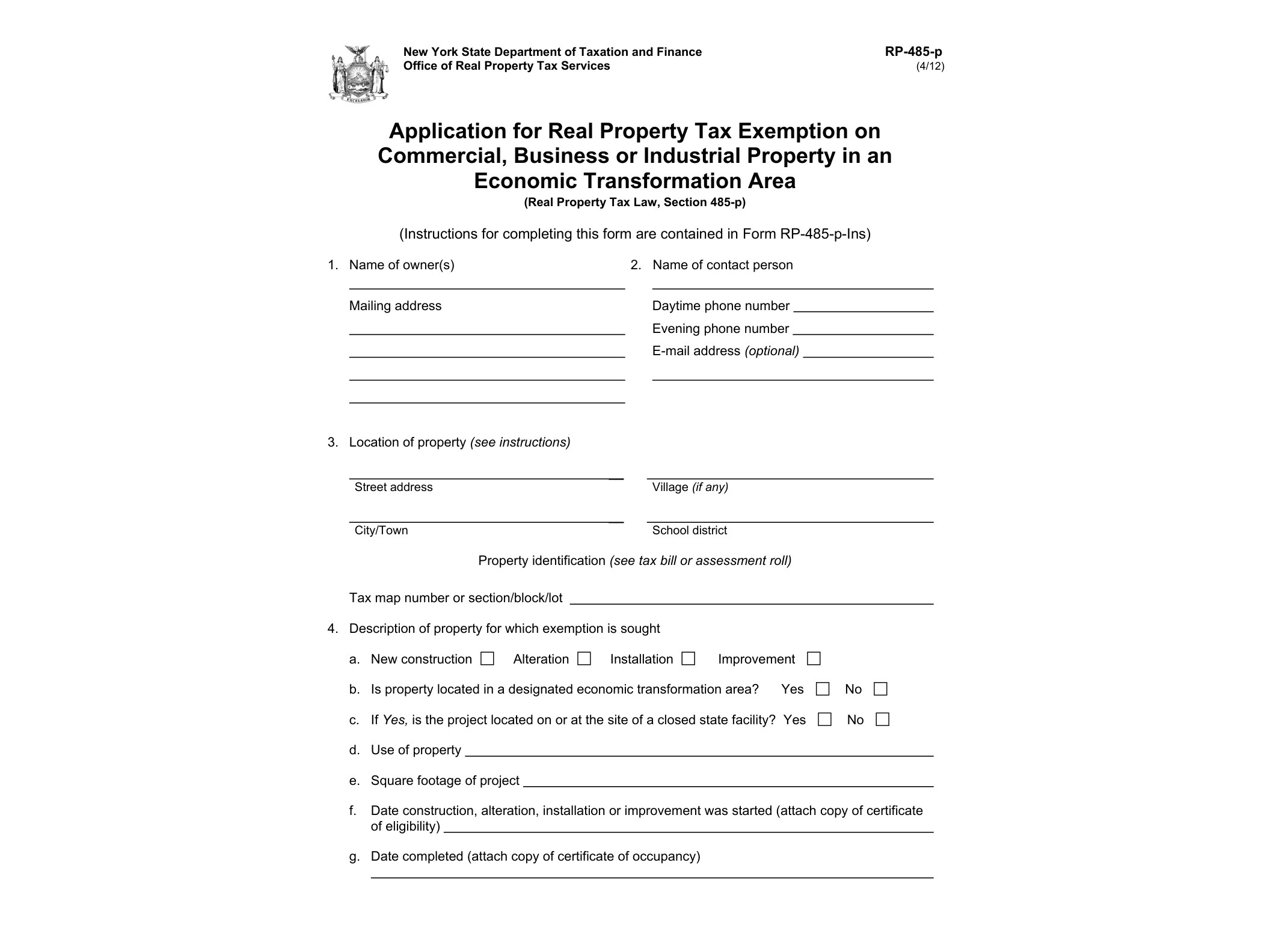
Form RP-485-P is issued by the New York State Department of Taxation and Finance to let owners of commercial, business, or industrial property apply for a real property tax exemption when their property sits inside a designated Economic Transformation Area. These areas are typically communities affected by the closure of a correctional facility or a similar state-designated economic shift, and the exemption exists to encourage new investment and job creation where the local economy needs it most.
If you own or are planning to build a commercial, business, or industrial facility in one of these zones, this form is how you formally request the reduced tax assessment tied to that investment. The exemption doesn’t apply automatically just because a property is located in an Economic Transformation Area — the owner has to file RP-485-P with the appropriate local assessor, along with any supporting documentation the assessor requests, such as proof of the area designation, construction or renovation costs, and evidence that the project meets program requirements.
Who Should File This Form
RP-485-P is meant for owners of income-producing, business, or industrial properties, not residential owners. Typical filers include developers rehabbing an existing commercial building, businesses constructing a new industrial facility, or companies expanding operations inside a zone that New York State has designated for economic transformation. The exemption is generally tied to construction, alteration, or improvement costs, so property owners who haven’t made qualifying capital investments usually won’t have anything to claim.
Local assessors are the ones who ultimately determine eligibility, so it’s worth confirming with your municipality’s assessment office that your parcel is actually within a recognized Economic Transformation Area before you file. Filing early in the process — ideally as soon as construction or renovation begins — helps avoid missing the exemption’s application deadlines, since New York property tax exemption forms are generally tied to the taxable status date of the local assessing unit.
How the Exemption Works
Once approved, the exemption phases in a reduction of the assessed value increase that results from the qualifying improvements, rather than exempting the entire parcel. This is similar in structure to other property-based incentive forms New York offers, such as Form RP-485-B, which covers commercial, business, and industrial property exemptions outside of Economic Transformation Areas. If your project doesn’t fall within a designated transformation zone, RP-485-B might be the more appropriate form to review instead.
Businesses in the hospitality sector should also check whether a more targeted program applies to them, like the one described in Form RP-4736, which addresses hospitality-related property tax exemptions in specific municipalities. Comparing these options before filing can save time, since each form serves a distinct type of property or location.
How to Get and Complete the Form
Form RP-485-P is a fillable PDF (AcroForm), meaning you can type your entries directly into the document using standard PDF software before printing it for signature and submission. The New York State Department of Taxation and Finance updates these forms periodically, so always download the current version directly from the state’s website rather than reusing an older copy, since outdated forms may reference expired program years or incorrect assessment procedures.
When filling it out, have your parcel information, project cost documentation, and the official Economic Transformation Area designation on hand. Assessors typically want a clear breakdown of construction or improvement expenses, the timeline of the project, and confirmation that the property use qualifies as commercial, business, or industrial rather than residential.
Businesses that also handle transportation or transmission operations in New York may find it useful to review related state tax obligations, such as those outlined in Form CT-183-M, since property tax exemptions and corporate tax filings often intersect for larger commercial operations.
Once completed, submit the form to your local assessor’s office rather than to the state tax department directly — assessors handle the review and approval process locally, even though the form itself is a state-issued document. Keep a copy of everything you submit, including supporting cost documentation, in case the assessor requests clarification or the exemption needs to be renewed in future tax years.
Download Official Form RP485P (PDF)
Opens the official government PDF in a new tab