
Download Official Form RP5022 (PDF)
Opens the official government PDF in a new tab
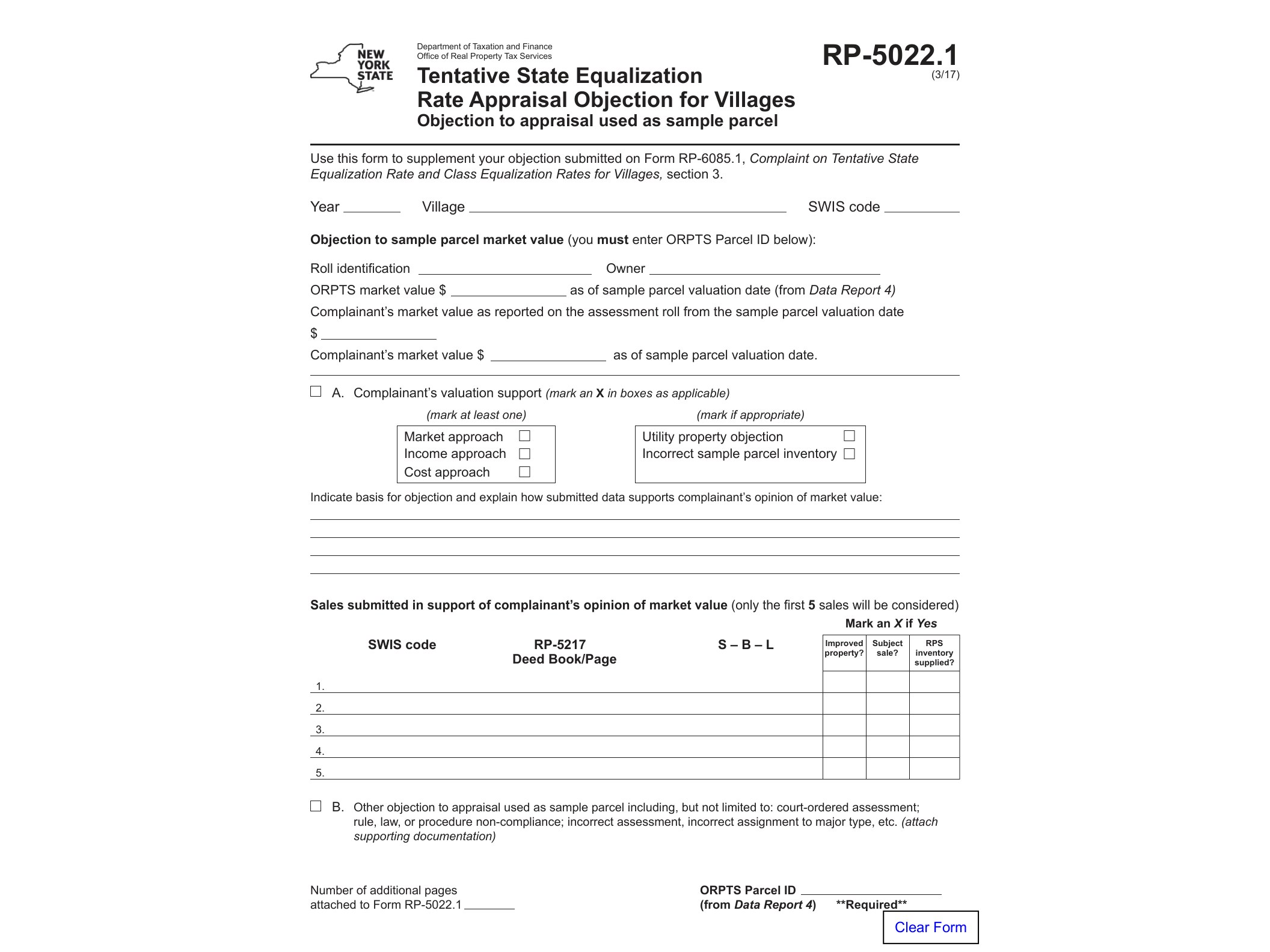
Form RP-5022.1 is issued by the New York State Department of Taxation and Finance, specifically through its Office of Real Property Tax Services (ORPTS). Its full title, “Tentative Equalization Rate Appraisal Objection for Villages,” describes exactly what it does: it gives village officials a formal, structured way to challenge the appraisal data behind a tentative equalization rate calculated for their village.
Equalization rates matter because they’re the mechanism New York uses to keep tax burdens fair across municipalities that assess property at different percentages of market value. When ORPTS sets a tentative rate for a village, that rate is built on appraisal data collected during the state’s review process. If village officials believe that data is flawed, incomplete, or doesn’t reflect actual market conditions, RP-5022.1 is the vehicle for raising that objection before the rate becomes final.
Who Needs This Form
This is not a form for individual homeowners or businesses. It’s designed for village assessors, village boards, or authorized representatives acting on behalf of a village government. If your village received a tentative equalization rate notice from ORPTS and you have reason to believe the underlying appraisals used to calculate that rate were inaccurate, this form lets you put that objection on the record.
Typical grounds for objection include disputes over the appraised values assigned to specific sample parcels, disagreements about property classifications used in the appraisal sample, or concerns that the sample parcels don’t fairly represent the village’s overall property stock. Villages that skip this step generally lose their opportunity to challenge the appraisal component of the rate later on.
When It Gets Used
Timing is strict. ORPTS issues tentative equalization rates on a schedule tied to each municipality’s assessment cycle, and villages have a limited window after receiving that tentative rate to file an objection. Missing the deadline generally means the tentative rate becomes final without further appraisal review, so village officials need to move quickly once they receive the notice and decide whether the appraisal data warrants a challenge.
It’s worth noting that RP-5022.1 addresses appraisal-based objections specifically. If a village’s concern is instead about a sale used in the rate calculation rather than an appraisal, that’s a separate track handled through Form RP-5023.1, which covers tentative equalization rate sale objections for villages. Many villages end up dealing with both forms in the same assessment cycle if they have objections on multiple fronts.
How to Get and Complete the Form
Form RP-5022.1 is available as a fillable PDF directly from the New York State Department of Taxation and Finance website. Because it has AcroForm fields built in, you can type your entries directly into the PDF using standard PDF reader software rather than printing it out and filling it in by hand, which speeds up preparation and keeps the submission legible.
When completing the form, village officials should be prepared to identify the specific parcels or appraisal figures in question, explain the basis for the objection, and provide any supporting documentation, such as independent appraisals, comparable sales data, or property records, that back up the claim. Vague objections without supporting evidence tend to carry less weight during ORPTS review, so it helps to be as specific as possible about which numbers are disputed and why.
Once completed, the form is submitted to ORPTS according to the instructions accompanying the tentative rate notice, typically within the timeframe specified in that notice. ORPTS staff then review the objection alongside any supporting evidence before finalizing the village’s equalization rate.
Villages dealing with real property tax administration often encounter a range of specialized ORPTS forms beyond this one. For context on other property-related exemption filings, it can help to look at forms like Form RP-487, which covers tax exemptions for wind energy systems, or Form RP-491-B, used for conservation easement agreement exemptions in certain towns. While these serve different purposes, they illustrate how granular and locality-specific New York’s property tax forms can get, and why village officials often need to track several ORPTS filings at once.
Download Official Form RP5022 (PDF)
Opens the official government PDF in a new tab