
Download Official Form RP491A (PDF)
Opens the official government PDF in a new tab
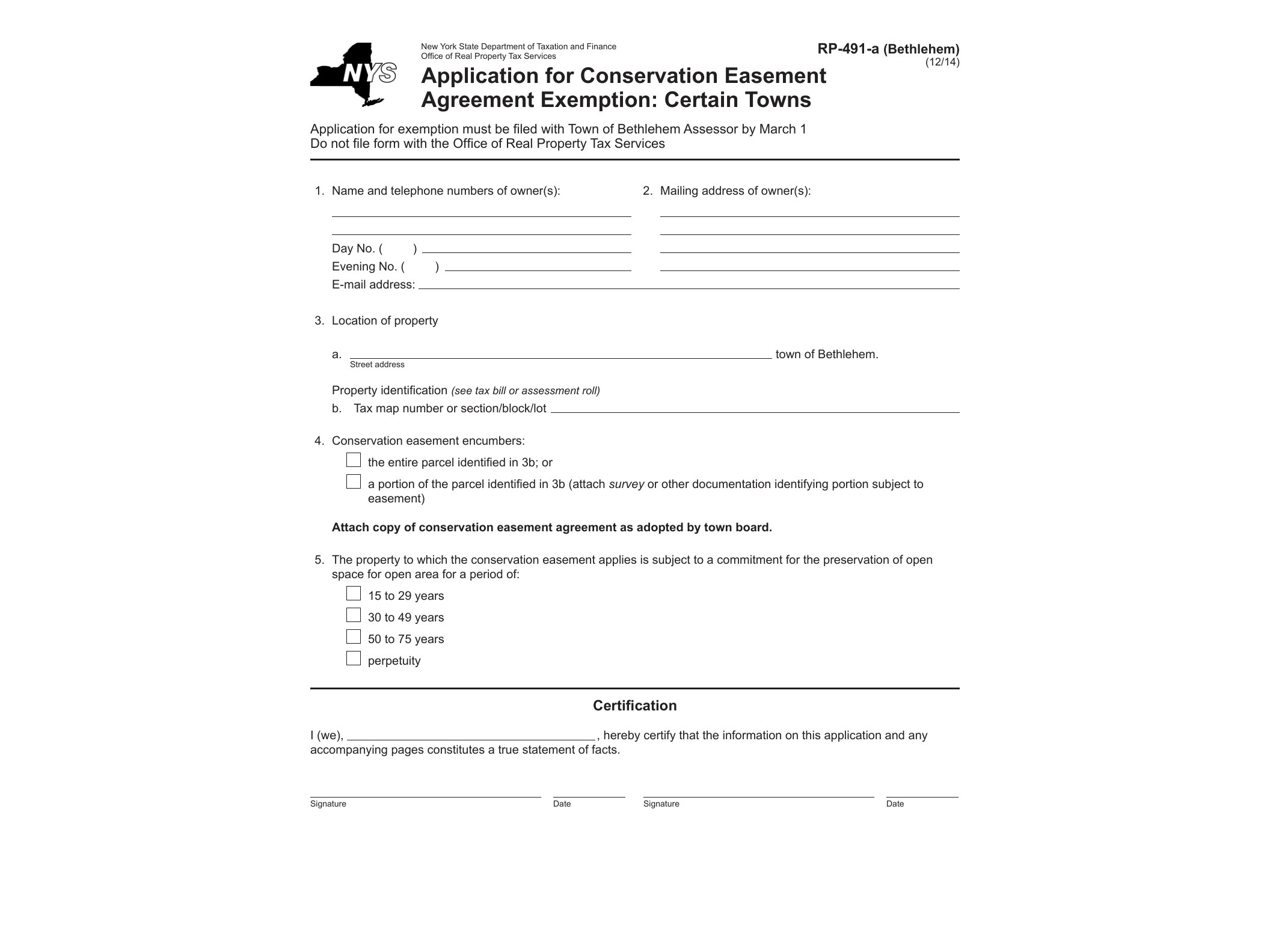
Form RP-491-A is a property tax exemption application created specifically for landowners in the Town of Bethlehem, New York. It’s issued by the New York State Department of Taxation and Finance and lets qualifying property owners request a partial exemption from real property taxes based on a conservation easement agreement they’ve entered into with a local government or a qualified conservation organization.
A conservation easement restricts how land can be developed or used going forward, usually to preserve farmland, open space, wetlands, or scenic areas. Because these restrictions permanently reduce the market value and development potential of the property, New York’s Real Property Tax Law allows municipalities to offer a corresponding tax exemption to the owner. Bethlehem adopted a local law authorizing this exemption, and RP-491-A is the specific application form tied to that local law.
This form only applies within the Town of Bethlehem. If your property is located elsewhere and you’ve signed a conservation easement, you’ll need a different version of the form built for your municipality. For example, property owners in Guilderland or Danby use a nearly identical but separately numbered application, which is covered in our guide to Form RP-491-B. Always confirm which version your town assessor requires before submitting anything, since filing the wrong municipality’s form can delay or invalidate your application.
Who Needs This Form
You need RP-491-A if you own real property in Bethlehem and have executed a conservation easement agreement that qualifies under the town’s local exemption law. This typically includes farmers, rural landowners, and conservation-minded property owners who’ve partnered with a land trust or the town itself to permanently limit development on their land in exchange for reduced property taxes. Renters, commercial tenants, or owners without a recorded easement agreement don’t qualify and shouldn’t file this form.
The exemption isn’t automatic just because an easement exists on paper. The town assessor has to review the application, verify the easement’s terms, and confirm it meets the criteria set out in the local law before granting any tax reduction. That’s why the form asks for detailed information about the easement itself, including who holds it, what restrictions it imposes, and when it was recorded.
When to File
Like most New York property tax exemption applications, RP-491-A generally needs to be filed with the Bethlehem town assessor by the taxable status date, which is typically March 1st in most New York towns, though it’s worth confirming the exact date with the assessor’s office since deadlines can shift. Missing this window usually means waiting until the following assessment year to apply, so it’s worth getting the paperwork in early rather than scrambling close to the deadline.
If your conservation easement was recently established, you’ll want to file as soon as the easement is properly recorded with the county clerk, since the assessor will need documentation proving the agreement is in effect before granting the exemption.
How to Fill It Out
The version currently available is a fillable PDF, meaning you can type your information directly into the form on a computer before printing it for signature and submission. You’ll need to provide basic identifying information about the property, the parcel’s section-block-lot number, details about the easement holder, and the date the easement was recorded. Supporting documentation, such as a copy of the recorded easement agreement, is usually required alongside the application.
Property owners exploring other exemption categories in New York, such as those tied to renewable energy installations, might also find it useful to look at Form RP-487 for wind energy system exemptions, or review how assessment challenges work through Form RP-5022.1 if you disagree with an equalization rate determination affecting your parcel.
Once completed, the form should be submitted directly to the Bethlehem town assessor’s office rather than mailed to the state. Keep a copy of everything you submit, along with proof of filing, since exemption renewals or audits may require you to reference your original application in future years.
Download Official Form RP491A (PDF)
Opens the official government PDF in a new tab