
Download Official Form RP6609 (PDF)
Opens the official government PDF in a new tab
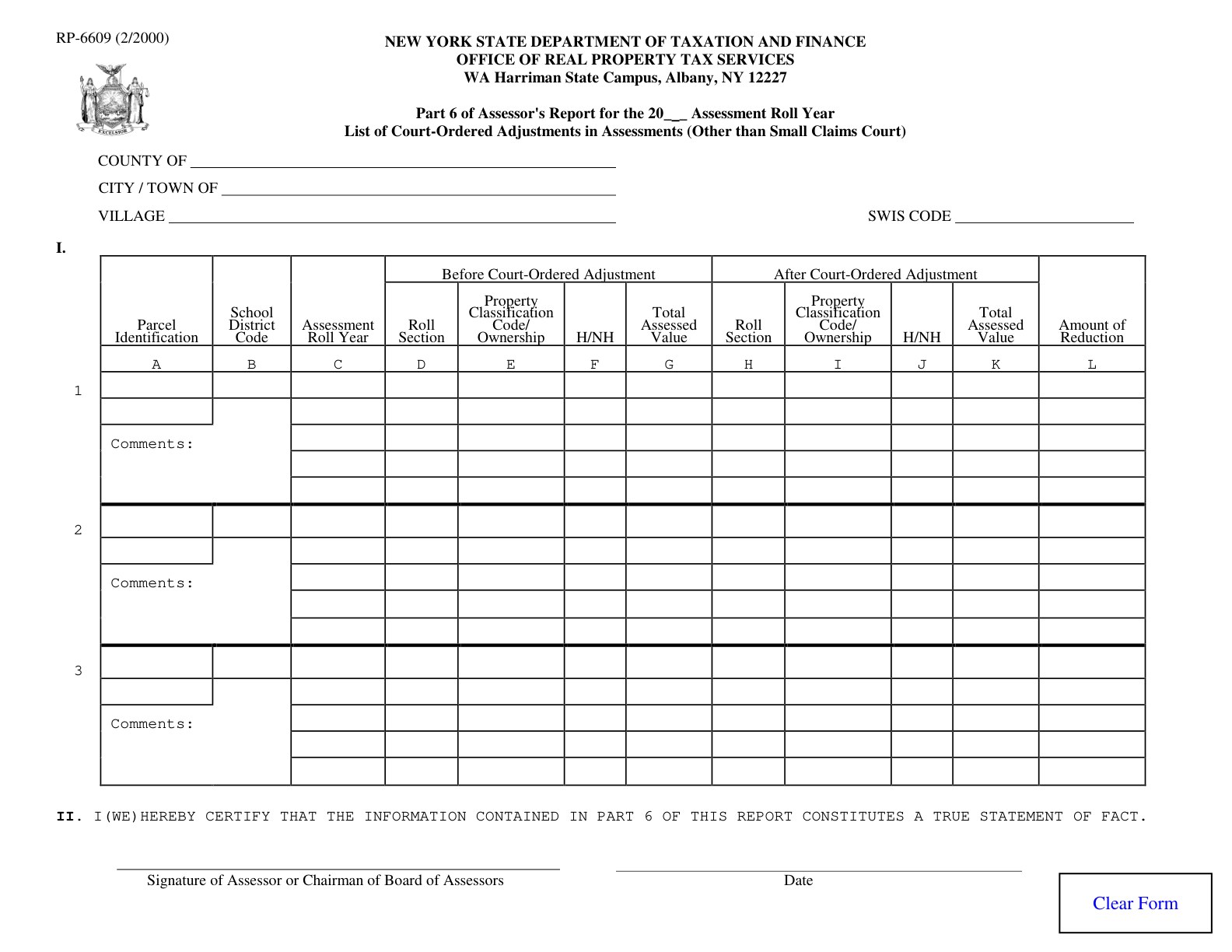
Form RP-6609, officially titled “List of Court-Ordered Adjustments in Assessments (other than Small Claims Court),” is a New York State Department of Taxation and Finance form used by local assessors to record changes to property assessments that result from a court order. Unlike routine assessment corrections handled through administrative channels, this form captures adjustments that came out of a judicial proceeding, typically a tax certiorari case or Article 7 proceeding, rather than the small claims assessment review process.
When a property owner successfully challenges an assessment through the courts and a judge orders the assessment roll to be corrected, the assessor’s office needs a standardized way to document that change. That’s exactly what RP-6609 is for. It creates a written record showing the parcel involved, the original assessed value, the court-ordered adjusted value, and the legal basis for the change. This documentation matters because it feeds into how the town, county, or school district recalculates tax levies and ensures the final assessment roll accurately reflects judicial determinations.
Who Needs to File This Form
RP-6609 isn’t something an individual homeowner fills out on their own behalf. It’s an internal administrative form used by assessors, boards of assessment review staff, or municipal tax officials who are responsible for maintaining accurate assessment rolls. If you’re a property owner who won a court case adjusting your assessment, you won’t personally submit this form, but you can expect your assessor’s office to use it to log the change and update your property record accordingly.
Assessors in towns, cities, and counties across New York State are the primary users. They rely on this form whenever a Supreme Court decision, settlement stipulation, or other court order modifies an assessment that was originally set through the regular assessment process, not through small claims.
When Is RP-6609 Used
This form comes into play after litigation concludes, specifically when a court order directs a change to an assessed value that falls outside the small claims assessment review track. Small claims cases, which typically involve owner-occupied one, two, or three-family homes, have their own separate reporting mechanism. For those situations, assessors instead use Form RP-6610, which covers corrections of errors and small claims court adjustments.
RP-6609 is reserved for larger or more complex assessment disputes, commercial properties, larger residential parcels, or cases that went through formal Supreme Court litigation rather than the streamlined small claims process. Once the court issues its ruling, the assessor’s office compiles the relevant parcel information onto this form as part of the year-end reconciliation of the assessment roll.
How to Get and Complete the Form
The form is available as a fillable PDF directly from the New York State Department of Taxation and Finance website. Because it contains AcroForm fields, assessors can type information directly into the document using standard PDF software rather than filling it out by hand, which helps keep records legible and consistent across municipalities.
Completing RP-6609 generally involves listing the affected parcel’s identification information, the assessed value before the court order, the corrected value after the order, and a reference to the court case or order that authorized the change. Multiple parcels can typically be listed on a single form if several properties were affected by related court decisions during the same assessment cycle.
This form is one of several reporting documents assessors use to keep New York’s property tax system transparent and accurate. Similar recordkeeping requirements exist for other municipal reporting obligations, such as those found in Form RP-6603-V, which tracks assessed values for village purposes, and Form RP-6704-A1, used for joint school tax levy statements. Together, these forms help ensure that assessment changes, whether from court orders, administrative corrections, or levy calculations, are properly documented at the local level.
Download Official Form RP6609 (PDF)
Opens the official government PDF in a new tab