
Download Official Form RP6610 (PDF)
Opens the official government PDF in a new tab
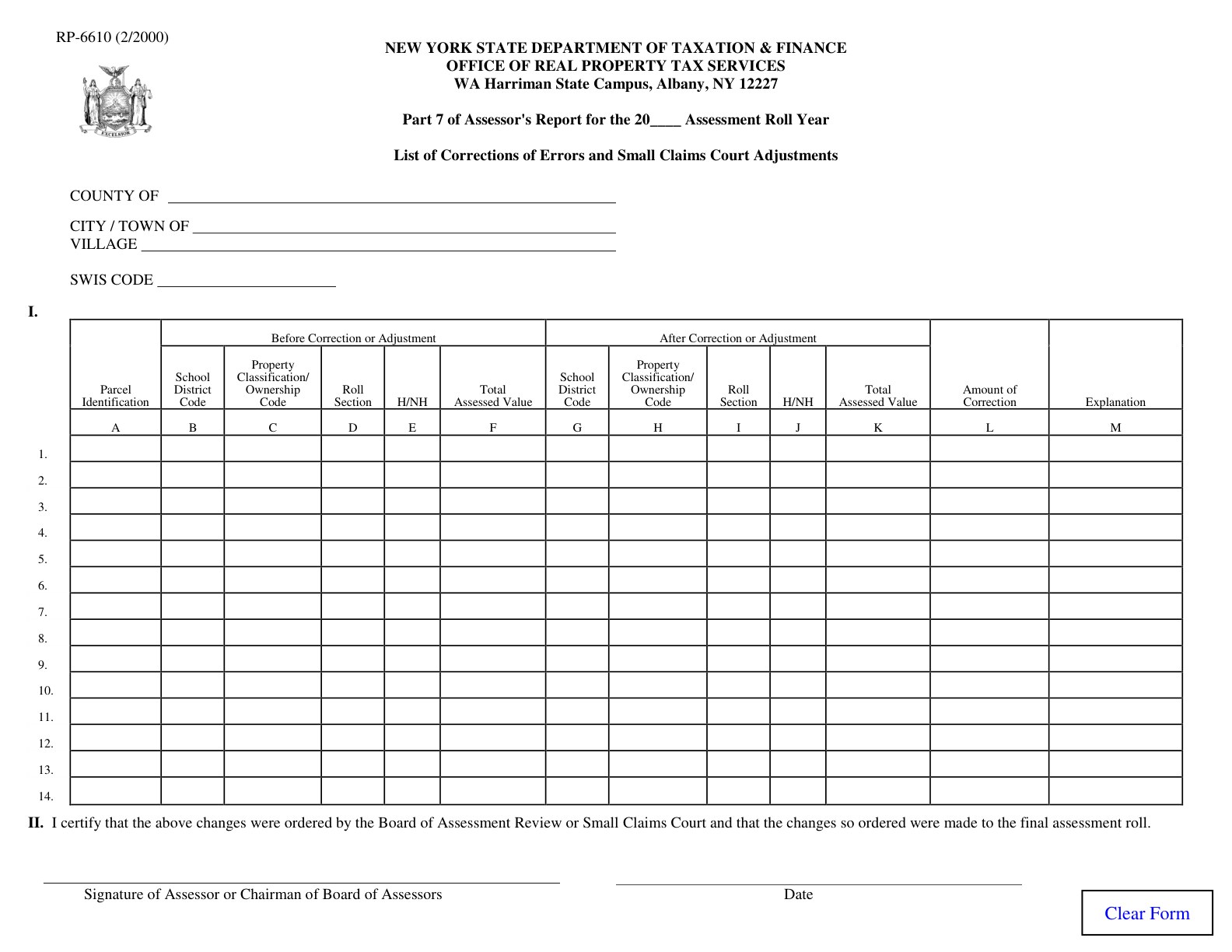
Form RP-6610, officially titled “List of Corrections of Errors and Small Claims Court Adjustments,” is a New York State Department of Taxation and Finance form used at the local assessment level. It provides a standardized way for assessors and other local officials to record changes made to the assessment roll after errors are identified or after a Small Claims Assessment Review (SCAR) proceeding results in a court-ordered adjustment.
Unlike forms that taxpayers submit to challenge their own assessments, RP-6610 is primarily a record-keeping and reporting tool used by assessing units. It documents the specific corrections applied to properties, whether those corrections stem from clerical or administrative errors discovered during roll review, or from judgments issued in Small Claims Court under Article 7 of the Real Property Tax Law. Keeping this list accurate matters because it directly affects the final assessment roll, the tax bills generated from it, and the equalization data reported to the state.
Who Needs This Form
The form is used by town, city, or county assessors and their support staff, particularly those responsible for maintaining assessment rolls and reporting data to the New York State Department of Taxation and Finance’s Office of Real Property Tax Services (ORPTS). Assessors typically complete RP-6610 after finalizing corrections resulting from:
- Clerical or typographical errors on the original assessment roll
- Errors of unlawful entry, such as taxable property mistakenly listed as exempt
- Small Claims Assessment Review decisions that reduce or otherwise change an assessed value
- Other adjustments ordered by a court or authorized under Real Property Tax Law provisions covering error corrections
Property owners generally don’t file this form themselves. Instead, they interact with the process indirectly — for example, by filing a SCAR petition to dispute an assessment, which, if successful, triggers the assessor’s obligation to log the resulting adjustment on this list.
When Is It Used
Assessing units typically prepare RP-6610 during the assessment roll finalization period, after grievance day and any related administrative or judicial reviews have concluded. Since Small Claims Assessment Review decisions can come in after the tentative roll is set but before the final roll is published, this form helps ensure those late-arriving corrections are properly captured and reflected in the official records used for tax billing.
It’s also used whenever an assessor identifies a roll error independently — not tied to litigation — that needs formal documentation before the correction is applied. This creates a clear paper trail showing what was changed, why, and under what authority.
How to Get and Complete the Form
Form RP-6610 is available as a fillable PDF directly from the New York State Department of Taxation and Finance website. Because it contains AcroForm fields, it can be filled out digitally on a computer before printing or submitting, which makes it easier for assessment offices to keep clean, legible records compared to handwritten logs.
Completing the form generally involves listing each affected parcel, identifying the type of correction (clerical error, unlawful entry, SCAR judgment, etc.), and recording the original and corrected assessment figures. Assessors should cross-reference this list with related documentation, such as court orders from Small Claims Assessment Review cases, to make sure the entries are accurate and consistent with what was legally authorized.
Assessment staff working with related state reporting forms may also find it useful to review Form RP-6603-V, which covers reporting total assessed value for village purposes, since corrections logged on RP-6610 can affect those totals. Similarly, offices handling school tax levy reporting may want to check Form RP-6704-A, as roll corrections can ripple into levy calculations. Assessors dealing with equalization rate disputes may also benefit from reviewing Form RP-6085.1, which addresses a related but distinct area of the assessment process.
Once completed, RP-6610 typically stays with the assessing unit’s records and supports the accuracy of the final assessment roll submitted to the state. Keeping this documentation current helps avoid discrepancies during equalization studies or future audits of the assessment process.
Download Official Form RP6610 (PDF)
Opens the official government PDF in a new tab