
Download Official Form RP6603V (PDF)
Opens the official government PDF in a new tab
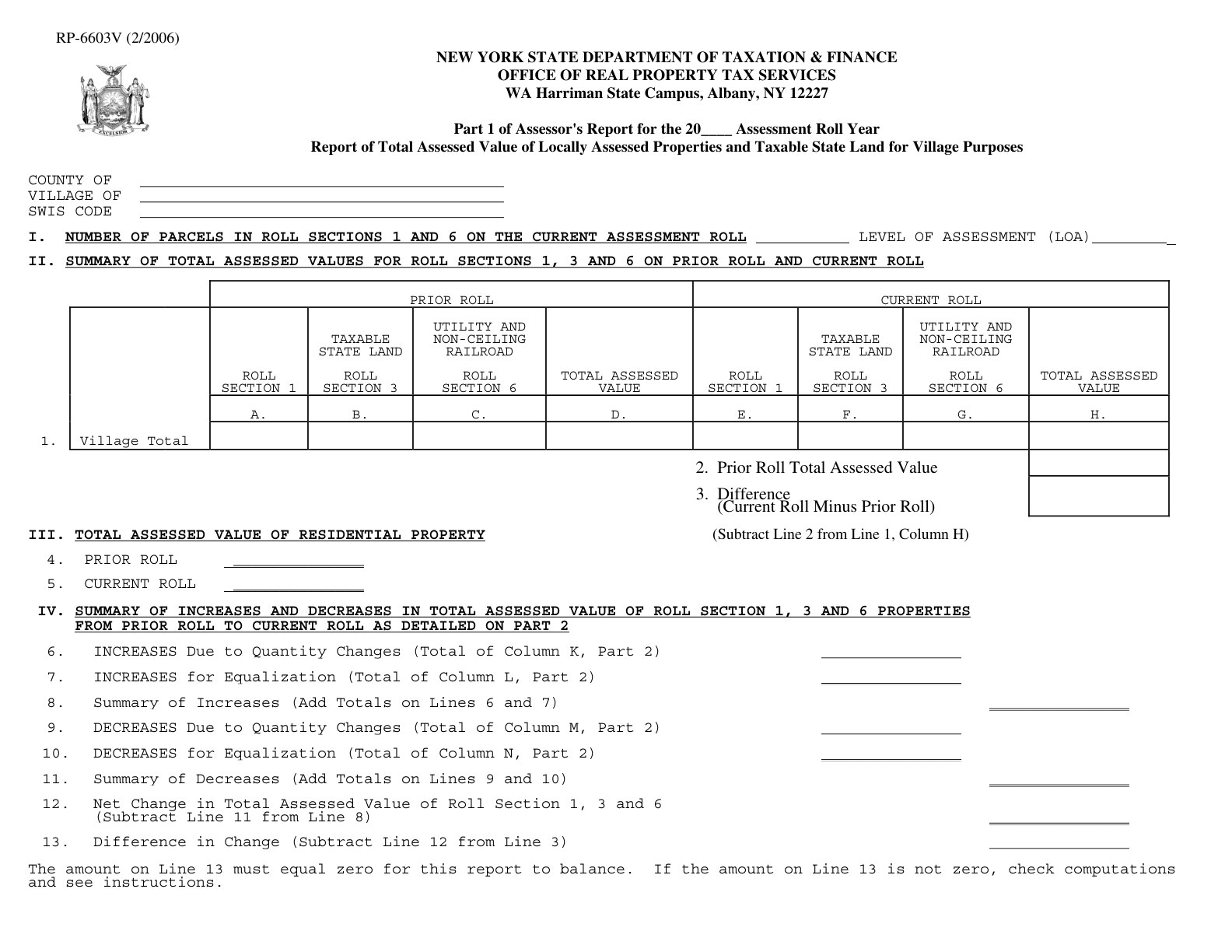
Form RP-6603-V is a reporting document used by local assessors in New York State to certify the total assessed value of locally assessed properties and taxable state land within a village’s boundaries. It’s issued by the New York State Department of Taxation and Finance, specifically through the Office of Real Property Tax Services (ORPTS), and plays a role in the broader process of setting village tax rates and calculating equalization figures.
At its core, this form is a summary statement. Assessors use it to report the assessed value totals that villages need in order to establish a fair and accurate basis for levying taxes. Because villages often overlap with towns and counties that maintain their own separate assessment rolls, having a consistent, standardized way to report village-specific assessed values keeps the numbers aligned across jurisdictions.
Who Needs to File Form RP-6603-V
This form isn’t something the average property owner fills out. It’s designed for use by village assessors or the assessing units responsible for compiling assessment roll data. If you’re a village official, an assessor, or someone working within a local assessing office, you’re the intended user of this form.
Property owners and taxpayers generally won’t interact with RP-6603-V directly, but the information it contains does affect them indirectly. The assessed values reported here feed into how village tax rates are calculated, which ultimately determines the tax bills residents receive.
When Form RP-6603-V Is Used
Assessors typically complete this form annually, in connection with the village assessment roll finalization process. The reporting period aligns with the village fiscal year and tax levy schedule, meaning the form needs to be prepared and submitted at a specific point after assessment rolls are finalized but before tax rates are set.
This timing matters because the assessed value totals reported on RP-6603-V are used alongside other figures — including equalization rates — to make sure the tax burden is distributed fairly among properties in the village. If you’re already familiar with how equalization rates work, you might find it useful to review our explanation of the Complaint on Tentative State Equalization Rate for Villages, since equalization and assessed value reporting are closely connected processes for village assessing units.
What Information Goes on the Form
RP-6603-V asks for a breakdown of assessed values covering locally assessed properties as well as taxable state land located within the village. Because state-owned land is assessed differently than privately owned property, it needs to be reported separately to ensure accurate calculations later in the tax rate-setting process.
The form is an AcroForm, meaning it has fillable digital fields. Assessors can complete it directly on a computer using PDF software, type in the required assessed value figures, and print or submit the completed form as needed. This makes the process more efficient compared to filling out a printed form by hand, and it reduces the chance of illegible entries or transcription errors when the data is later compiled at the state or county level.
How This Form Fits Into the Bigger Picture
Village tax administration in New York relies on several interconnected forms and reports, each covering a different part of the assessment and levy process. For example, school tax levy figures are reported through a separate mechanism, which you can read more about in our post on the Joint Statement of School Tax Levy. Similarly, when a property experiences a loss in value that needs to be documented separately, assessors may reference the process described in the Notice of Assessor’s Determination of Loss of Property Value.
Together, these forms help maintain an accurate and transparent system for calculating property taxes at the village level. For assessors, keeping RP-6603-V accurate and submitted on time is a routine but essential part of the annual assessment cycle, and it directly supports the fairness of the final tax rates applied to village properties.
Download Official Form RP6603V (PDF)
Opens the official government PDF in a new tab