
Download Official Form DTF624I (PDF)
Opens the official government PDF in a new tab
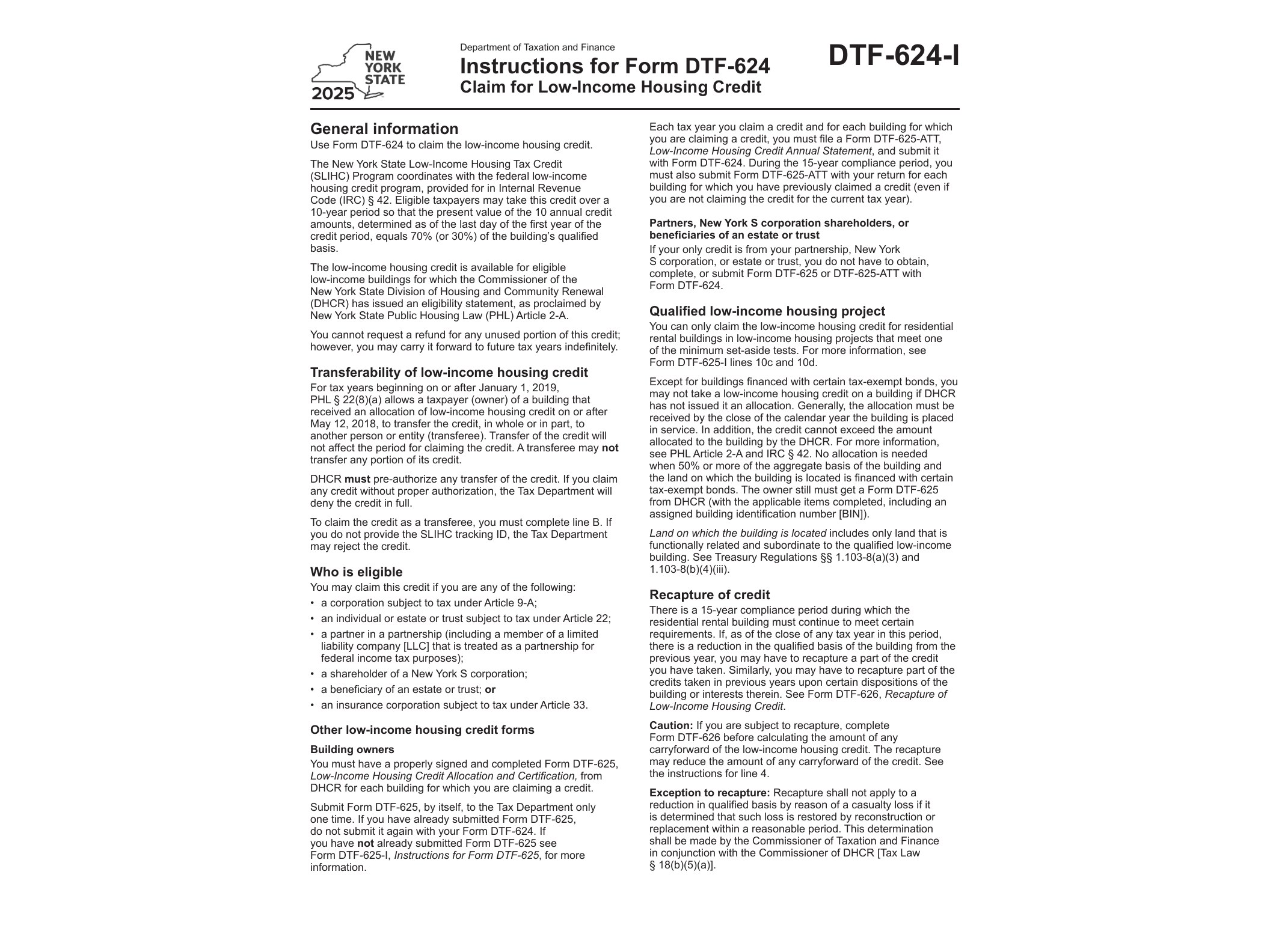
Form DTF-624I is the instruction booklet that accompanies Form DTF-624, Claim for Low-Income Housing Credit, issued by the New York State Department of Taxation and Finance. If you own an interest in a qualified low-income housing project located in New York and have been allocated a share of the credit, this is the guide that walks you through calculating and claiming that credit on your state tax return for tax year 2025.
The Low-Income Housing Credit is a New York State incentive designed to encourage investment in affordable rental housing. It mirrors, in many ways, the federal low-income housing tax credit program, but it operates as a separate state-level credit that reduces your New York tax liability. Owners of qualified buildings, partners in partnerships that hold these properties, shareholders in S corporations, and beneficiaries of estates or trusts involved in such projects may all need to file Form DTF-624, depending on how their ownership interest is structured.
Who Needs This Form
You’ll need Form DTF-624 (and its instructions) if you received an allocation of the credit from a building’s owner or if you’re claiming your share as a partner, shareholder, or beneficiary passed through from an entity that owns a qualified low-income building. The credit amount you can claim depends on the credit allocation certificate issued for the project, which is documented through a related process described in Form DTF-625-I, the instructions for the Low-Income Housing Credit Allocation and Certification. That form establishes the credit at the project level; DTF-624 is what individual owners and pass-through recipients use to actually claim their portion.
Property managers, syndicators, and accountants handling affordable housing developments in New York are the most frequent users of this instruction set, since the underlying calculations involve credit period years, applicable percentages, and carryforward amounts that can get complicated without a clear reference.
When to Use Form DTF-624
You use this form when filing your annual New York State income tax return for any year in which you’re eligible to claim a portion of the low-income housing credit. Because the credit is generally spread over a ten-year credit period, you may need to file this form repeatedly across multiple tax years for the same housing project, as long as you continue to hold an eligible interest and the project remains in compliance with income and rent restrictions for tenants.
The instructions clarify how to handle situations where the credit passes through multiple tiers of ownership, how unused credit amounts carry forward, and what happens if a building falls out of compliance during the credit period, which can trigger recapture provisions.
How to Get and Complete It
Form DTF-624I is not fillable online. Like the underlying Form DTF-624, it needs to be printed and completed by hand, then attached to your New York State tax return. The instructions guide you through each line of the form, including how to reference your credit allocation certificate number, how to compute the annual credit amount based on your ownership percentage, and where to report carryforward credits from prior years.
Before starting, gather your credit allocation certificate, any Schedule K-1 statements showing your share of the credit from a partnership or S corporation, and records of the building’s placed-in-service date. These documents determine which credit period year you’re in and how much you’re entitled to claim.
Taxpayers dealing with other New York property tax matters, such as homeowners or renters seeking a separate credit, often find it useful to also review Form IT-214 instructions for the Real Property Tax Credit, since housing-related credits in New York frequently intersect for landlords who also qualify for personal property tax relief. Similarly, those managing multi-generational living arrangements within a qualifying property might want to check Form RP-469 for partial tax exemption on living quarters for a parent or grandparent, which addresses a different but related property tax benefit.
Once completed, Form DTF-624 gets submitted along with your regular state income tax filing, not separately. Keep copies of the form and all supporting allocation certificates in your records, since the state may request documentation to verify the credit during the ten-year compliance period tied to the housing project.
Download Official Form DTF624I (PDF)
Opens the official government PDF in a new tab