
Download Official Form AU100I (PDF)
Opens the official government PDF in a new tab
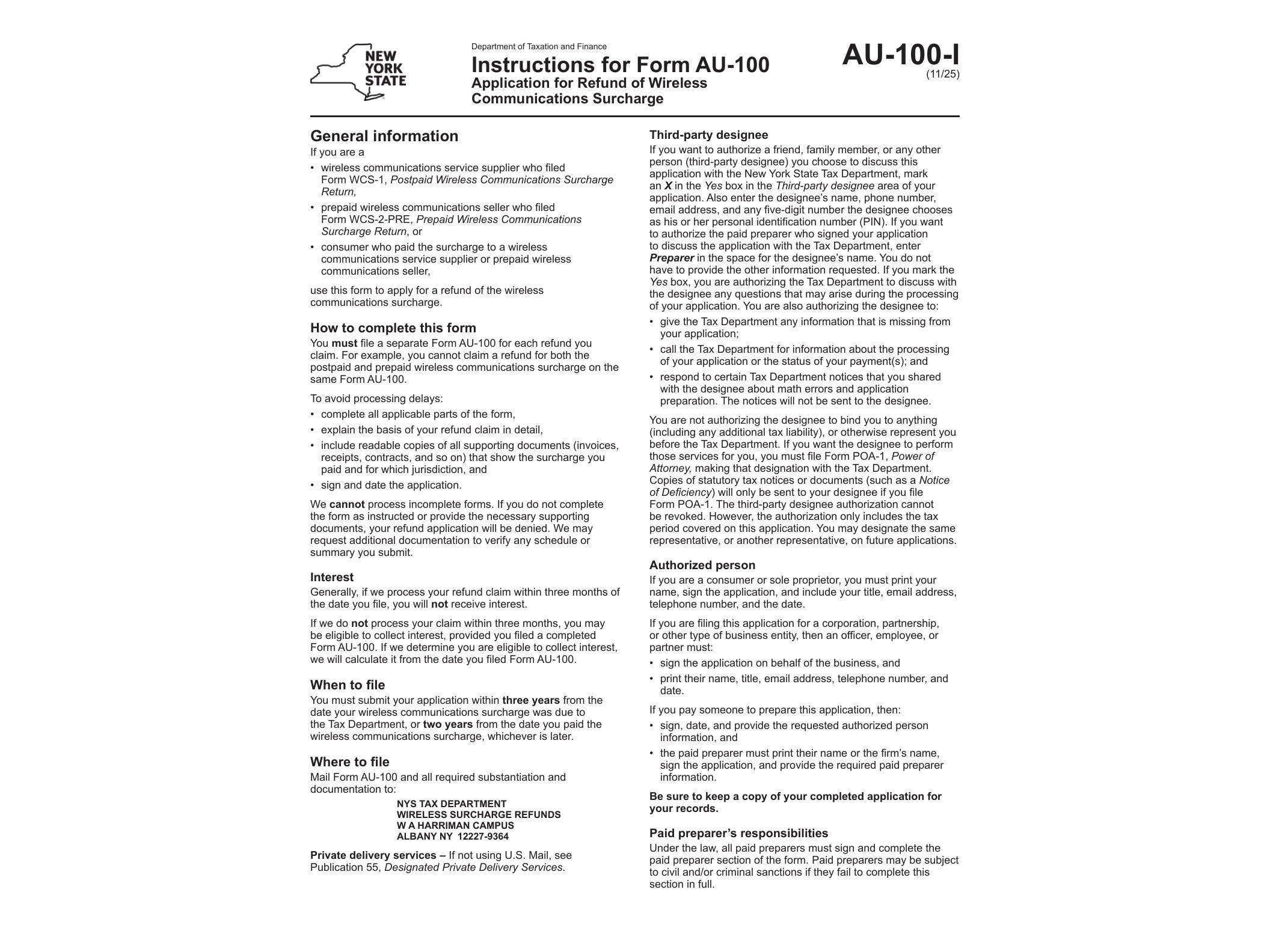
Form AU-100-I is the instruction sheet published by the New York State Department of Taxation and Finance to accompany Form AU-100, Application for Refund of Wireless Communications Surcharge. If you or your business paid this surcharge on wireless phone service and believe you were overcharged, charged in error, or entitled to a refund for some other reason, this guidance walks you through exactly how to complete the application correctly the first time.
The wireless communications surcharge is a fee that New York imposes on wireless telephone service, collected by carriers and remitted to the state. Sometimes billing errors happen, a surcharge gets applied to an account that shouldn’t be charged, or a customer is billed twice. When that occurs, the Tax Department allows the affected party to request a refund directly using Form AU-100, and the AU-100-I instructions explain the supporting documentation, deadlines, and calculation methods needed to support that claim.
Who Needs This Form
This form is generally used by wireless service subscribers, businesses managing multiple wireless accounts, or in some cases carriers themselves, who need to correct an overpayment of the surcharge. If your business operates a fleet of company phones and discovers a billing discrepancy across several devices, or if you’re an individual consumer who was billed the surcharge in error after switching plans or canceling service, this is the pathway to recovering that money. Anyone submitting a claim needs to reference specific billing periods, the amount paid, and the reason a refund is warranted, all of which the instructions in AU-100-I clarify step by step.
It’s worth noting that this is a fairly specialized filing. Most everyday taxpayers won’t ever need it, but for businesses dealing with telecom accounts or accounting departments processing surcharge disputes, understanding this process avoids unnecessary back-and-forth with the department.
When to Use Form AU-100
You’d file Form AU-100 after identifying that a surcharge was billed incorrectly and after confirming with your carrier that the issue wasn’t already resolved at the billing level. The state generally expects you to have already attempted to address the discrepancy with your wireless provider before submitting a formal refund application. The AU-100-I instructions detail the required timeframe for filing, which is tied to when the surcharge was originally paid, so acting promptly once you spot the error matters.
Businesses that also deal with other New York tax refund applications may find some procedural similarities worth reviewing. For example, the process outlined in Form AU-11-I instructions for sales or use tax refunds follows a comparable logic of documentation and eligibility verification, even though it applies to a different tax type entirely.
How to Get and Complete the Form
Form AU-100-I is a print-and-fill document — there’s no digital fillable version, so you’ll need to download the PDF from the Department of Taxation and Finance’s website, print it, and complete it by hand. Once printed, follow the instructions carefully to gather the required attachments, which typically include copies of billing statements showing the surcharge charge, proof of payment, and any correspondence with your carrier about the disputed amount.
Since accuracy matters when submitting refund claims to any state tax authority, take your time filling in account numbers, billing periods, and surcharge amounts exactly as they appear on your statements. Mismatched figures are one of the most common reasons refund applications get delayed or rejected outright.
If your business handles multiple types of state tax filings, it can help to get familiar with related documentation structures. Businesses in the fuel or transportation sector, for instance, often deal with parallel paperwork such as Form FT-940 for motor fuel certification or bonding requirements described in Form AU-432 for motor fuel distributor bonds, both of which follow the same general principle of supporting a claim or registration with clear, verifiable records.
Once your AU-100 application is complete and all supporting documents are attached, mail it to the address specified in the AU-100-I instructions. Processing times can vary, so keep copies of everything you submit in case the department requests additional information or clarification about your claim.
Download Official Form AU100I (PDF)
Opens the official government PDF in a new tab