
Download Official Form IT182 (PDF)
Opens the official government PDF in a new tab
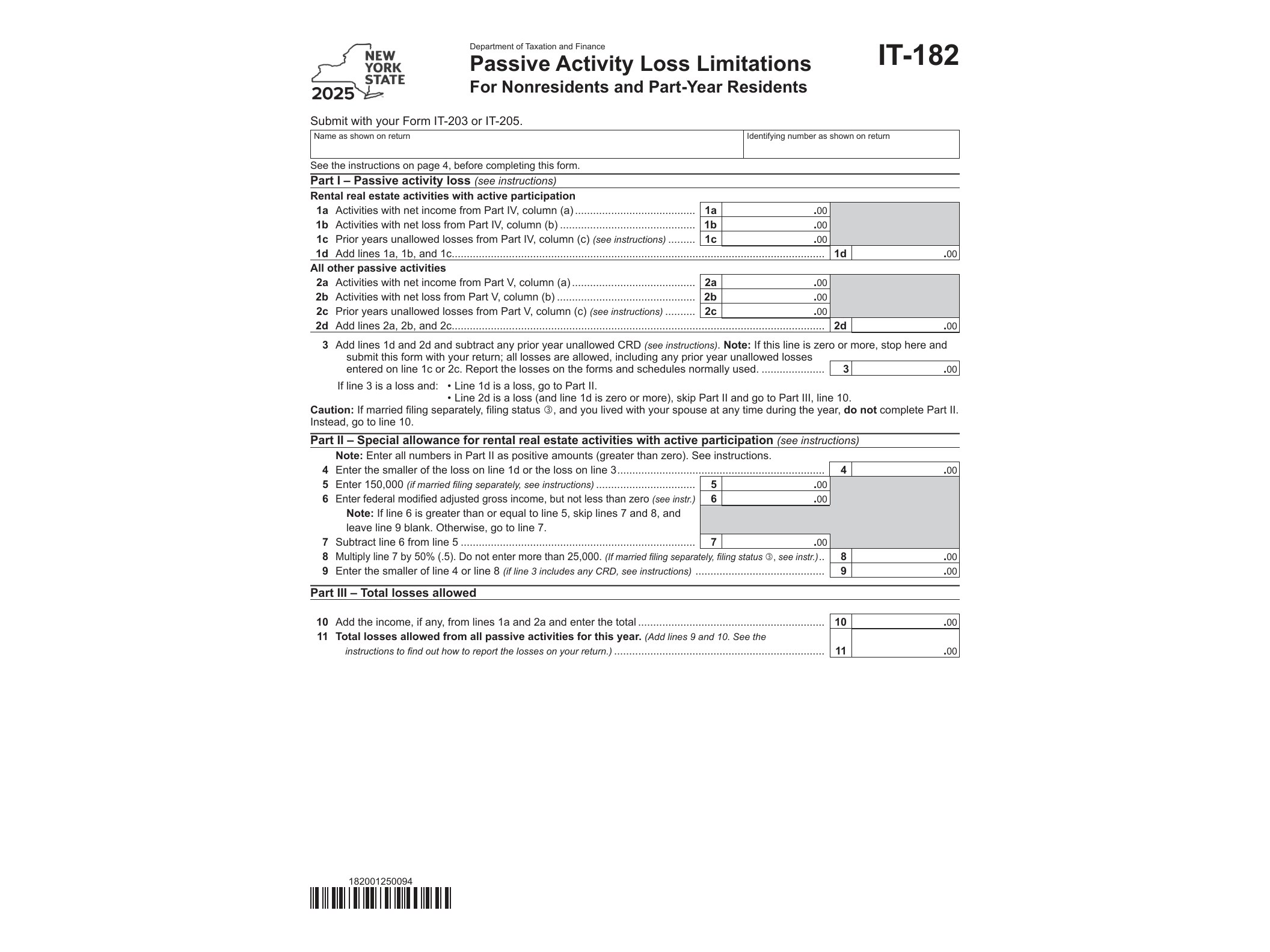
Form IT-182, Passive Activity Loss Limitations, is issued by the New York State Department of Taxation and Finance for taxpayers whose federal passive activity loss calculations don’t line up with their New York State tax return. If you’ve ever dealt with rental property losses, limited partnership interests, or any business activity where you don’t materially participate, this form is likely part of your filing picture.
The purpose of IT-182 is to reconcile the federal passive activity loss rules under IRC Section 469 with New York’s own adjustments. New York generally follows the federal passive loss limitation framework, but state-specific modifications, addback items, and differences in how certain deductions are treated mean the numbers on your federal Form 8582 don’t always transfer directly to your state return. IT-182 is where that reconciliation happens.
Who Needs to File IT-182
You need this form if you’re a New York State resident, nonresident, or part-year resident who reports passive activity losses on your federal return and those losses are subject to New York adjustments. This typically applies to:
- Taxpayers with rental real estate losses, especially those who don’t qualify as real estate professionals
- Limited partners or LLC members with losses from businesses they don’t actively manage
- Individuals carrying forward passive losses from prior tax years
- Fiduciaries and estates dealing with passive activity income or loss allocations
If your federal return already includes Form 8582 (Passive Activity Loss Limitations), there’s a strong chance you’ll need IT-182 to properly reflect those figures on your New York filing. The state form asks you to identify each passive activity, show the federal loss allowed, and then apply any New York-specific modifications before arriving at the amount you can actually claim on your state return.
When to Use This Form
IT-182 is filed alongside your annual New York State income tax return, not separately. For tax year 2025, it accompanies whichever base form applies to your filing status — typically Form IT-201 for residents or IT-203 for nonresidents and part-year residents. You don’t submit IT-182 on its own; it’s a supporting schedule that documents how you arrived at the passive loss figures reported elsewhere on your return.
Timing matters here because passive losses that are disallowed in one year can often be carried forward. If you have suspended losses from a prior year, IT-182 helps track and apply those correctly for 2025, ensuring you don’t lose the benefit of losses you were unable to deduct previously due to passive activity limitations.
How to Get and Complete the Form
The form is available directly from the New York State Department of Taxation and Finance as a fillable PDF, which means you can type your entries directly into the document using Adobe Acrobat Reader or a similar PDF viewer rather than filling it out by hand. This reduces errors and makes the entries easier to read when the return is processed.
When completing IT-182, have your federal Form 8582 on hand, since much of the state form mirrors the structure of the federal calculation. You’ll list each passive activity separately, note the federal amounts, and then apply New York’s adjustment columns. If you’re unsure how New York’s rules differ from federal treatment for a specific type of activity, the instructions packaged with the form walk through common scenarios, including real estate rentals and publicly traded partnerships.
Taxpayers juggling multiple state forms in the same filing season sometimes also need to handle refund allocations, similar to what’s covered in our guide to Form IT-195 for allocation of refunds. And if a reasonable cause issue comes up with a prior claim, it’s worth reviewing how other states approach similar situations, such as the FTB Form 2917 reasonable cause claim process in California, since the underlying documentation principles are comparable even across different tax agencies.
Once completed, keep a copy of IT-182 with your tax records for at least three years, since passive loss carryforwards may need to be referenced again in future filings if losses remain suspended.
Download Official Form IT182 (PDF)
Opens the official government PDF in a new tab