
Download Official Form IT260I (PDF)
Opens the official government PDF in a new tab
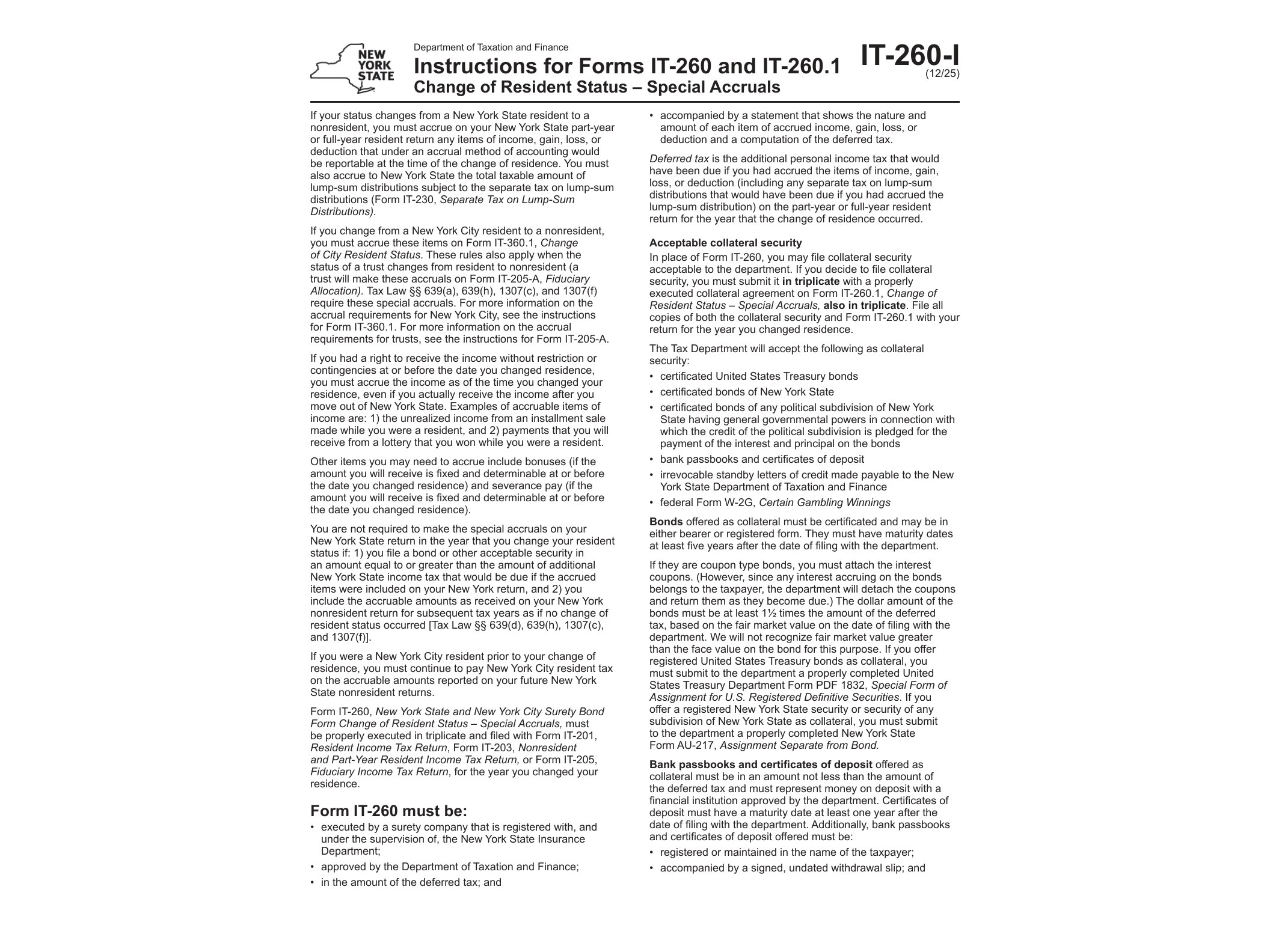
Form IT-260-I is the instruction booklet that accompanies Form IT-260 and Form IT-260.1, both tied to a fairly specific situation in New York State tax law: what happens to certain income and deduction items when a taxpayer changes their residency status during the year. The New York State Department of Taxation and Finance issues this guidance to help filers understand “special accruals” — a concept most people never encounter unless they’ve moved into or out of New York State and use the cash basis method of accounting.
The core idea behind special accruals is that New York wants to make sure income earned while you were a resident gets taxed as resident income, even if you wouldn’t have normally reported it until later under your regular accounting method. The same logic applies to certain deductions. Without this rule, someone could time their move in a way that shifts taxable income out of New York’s reach, or claim deductions twice (once as a resident, once as a nonresident). Forms IT-260 and IT-260.1 exist to prevent that kind of mismatch.
Who Needs This Form
This isn’t a form for the average filer. It applies specifically to taxpayers who:
- Changed their New York resident status during the tax year (moved into New York and became a resident, or moved out and became a nonresident)
- Use the cash method of accounting
- Have income or deduction items that would otherwise be accrued or deferred under normal reporting rules — things like installment sale proceeds, deferred compensation, or accrued but unpaid expenses
If your move happened cleanly at the start or end of a calendar year with no lingering income items tied to your prior residency period, you likely won’t need these forms at all. But if you have income streams that straddle your change in status — say, a bonus that vested while you were a resident but gets paid out after you left the state — this is exactly the scenario Form IT-260 is built to address.
When These Forms Come Into Play
Form IT-260 and IT-260.1 are filed alongside your regular New York part-year resident income tax return for the year in which your status changed. The instructions in IT-260-I walk through how to identify items subject to special accrual, how to calculate the accrued amount, and how to report it correctly so you’re not double-taxed or under-taxed relative to your actual New York-source income during your resident period.
The distinction between IT-260 and IT-260.1 generally comes down to direction of the move — one form applies when you’re accounting for accruals related to becoming a resident, and the other applies when you’re leaving resident status. The instruction booklet clarifies which form applies to your specific circumstances and walks through the calculation line by line.
How to Get and Complete the Form
Form IT-260-I, along with the underlying forms IT-260 and IT-260.1, is available directly from the New York State Department of Taxation and Finance as a PDF. None of these forms are digitally fillable — you’ll need to print them out and complete them by hand before attaching them to your paper or electronically filed return package, depending on how your tax software or preparer handles supplemental schedules.
Because special accrual calculations can get complicated fast, especially if you have multiple income sources with different accrual timing, it’s worth reading through the full instruction set before you start filling anything in. Many filers dealing with this issue also end up cross-referencing other New York specialty credit and deduction instructions during the same filing season — for instance, taxpayers with lump-sum distributions often need to consult the instructions for Form IT-230 in the same year they’re dealing with a residency change. If you’re also claiming a state-specific credit, such as the Rehabilitation of Historic Properties Credit or the Empire State Film Production Credit, those instructions are separate but often get filed in the same return package as your accrual forms.
Given how narrow and technical this filing situation is, many people who need Form IT-260 or IT-260.1 choose to work with a tax professional familiar with New York part-year resident rules, particularly if the dollar amounts involved are significant. The instructions are thorough, but the underlying calculations require careful tracking of exactly when income was earned versus when it was received.
Download Official Form IT260I (PDF)
Opens the official government PDF in a new tab