
Download Official Form 2335 (PDF)
Opens the official government PDF in a new tab
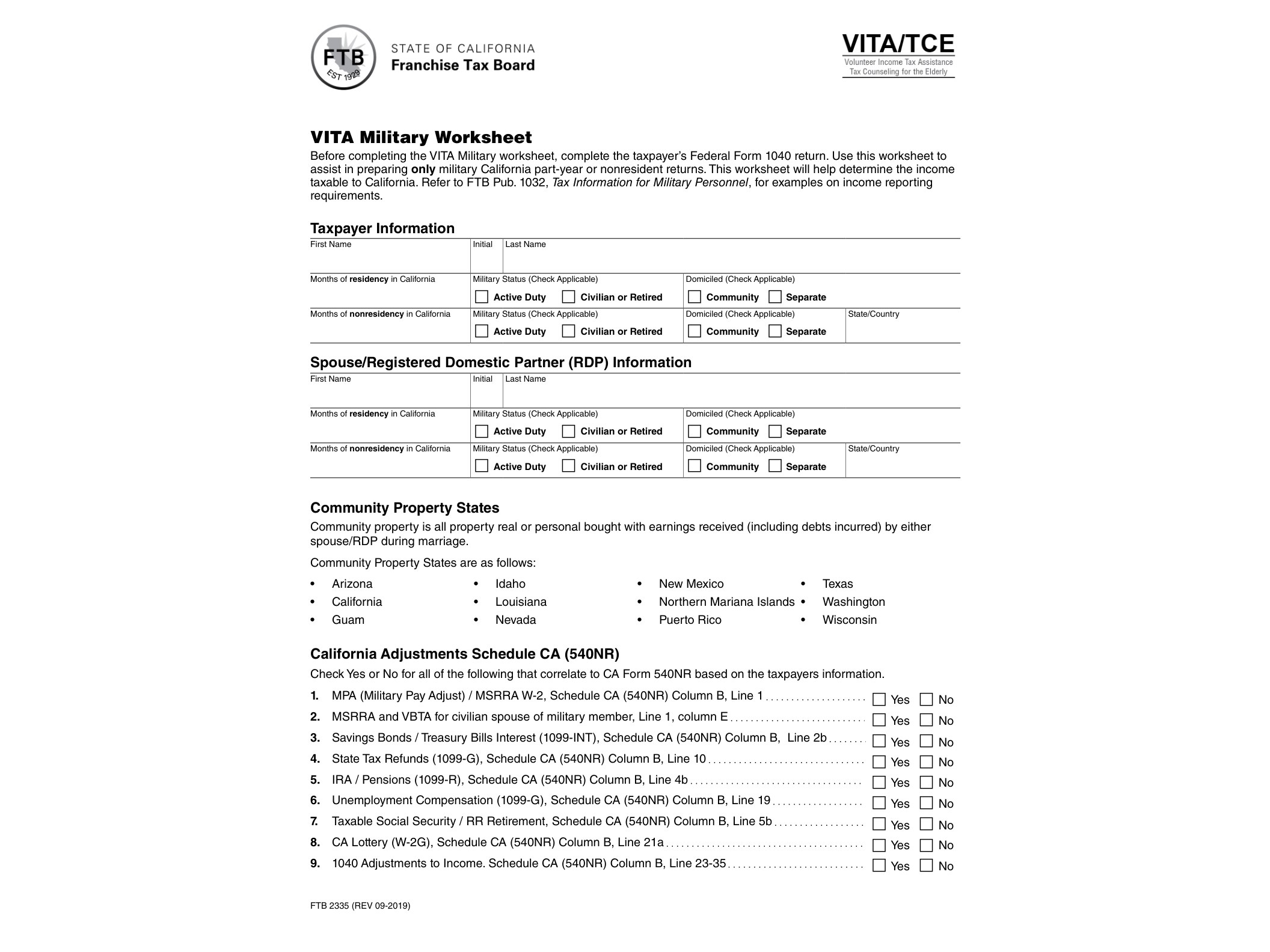
FTB Form 2335 is a worksheet used by Volunteer Income Tax Assistance (VITA) preparers and military personnel to determine California state filing requirements and residency status for active duty service members. Issued by the California Franchise Tax Board, this document isn’t a standalone tax return you submit on its own — it’s a working tool that helps identify whether military pay, spousal income, and other earnings are taxable by California under the state’s specific rules for service members.
Military tax situations get complicated fast. A service member stationed in California but domiciled in Texas doesn’t owe California tax on military wages, but might owe tax on other income earned in-state. A military spouse covered by the Servicemembers Civil Relief Act (SCRA) and its later amendments may also be exempt from California tax on wages, even if living in the state temporarily due to orders. The FTB 2335 worksheet walks through these scenarios methodically, asking about domicile state, PCS orders, spousal employment, and the type of income received during the tax year.
Who Needs This Worksheet
This form is primarily used by VITA volunteers and military tax assistance centers when preparing California returns for active duty personnel, National Guard members, and military spouses. If you’re a service member stationed in California with a different state of legal residence, or a military spouse whose income might qualify for SCRA protections, this worksheet helps your preparer figure out exactly what needs to be reported on your California return — and what can be excluded.
It’s also useful for self-preparers who want to understand their own filing obligations before sitting down with a volunteer preparer or tax software. Working through the questions on Form 2335 ahead of time can save significant back-and-forth during an appointment, especially during the busy tax season when VITA sites are handling high volumes of returns.
When the Worksheet Applies
You’ll typically use FTB 2335 when:
- You’re active duty military domiciled outside California but stationed there under orders
- Your spouse is a military spouse whose income may be exempt under federal law
- You need to determine whether non-military income earned in California is taxable
- You’re unsure whether you qualify as a California resident, nonresident, or part-year resident for state tax purposes
The worksheet doesn’t replace your actual California tax return — forms like the 540NR for nonresidents or part-year residents — but it feeds directly into how those forms get completed. Getting the residency determination wrong can lead to overpaying state tax or, conversely, underreporting income that is genuinely taxable in California, so the worksheet exists to reduce that risk.
How to Get and Complete Form 2335
The form is available as a fillable PDF directly from the Franchise Tax Board’s website, and it supports digital entry, meaning you can type responses directly into the form fields before printing or saving a copy for your records. There’s no complicated registration process — anyone can access and complete it.
When filling it out, have your military orders (particularly your Leave and Earnings Statement and PCS orders), your state of legal residence documentation, and any W-2s or 1099s for both spouses on hand. The worksheet will ask you to categorize each income source and apply the relevant exclusion rules. If you’re working with a VITA volunteer, they’ll typically walk through this with you as part of the intake process rather than having you complete it entirely on your own.
Keep in mind this worksheet is specific to California’s treatment of military income and doesn’t address federal tax obligations, which follow separate rules under the Servicemembers Civil Relief Act. If you also have other state tax matters — for instance, sales tax reporting obligations similar to what’s covered in New York’s Form IT-135 — those would need to be handled through entirely separate filings in the relevant state.
Once you’ve completed the worksheet and determined your California filing status, you’ll use that information to prepare your actual state return. If a penalty or accuracy issue comes up later, taxpayers sometimes need to file a reasonable cause claim, similar to the process described in FTB Form 2917. And if your California income situation involves passive activities or losses carried from federal returns, it may be worth comparing how other states handle similar issues, such as in New York’s IT-182 form for passive activity loss limitations.
The FTB 2335 worksheet itself doesn’t get filed with the state — it stays with your records or your preparer’s file as documentation supporting how your California return was completed.
Download Official Form 2335 (PDF)
Opens the official government PDF in a new tab