
Download Official Form IT203B (PDF)
Opens the official government PDF in a new tab
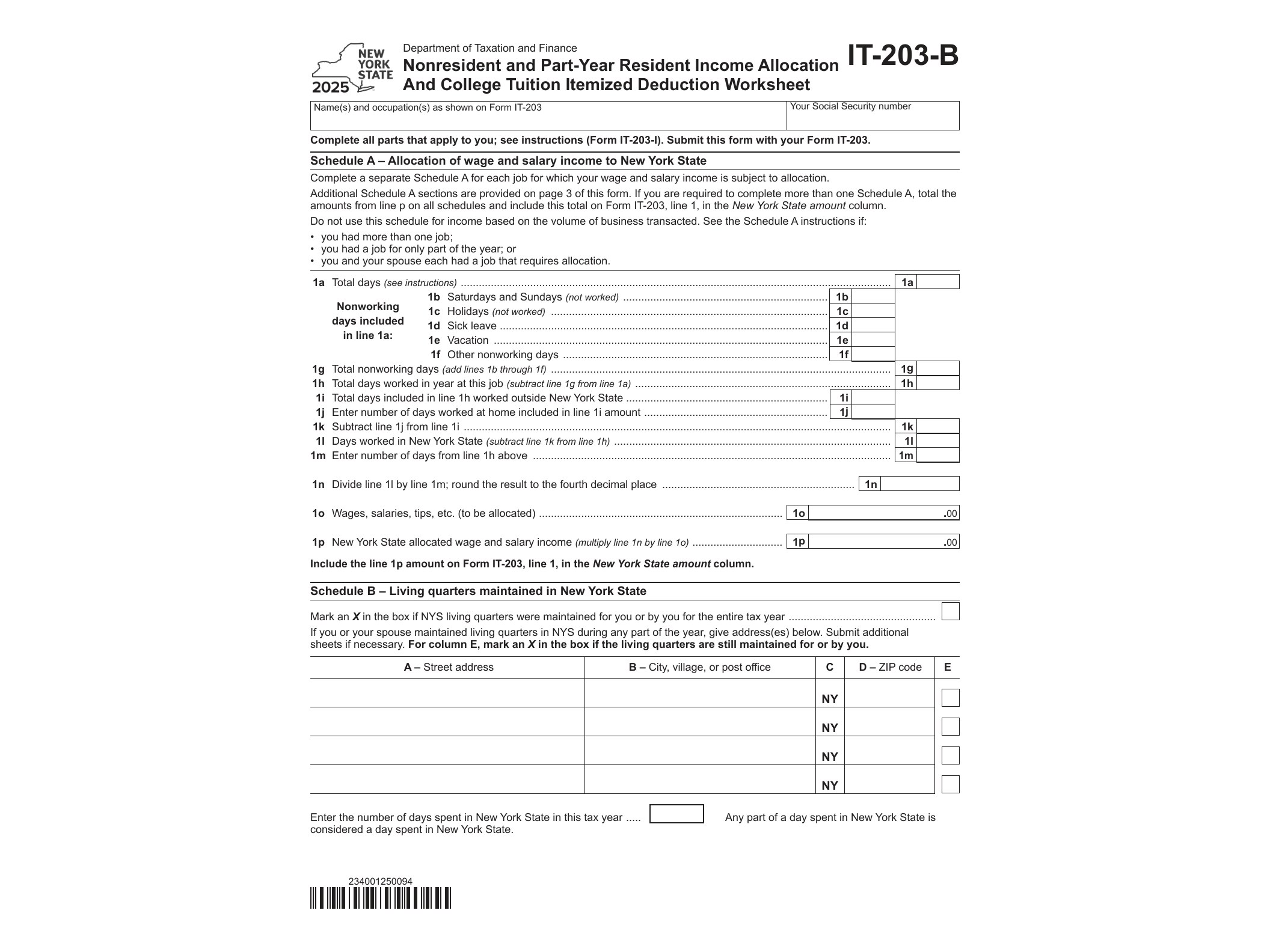
Form IT-203-B is a supporting schedule filed alongside Form IT-203, the New York State nonresident and part-year resident income tax return. Its purpose is twofold: it helps you allocate income earned both inside and outside New York State during the tax year, and it walks you through the college tuition itemized deduction worksheet if you or a dependent paid qualified tuition expenses. The New York State Department of Taxation and Finance issues this form for tax year 2025, and it comes as a fillable AcroForm PDF, so you can type your figures directly into the document before printing or saving it.
If you lived in New York for only part of the year, or if you earned income from New York sources while living elsewhere, the state doesn’t tax all of your income the same way a full-year resident would be taxed. Instead, New York wants to know exactly what portion of your wages, self-employment income, or other earnings is connected to New York activity. Form IT-203-B is where that calculation happens. It breaks down your income by category — wages, business income, rental income, and so on — and asks you to separate the New York-source amount from the total amount reported on your federal return.
This form is necessary for anyone filing Form IT-203 who had income from multiple states during the year, whether because they moved into or out of New York, worked remotely for a New York employer while living elsewhere, or held a job that required travel across state lines. Freelancers and consultants who performed some work in New York and some outside the state often need this schedule too, since their income doesn’t come from a single, easily traceable paycheck.
The second part of Form IT-203-B covers the college tuition itemized deduction. New York allows taxpayers to deduct qualified higher education expenses paid for themselves, a spouse, or a dependent, as long as the expenses meet the state’s eligibility rules. This section walks through the calculation step by step: you enter the tuition paid, subtract any scholarships or tax-free educational assistance, and arrive at the deductible amount that flows back into your IT-203 filing. Taxpayers sometimes confuse this deduction with the federal education credits, but New York’s rules are separate and require this specific worksheet to claim the benefit correctly.
Filling out Form IT-203-B requires having your federal return finished first, since many of the entries reference figures already reported to the IRS. You’ll also want documentation showing which income was earned in New York versus elsewhere — pay stubs noting work location, employer allocation statements, or your own records if you’re self-employed and tracking days worked in different states. For the tuition section, keep your 1098-T forms or tuition statements handy, along with records of any scholarships or grants that reduced your out-of-pocket costs.
Because the form is a fillable PDF, you can complete it on your computer using free PDF reader software, then print the finished pages to attach to your paper return, or save the completed file if you’re preparing your return through tax software that accepts imported PDF data. There’s no separate mailing address for IT-203-B alone — it gets submitted together with your full IT-203 packet.
Nonresidents dealing with more complex financial situations often need to file several supporting schedules alongside their main return. If you had significant untaxed purchases during the year, you might also need Form IT-135 for sales and use tax reporting. Taxpayers with rental properties or business interests generating losses should also check whether Form IT-182 for passive activity loss limitations applies to their situation. And if your household includes military service members navigating multi-state tax questions, the VITA Military Worksheet guide covers related allocation concepts that can clarify how income splits work across jurisdictions.
Getting the income allocation right on Form IT-203-B matters because it directly affects how much New York tax you actually owe. Splitting income incorrectly, whether by overestimating or underestimating the New York-source portion, can lead to an inaccurate refund or an unexpected balance due, and potentially trigger a notice from the Department of Taxation and Finance asking for clarification.
Download Official Form IT203B (PDF)
Opens the official government PDF in a new tab