
Download Official Form RP520 (PDF)
Opens the official government PDF in a new tab
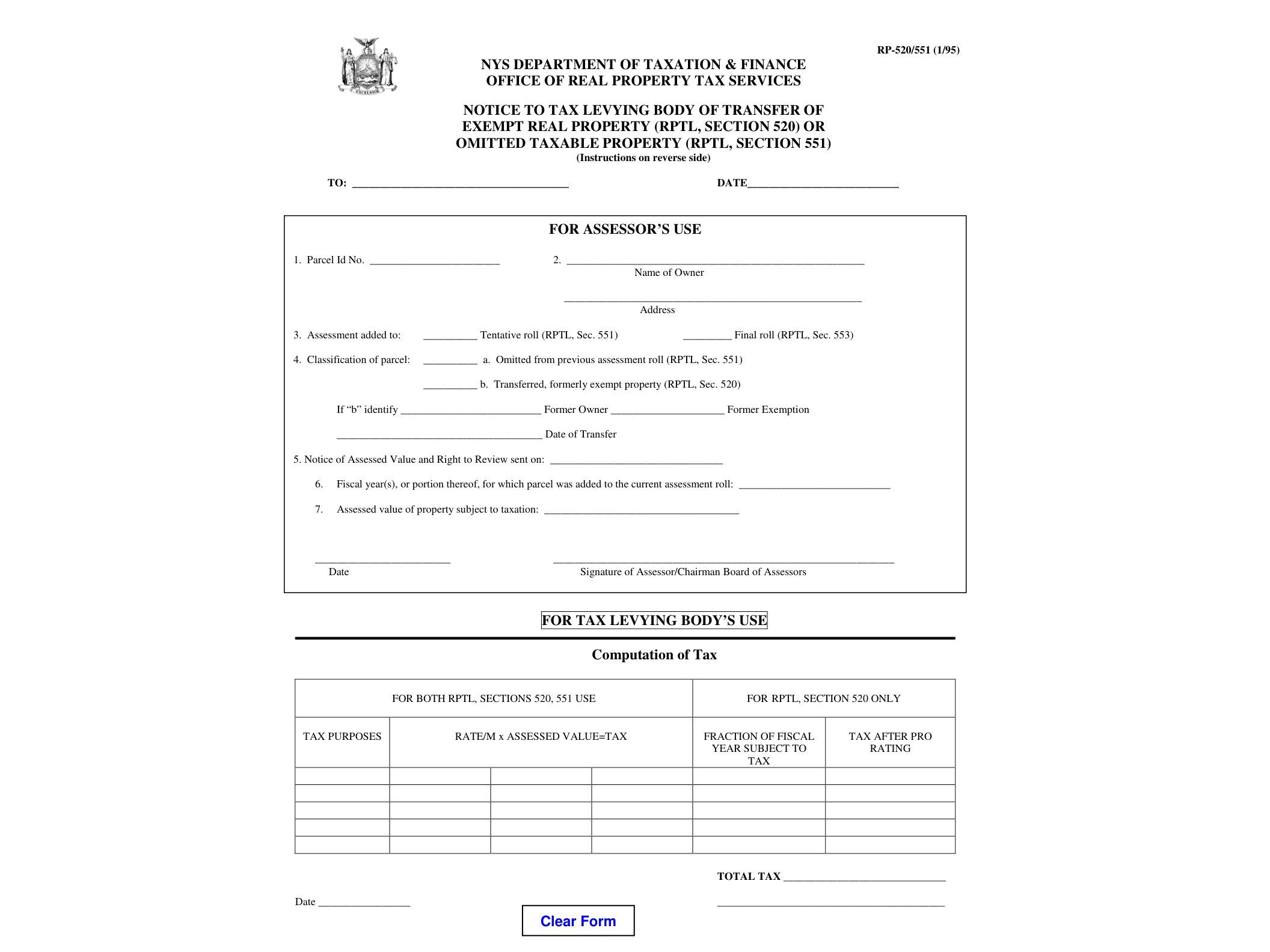
Form RP-520/551 is a notification form used in New York State whenever a piece of real property changes tax status in a way that affects local tax rolls outside the normal assessment cycle. Issued by the New York State Department of Taxation and Finance, this form serves two related but distinct purposes under the Real Property Tax Law (RPTL): notifying a tax levying body when previously exempt property is transferred (Section 520), or when taxable property was mistakenly omitted from the assessment roll (Section 551).
Assessors don’t just fill out this form for fun — it exists because tax levying bodies (school districts, counties, towns, villages) need to know when property that was generating no tax revenue suddenly becomes taxable, or vice versa. Without this notice, a levying body could miscalculate its tax base and either overtax or undertax residents in the affected jurisdiction.
Who Needs to File Form RP-520/551
This form is completed by the local assessor, not by property owners directly. That said, property owners, buyers, and real estate attorneys involved in transactions with formerly exempt property should understand this form because it directly affects when and how a parcel starts appearing on the tax rolls.
Typical situations that trigger this form include:
- A nonprofit organization sells a previously tax-exempt building to a for-profit buyer
- A government-owned parcel is sold or transferred to a private party
- An assessor discovers that a taxable parcel was left off the assessment roll in error
- A property that lost its exempt status (similar to what happens with a renounced exemption, as covered in our guide on Form RP-496-W and repayment calculations) needs to be reflected in future tax billing
In each of these cases, the assessor is required to notify every tax levying body with jurisdiction over the parcel — this can include the county, town, village, and school district, since each one levies its own portion of the tax bill.
When This Form Is Used
Form RP-520/551 isn’t filed on a fixed annual schedule like a standard exemption renewal. It’s filed as-needed, whenever a qualifying transfer or omission is identified. Because exempt-to-taxable transitions can happen at any point during the year, this form allows assessors to correct the record promptly rather than waiting for the next full assessment roll to catch up. That matters because delayed notice can mean a tax levying body loses out on revenue it was entitled to collect, or a new property owner gets hit with an unexpected retroactive tax bill.
The Section 551 portion of the form — covering omitted taxable property — is used less frequently but is just as important. If a parcel was inadvertently excluded from an assessment roll, the assessor uses this form to formally notify the levying bodies so the omission can be corrected and appropriate taxes assessed going forward.
How to Get and Complete the Form
Form RP-520/551 is available directly from the New York State Department of Taxation and Finance as a fillable PDF with AcroForm fields, meaning you can type information directly into the document using standard PDF software before printing or submitting it electronically, depending on the levying body’s preferred method of receipt.
When completing the form, the assessor will typically need to provide the property’s tax map identification number, the prior exempt status and the applicable RPTL section, the effective date of the transfer or the date the omission was discovered, and the assessed value affected by the change. Accuracy here matters, since this information flows directly into how much a jurisdiction can levy from that parcel going forward.
If you’re working through other property tax exemption paperwork in New York, it’s worth comparing this form to related filings like Form RP-5217-ACR, used by county directors to correct sale reporting errors, or Form RP-491-A, which deals with conservation easement exemptions. Each of these forms addresses a different piece of how New York tracks property tax status changes at the local level, and assessors often handle several of them together when a property’s status shifts.
Download Official Form RP520 (PDF)
Opens the official government PDF in a new tab