
Download Official Form RP5217AD (PDF)
Opens the official government PDF in a new tab
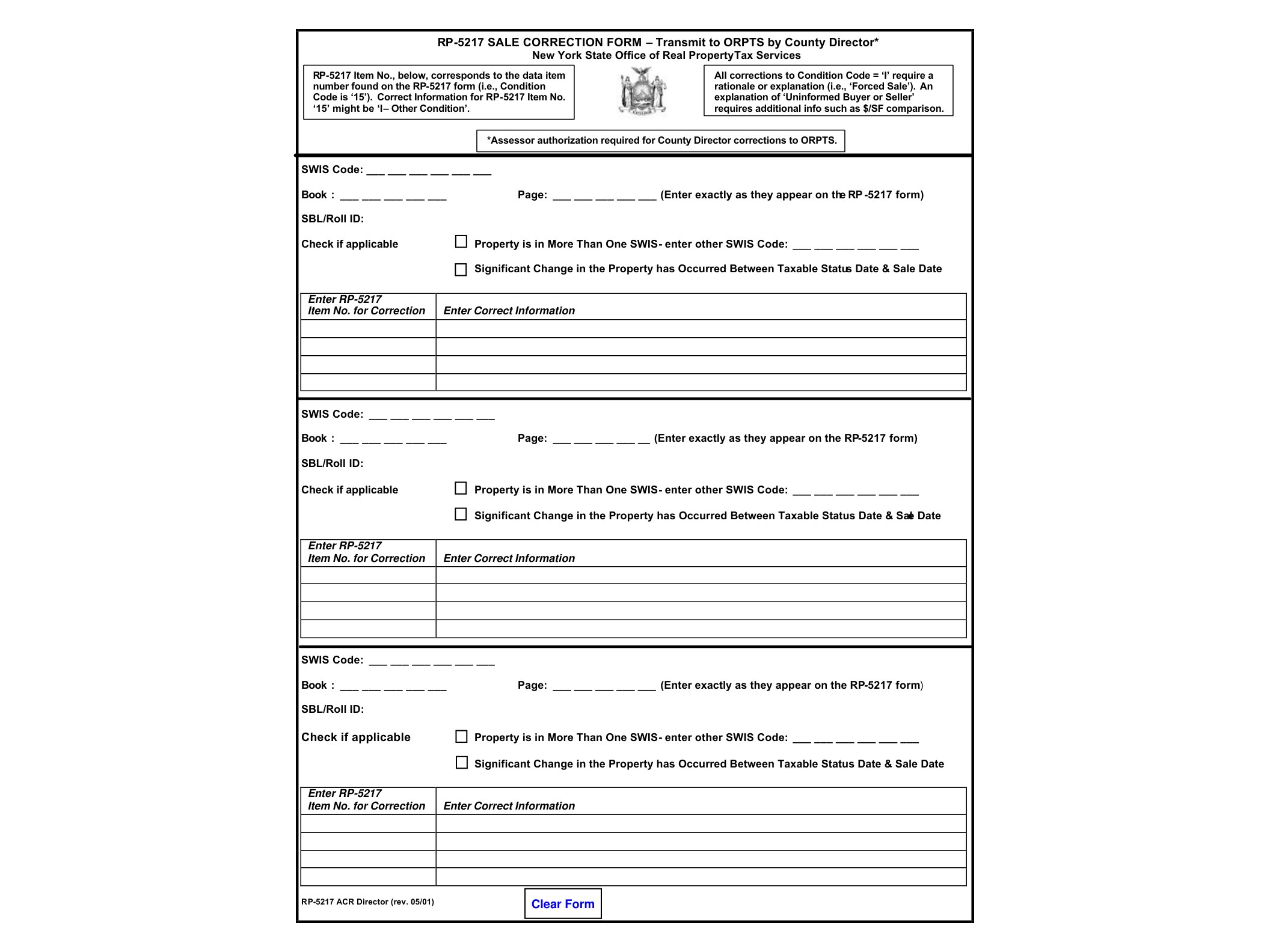
Form RP-5217-ACR-Director, officially titled RP-5217-ACR-Director:5/01: Sale Correction Form-County Director, is issued by the New York State Department of Taxation and Finance for a very specific purpose: fixing errors on a previously filed RP-5217 Real Property Transfer Report. When a deed transfer is recorded, the original RP-5217 captures sale price, parcel classification, and other transaction details that feed into the state’s equalization and assessment data. If something on that original report turns out to be wrong, this correction form is how the fix gets made official.
Unlike the standard transfer report, this form isn’t filed by the buyer, seller, or their attorney. It’s used by the county director of real property tax services (or their staff) to correct data already on file. That’s why the form carries the “Director” designation in its title. If you’re a homeowner or a title company representative, you generally won’t be the one submitting this paperwork yourself, but you may need to request that your county director file it on your behalf if you discover an error in a recorded transfer.
Who Actually Needs This Form
The people who work with RP-5217-ACR-Director day to day are county assessment office staff, county clerks who handle land records, and sometimes town assessors who spot discrepancies during equalization rate calculations. If a sale price was entered incorrectly, a property classification code was wrong, or basic parcel information didn’t match county tax maps, the director’s office uses this form to submit the correction to the state.
That said, everyday property owners and real estate professionals sometimes end up involved indirectly. If you’re refinancing, selling again, or dealing with an assessment challenge and notice that your original transfer report data looks off in the county’s system, contacting the county real property tax services office is the first step. They determine whether a correction is warranted and, if so, file this form.
When This Form Gets Used
Corrections typically surface in a few common scenarios: a data entry mistake made when the original RP-5217 was processed, a sale price that was reported inconsistently with the deed, or a classification error that affects how the property factors into equalization rates. Since equalization data influences tax burden distribution across a municipality, getting these numbers right matters beyond just one property’s tax bill — it can affect broader calculations similar to those addressed in tentative equalization rate appraisal objections for villages, where accurate underlying sale data is just as critical.
There’s no fixed deadline printed on the form itself, but corrections are generally filed as soon as the error is identified, since delays can ripple into assessment rolls, equalization studies, or state aid calculations tied to reported sale data.
How to Get and Complete the Form
The form is available directly from the New York State Department of Taxation and Finance as a fillable PDF with AcroForm fields, meaning it can be completed digitally before printing or submitting electronically to the state’s Office of Real Property Tax Services, depending on the county’s filing procedures. Because it’s an AcroForm, users don’t need special software beyond a standard PDF reader — text boxes and fields are built into the document itself.
Filling it out requires referencing the original RP-5217 filing, including the parcel’s SWIS code, the original transaction details, and a clear description of what’s being corrected. County director offices typically have their own internal checklist for supporting documentation, such as a copy of the deed or an amended settlement statement, to justify the correction before it’s submitted to the state.
If you’re dealing with related property tax paperwork, it’s worth knowing that other specialized forms exist for different situations — for example, Form RP-496-W handles repayment calculations when a property tax exemption is renounced, and Form RP-491-A covers conservation easement exemption applications in Bethlehem. None of these substitute for RP-5217-ACR-Director, but they show how New York’s property tax system relies on a network of narrowly scoped forms, each addressing one specific administrative need.
If you suspect an error on a recorded property transfer, the most efficient route is contacting your county’s real property tax services office directly rather than attempting to file the correction independently, since they maintain the official record and coordinate directly with the state on any adjustments.
Download Official Form RP5217AD (PDF)
Opens the official government PDF in a new tab